In 2016, a group of amateur sports fans using Unanimous AI's Swarm platform correctly predicted all four horses of the Kentucky Derby superfecta. A $20 bet placed through a legal sportsbook returned $11,000; the payout varies by race, pool size, and track odds, and Unanimous AI urges anyone seeking current wagering rules to consult the official Kentucky Derby website. The participants were not professional handicappers. They were connected in real time through a system modeled on bee colonies and bird flocks, and the system converged on a set of choices that no single person in the group would have made alone.
That prediction was not a one-off stunt. The same engine achieved 94 percent accuracy on the 2017 Academy Award winners. And in medical studies, groups of radiologists using the Swarm AI system improved their accuracy in diagnosing pneumonia from chest X-rays compared with the same radiologists working individually or as a traditional majority vote.
The mechanism behind these results is Artificial Swarm Intelligence (ASI), developed by Dr. Louis Rosenberg at Unanimous AI, a venture he founded in 2014. The firm continues to operate today as an ongoing concern, having transitioned from public prediction spectacles to enterprise applications in market research and clinical medicine. No acquisition or closure has occurred.

What is Artificial Swarm Intelligence and how does it differ from traditional AI and polling?
Artificial Swarm Intelligence is not another name for majority voting or averaging opinions. In a traditional poll, each person submits an independent answer and the most common response wins. In a typical machine learning system, a model trained on historical data produces a prediction. ASI does neither.
Unanimous AI's engine connects a group of human contributors into a real-time closed-loop system. Each person sees a graphical puck or cursor that they can move toward their preferred option. But the puck is also influenced by the movements of every other contributor. The software uses an algorithm modeled on the way bees in a hive or starlings in a flock reach collective decisions. No single individual controls the outcome. The group converges organically on a single choice, often one that no member would have selected on their own.
Rosenberg describes the result as amplified human intelligence, not replaced human intelligence. The contributors do not just vote. They negotiate in real time via their cursor movements, and the algorithm resolves the conflict into a decision that draws on the group's collective knowledge, bias, and intuition.
Who is Dr. Louis Rosenberg and what was his role in the development of both augmented reality and swarm AI?
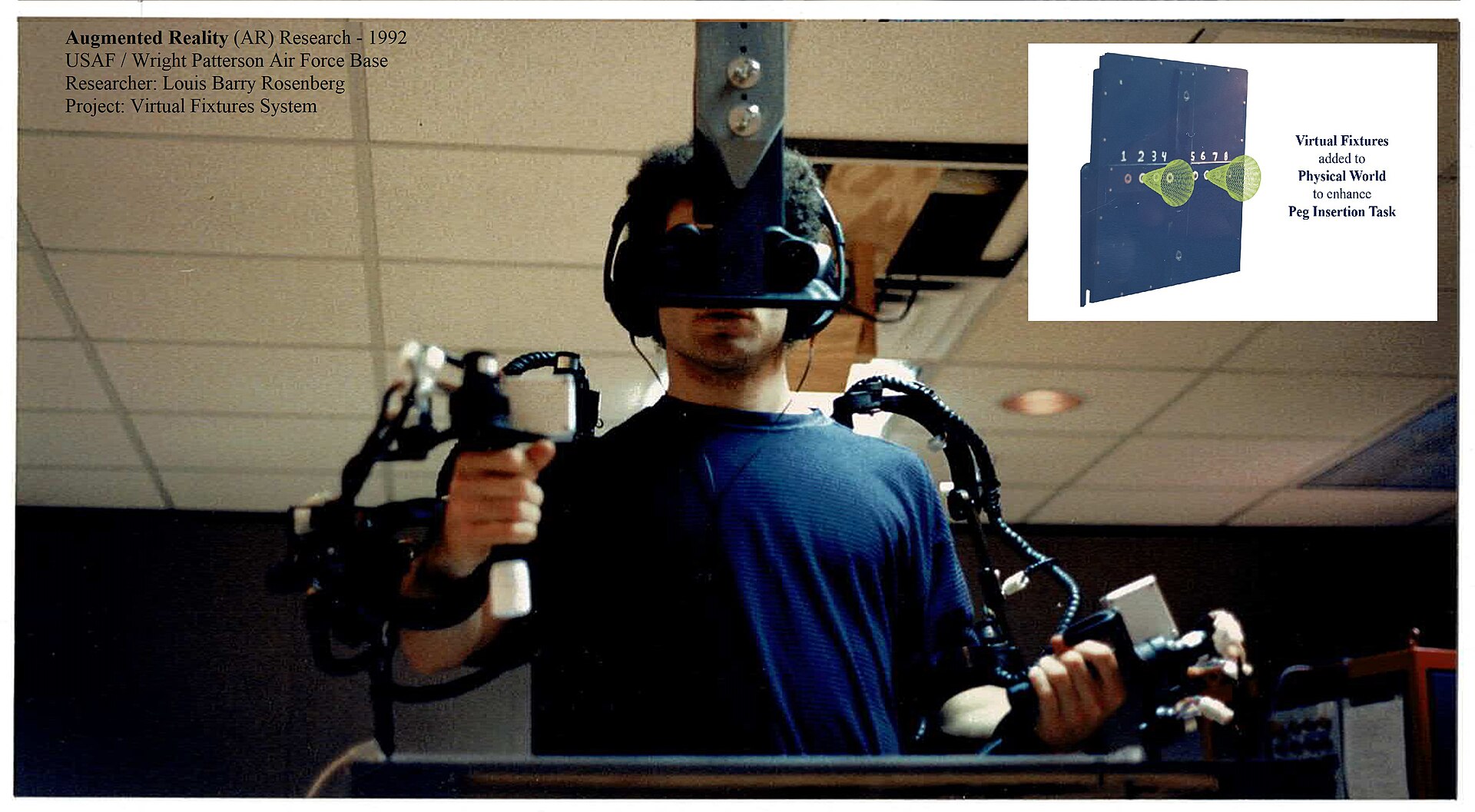
Dr. Louis Rosenberg is the CEO and Chief Scientist of Unanimous AI. Before founding the business, he developed the first functional mixed reality system at the U.S. Air Force's Armstrong Labs in the early 1990s. That system, called Virtual Fixtures, overlayed computer-generated graphics onto a real workspace to guide a user's physical movements. It is widely cited as a foundational advance in augmented reality.
Rosenberg holds a PhD from Stanford University. His doctorate and early career work focused on how humans interact with machines in real time, a thread that runs through both his AR work and his later swarm intelligence research. He has said in interviews that the shift from AR to swarm intelligence was not a pivot but a continuation. Both fields ask the same question: how do you combine human and machine capabilities into a system that performs better than either alone?
Unanimous AI was founded in 2014. The firm's core innovation, Swarm AI, draws directly on Rosenberg's understanding of real-time human-machine feedback loops, which he first developed building AR systems for the Air Force.
How does the Swarm platform operate in real time with human participants?
The session mechanics
A Swarm AI session works like this. A group of contributors, usually between 10 and 50 people, logs into the application. They see a question with two or more possible answers. Each person controls an on-screen puck, similar to a mouse cursor, and can push it toward the answer they favor.
But the puck is not independent. It responds to the aggregate force of every other puck in the system. If a contributor pushes left while the majority pushes right, the puck resists and tends to move right. The person can still resist, but only by applying continuous counter-pressure. Over the course of a few seconds or minutes, the group settles on a single answer. The software records the path and the time to convergence.
The biological algorithm
The algorithm is modeled on the way a bee colony selects a new hive location. Individual scout bees return to the swarm and perform a waggle dance that communicates the quality and distance of a site. Other bees feel the dance and begin to advocate for the same site. The colony does not vote. It physically converges on a decision. Unanimous AI's software replicates that physical convergence using cursor movements and force feedback.
The result is a decision that draws on the group's collective intelligence but does not require any individual to articulate or defend their reasoning. The system extracts the group's implicit knowledge via real-time interaction rather than via discussion or written argument.
What biological principles inspired the technology?
How bees decide without voting
The core insight that Unanimous AI exploits is that biological swarms do not make decisions by counting votes. A hive of bees selecting a new nest site does not hold a show of hands. Individual bees advocate for a location by dancing. Other bees feel the dance and join it. The colony reaches a consensus via a process of positive feedback and mutual reinforcement. No bee knows the preferences of every other bee, but the colony as a whole converges on the best available site.
Flocking and schooling as local coordination
Bird flocks and fish schools use similar mechanisms. A flock of starlings turns as a single entity because each bird adjusts its position relative to its immediate neighbors, not because a leader gives a command. The collective behavior emerges from local interactions.
Translating nature into software
Unanimous AI's Swarm engine is an attempt to replicate that emergent decision-making in human groups. The contributors are not told to mimic bees or birds. The software's interface and algorithm nudge them into a similar pattern of real-time mutual influence. The cursor movements replace the waggle dance. The force feedback replaces the physical sensation of being pulled toward a consensus. The result is a human group that behaves like a biological swarm, reaching decisions faster and more accurately than the same group would via discussion or voting.
What notable predictions did Swarm AI accomplish in sports and entertainment forecasting?
The Kentucky Derby superfecta
The most famous demonstration of Swarm AI's prediction capability came in 2016, when a group of amateur sports fans using the engine correctly picked all four horses in the Kentucky Derby superfecta. The superfecta requires the bettor to name the first four finishers in exact order. Odds of a correct pick by chance are extremely low. The group's $20 bet, placed through a legal sportsbook, returned $11,000; the actual payout depends on the pari-mutuel pool and official track odds published by Churchill Downs.
Oscars accuracy
In 2017, the same engine predicted the Academy Award winners with 94 percent accuracy. The group was drawn from the general public, not from film critics or industry insiders. The Swarm AI system outperformed individual expert predictions and traditional crowd polling on the same set of categories.
From proof-of-concept to product
These results were published by Unanimous AI as proof of concept. The firm has since moved away from public prediction stunts and toward enterprise applications. But the early demonstrations served to establish that the approach could extract accurate forecasts from groups of non-experts, as long as those groups were connected in real time through the swarm mechanism rather than polled independently.
How has the technology been applied in medical diagnostics?
Pneumonia detection study
Beyond sports and entertainment, Unanimous AI has tested its engine in clinical settings. In one study, groups of radiologists used the Swarm AI system to diagnose pneumonia from chest X-rays. The same radiologists also reviewed the images individually and as a traditional majority vote. The swarm-connected groups showed improved accuracy compared with either of the other two methods.
Why swarms catch borderline cases
The mechanism is the same as in the Derby and Oscars predictions. The radiologists did not discuss the cases. They moved their cursors in real time, and the system converged on a diagnosis that reflected the group's collective judgment. The improvement was most pronounced for borderline cases, where individual radiologists were uncertain and the swarm was able to pull the group toward the correct answer.
Expanding into market research
Unanimous AI has also explored applications in market research and business forecasting. The firm's current focus, as of early 2025, is on what Rosenberg calls Conversational Swarm Intelligence, which combines large human groups with AI agents to produce decisions that neither humans nor algorithms could reach alone. Clinical medicine and market research are the primary sectors targeted.

How did the company transition from spectacle to enterprise?
Why the public stunts mattered
Unanimous AI's early public predictions generated media attention and inbound links from publications covering AI and the future of work. That attention helped establish credibility for an approach that could sound implausible on paper. But the business did not build a revenue model around betting on horses or movies. The Kentucky Derby and Oscars predictions were demonstrations, not products.
Repackaging the engine for buyers
By 2020, Unanimous AI had shifted its commercial focus to enterprise decision-making. The engine was repackaged as a tool for market research firms wanting to test consumer reactions, for organizations wanting to forecast product demand, and for medical institutions wanting to improve diagnostic accuracy. The underlying mechanism did not change. What changed was the customer base and the sales pitch. Instead of selling predictions, the firm sold a method for amplifying group expertise.
Rosenberg's ongoing role
Dr. Rosenberg has remained the public face of the venture, giving talks and publishing on the concept of conversational swarm intelligence. The organization continues to operate as an independent concern. No acquisition or closure has been announced.
Where does the technology go next?
Conversational Swarm Intelligence
As of March 2025, Unanimous AI is pursuing a direction that Rosenberg calls Conversational Swarm Intelligence. The idea extends the original Swarm AI concept to include not just human contributors but also AI agents that can hold their own in the real-time feedback loop. The goal is a hybrid swarm of people and algorithms that converges on decisions that neither could produce alone.
Use cases on the horizon
That approach has direct applications in market research, where a swarm of consumers and AI personas might predict product adoption more accurately than a survey. In clinical medicine, a swarm of doctors and diagnostic algorithms might catch borderline cases that either would miss on their own. The firm has not disclosed specific partnerships or customers, citing active nondisclosure agreements.
Amplification, not replacement
The approach has not been acquired by a larger firm, nor has it been abandoned. Unanimous AI remains a private organization, and Rosenberg continues to advocate for the view that human intelligence is not something to be replaced by machines but something to be amplified by connecting humans to each other in real time via interfaces modeled on the natural world.
Key facts about Unanimous AI and Dr. Louis Rosenberg
- Founded: 2014 by Dr. Louis Rosenberg
- Core technology: Artificial Swarm Intelligence (ASI) via the Swarm AI platform
- Biological inspiration: Bee colonies, bird flocks, fish schools
- Notable prediction (2016): Kentucky Derby superfecta: all four horses correct; $20 bet returned $11,000 through a legal sportsbook (payout set by Churchill Downs pari-mutuel pool)
- Notable prediction (2017): Academy Award winners with 94 percent accuracy
- Medical application: Improved pneumonia diagnosis from chest X-rays in swarm-connected radiologist groups
- Dr. Rosenberg's background: Developed first functional mixed reality system at U.S. Air Force Armstrong Labs (early 1990s); PhD from Stanford University
- Current status: Ongoing independent venture; no acquisition or closure; focus on Conversational Swarm Intelligence for market research and clinical medicine
Comparison: Swarm AI vs. Traditional Polling vs. Individual Expert
| Method | Decision mechanism | Real-time feedback | Typical accuracy on known tests | Requires expert participants |
|---|---|---|---|---|
| Swarm AI (Unanimous AI) | Real-time cursor negotiation with force feedback | Yes | 94% (Oscars 2017); outperformed individual and majority vote in medical studies | No (amateurs outperformed experts in Derby prediction) |
| Traditional polling / majority vote | Independent responses counted and aggregated | No | Lower than swarm on same tasks in published studies | No |
| Individual expert judgment | Single person's analysis | No | Lower than swarm on same tasks in published studies | Yes |
Frequently asked questions about Unanimous AI and Swarm Intelligence
Is Unanimous AI still in business?
Yes. As of March 2025, the organization continues to operate as an independent venture. No acquisition or closure has occurred.
Does Swarm AI predict the future?
The engine does not claim to predict the future. It aggregates the real-time judgment of a group, which can produce accurate forecasts when the group has relevant knowledge. The Kentucky Derby and Oscars predictions were demonstrations of that capability, not a guarantee of future performance.
How is Swarm AI different from a prediction market?
Prediction markets let traders exchange contracts whose price reflects probability. Swarm AI uses real-time cursor movement and force feedback to converge on a single decision, without prices or trading. The mechanism is modeled on biological swarm behavior, not on financial markets.
Who uses Swarm AI today?
Unanimous AI has not disclosed specific clients or partners under active NDA. The firm's stated focus areas are market research and clinical medicine.
\nRelated reading: Alphabet Q3 net income $19.7B, up 41.5% and How AI and Automation Will Create New Professions.