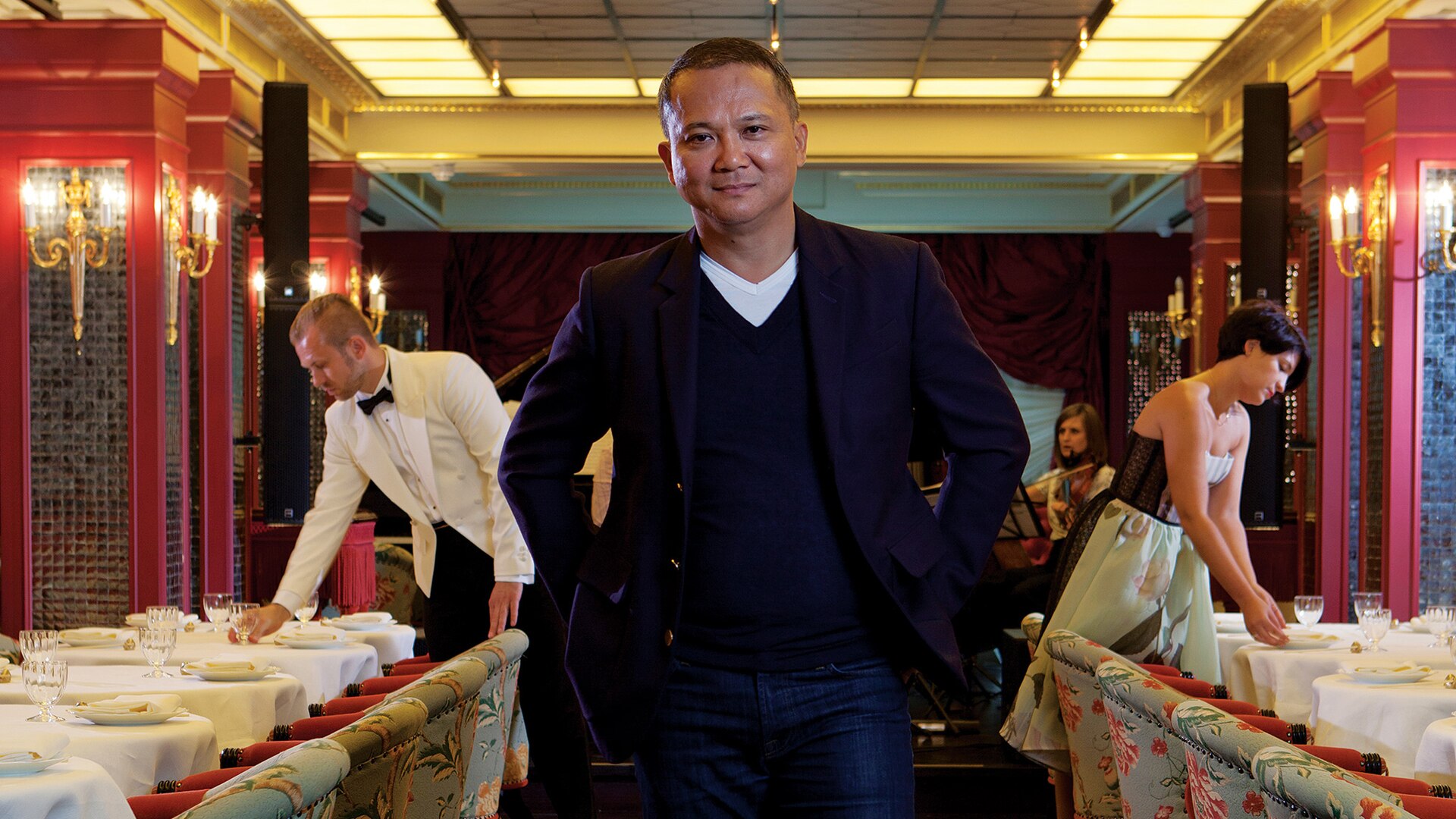
Alan Yau sold his stake in Wagamama in the late 1990s, years before the chain became a national fixture. The brand he founded in a single Bloomsbury site in 1992 has since passed through multiple corporate owners, most recently being taken off the public market by Apollo Global Management as part of its acquisition of The Restaurant Group in April 2023. Yau had no role in that deal. He had moved on to other ventures by the early 2000s.
The story of Wagamama is not one of a founder who grew a business and cashed out at the peak. Yau left while the chain was still small. The subsequent expansion happened under owners who applied his template at scale. What Yau built was a set of dining conventions that reshaped British casual dining: communal bench seating, open kitchens, and a no-reservations policy. Those innovations, not the number of outlets, were his real product.

A Bloomsbury start
Alan Yau was born in Hong Kong and moved to the UK as a child. By 1992, at age 30, he had worked in his family's restaurant trade and studied at university, but he had not yet run a business of his own. The first Wagamama opened that year on Streatham Street in Bloomsbury, a part of London better known for the British Museum than for noodle bars.
The location was deliberate. Bloomsbury drew a mix of students, office workers, and tourists. Yau wanted a format that could turn tables quickly and serve a high volume of customers without the overhead of a traditional restaurant. The menu was pan-Asian, centred on ramen and rice dishes, and priced below what a sit-down Chinese restaurant charged. The name Wagamama, which Yau has said was meant to convey a self-willed or naughty child in Japanese, signalled that this was not a formal dining room.
Design and service as competitive weapons
The look that broke the mould
Wagamama's interior was as distinctive as its menu. Yau specified communal bench seating, long tables that forced strangers to sit together, and an open kitchen that put the cooking process on display. At a time when British casual dining meant either pub food or American-style chains with booths and soft lighting, the look was industrial and unapologetic. The no-reservations policy eliminated the problem of empty tables during slow periods and created queues at peak hours. Those queues served as free advertising.
Speed as a system
Service was designed for velocity. Waitstaff took orders on handheld devices, a novelty in 1992, and the kitchen cooked to order rather than holding food under heat lamps. The average time from order to table was measured in single-digit minutes. These operational choices were the mechanism by which Wagamama achieved higher revenue per square foot than conventional restaurants in the same neighbourhood.
Expansion and the founder's exit
Wagamama grew quickly by the standards of independent restaurants. After the Bloomsbury site proved profitable, Yau opened a second London location in 1993 and a third in 1994. By the late 1990s, the chain had around a dozen outlets in the UK and had begun to attract attention from buyout firms looking for scalable concepts. Yau sold his stake in the late 1990s. The exact price he received is not public, but the sale ended his operational involvement with the brand he had founded.
The timing is striking. Yau sold before Wagamama became the national chain it is today, before it expanded into international markets, and before the noodle bar concept became a standard feature of UK high streets. He left at the point when the business was proven but not yet dominant. The buyers saw a format that could be replicated across multiple geographies, and they were right. But that replication was their work, not Yau's.

From private equity to The Restaurant Group
A chain changes hands
After Yau's departure, Wagamama passed through a series of institutional owners. Duke Street Capital owned the chain for a period, followed by Lion Capital. Each owner added outlets, refined the supply chain, and pushed into new markets including the United States, Australia, and the Middle East. The core formula of communal seating, no reservations, and pan-Asian food remained intact, but the company that Yau had started as a single restaurant became a multi-country operation with hundreds of locations.
The TRG deal
The biggest change came in October 2018, when The Restaurant Group (TRG) announced it would acquire Wagamama for approximately £559 million. TRG, which at the time owned Frankie & Benny's, Chiquito, and other casual dining brands, saw Wagamama as a way to reposition its portfolio toward younger, more urban customers. The deal was structured as a cash-and-shares transaction and closed later that year. TRG operated Wagamama for about four and a half years.
Apollo takes Wagamama private
Going off-market
In April 2023, Apollo Global Management completed its acquisition of The Restaurant Group, taking Wagamama into its portfolio along with TRG's other brands. The deal valued TRG at slightly below what TRG had paid for Wagamama alone five years earlier. Apollo's rationale was similar to the one that had attracted earlier institutional buyers: Wagamama was a recognisable brand with a loyal customer base and a supply chain that could generate consistent cash flow.
Survival by design
By the time of the Apollo acquisition, Wagamama had locations across multiple continents. The chain had survived the COVID-19 pandemic, shifts in consumer tastes, and the departure of its founder. It had done so by adhering to the operational model Yau designed in 1992, even as the company that owned it changed hands repeatedly. The 2023 deal marked the end of Wagamama's run as a publicly traded asset. As of April 2024, the chain remains held by Apollo.
What Yau did next
Alan Yau did not retire after selling Wagamama. In 2001, he opened Hakkasan in London, a high-end Chinese restaurant that reinterpreted Cantonese fine dining through a modern lens. Hakkasan earned a Michelin star and expanded to cities including New York, Dubai, and Shanghai. In 2004, Yau opened Yauatcha, a dim sum teahouse in London's Soho that applied the Wagamama template of casual luxury to Chinese tea and pastries.
These later ventures established Yau as one of the most influential restaurateurs of his generation. He had demonstrated that a fast-casual noodle bar and a Michelin-starred Chinese restaurant could be built by the same person, using different versions of the same insight: that UK diners would pay for Asian food if the environment and service were designed to their expectations. Wagamama was his first and most widely copied creation. But it was not his last, and it was not the one he chose to run for the long term.
Key facts
- Founder: Alan Yau, Hong Kong-born restaurateur who moved to the UK as a child
- First restaurant opened: Bloomsbury, London, 1992
- Founder exit: Alan Yau sold his stake in the late 1990s
- Acquisition by The Restaurant Group: October 2018, valued at approximately £559 million
- Taken private by Apollo Global Management: April 2023, as part of acquisition of The Restaurant Group
- Yau's later ventures: Hakkasan (2001) and Yauatcha (2004), both in London
Related reading: Muslim American Business Leaders: Profiles and Market Impact and Charles Delingpole: From The Student Room to ComplyAdvantage.