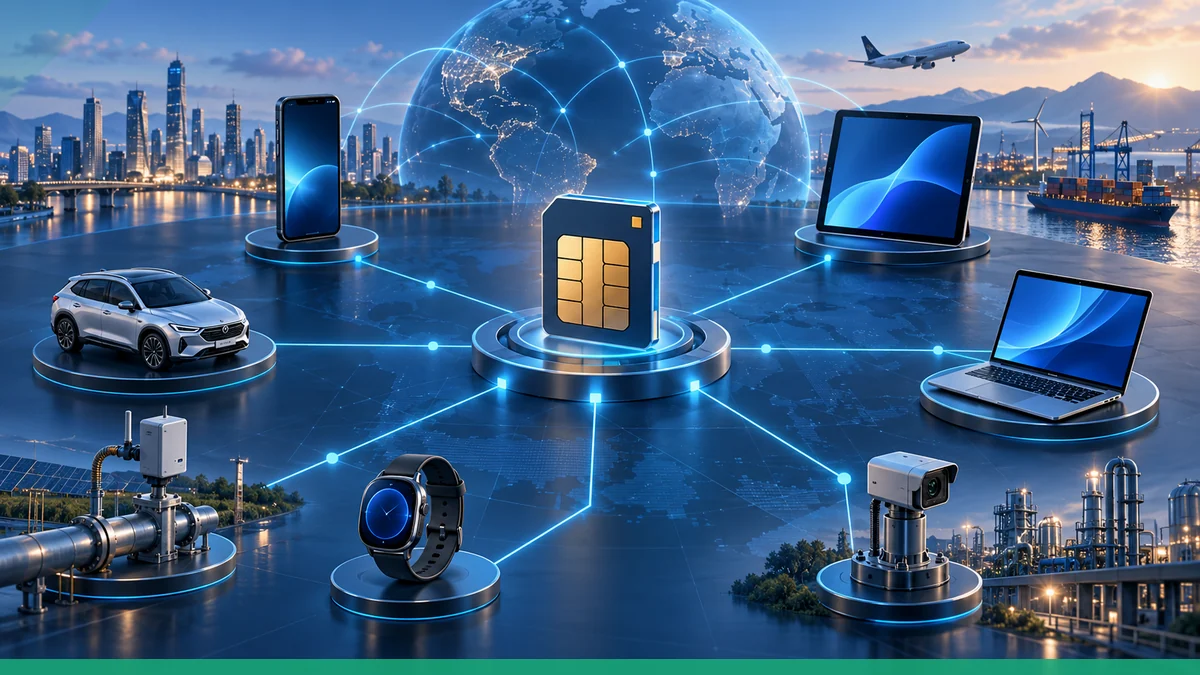
eSIM distribution is shifting carrier economics away from plastic cards, retail handoffs and physical logistics toward digital provisioning, software control and partner marketplaces. The change matters because how eSIM distribution works affects acquisition costs, activation speed and the carrier’s role in retail and roaming, as documented in GSMA's eSIM overview, FCC's international roaming guidance and uPhone’s eSIM explainer.
From physical fulfillment to digital provisioning
GSMA describes eSIM as a secure means for authenticating devices onto networks inside a removable Secure Element, with profiles securely downloaded into permanently embedded hardware rather than loaded through a removable card. uPhone’s explainer says activation can happen by scanning a QR code or entering an activation code, with no physical card needed and no store visit required.
That shifts carrier distribution from making, stocking and shipping SIM cards to managing digital profile issuance and activation flows. The operating change is not just a different format for the subscriber identity; it is a different fulfillment model.
- Digital delivery replaces card printing, packaging and courier or retail handoff.
- Activation can be initiated remotely through QR code or activation code workflows.
- The carrier or provider controls provisioning through software rather than through a physical SIM tray exchange.
Lower physical distribution friction changes carrier economics
Removing the physical SIM card lowers the friction in the distribution chain. A carrier no longer depends on inventory movement, retail counter replacement or postal delivery to start service, and that changes the economics of acquisition and support.
The GSMA says the eSIM approach supports a secure ecosystem and offers an equivalent level of security and protection to a removable SIM card. That makes the economics of digital distribution the main operational tradeoff, not the absence of security controls.
- Less physical handling reduces dependence on retail stocking and fulfillment logistics.
- Digital activation can shorten the time between purchase and use.
- Carriers can support connected devices without requiring a removable SIM slot exchange.
Roaming and travel provisioning move closer to local-market competition
The FCC’s international roaming guidance says an unlocked phone can use a local SIM card or an embedded eSIM with a local number in the country being visited, effectively turning the handset into a local phone. It also says travelers may purchase a local SIM in the United States before departure or from a local provider after arrival.
That guidance shows the commercial pressure on roaming economics. If a traveler can load a local service digitally, the carrier that owns the home line is no longer the only practical path to connectivity abroad. The economics shift toward whichever provider can issue service fastest and most conveniently for the trip.
- The FCC says unlocking varies by device and carrier.
- The FCC says providers may differ by country, and the device may not work on every network abroad.
- The FCC says travelers should check roaming rules and rates before traveling.
Marketplaces become a new distribution layer
As digital provisioning replaces card logistics, marketplaces gain importance as the place where consumers discover, compare and buy connectivity. uPhone’s materials describe a model where a digital profile is downloaded to connect to mobile networks in many countries without swapping SIMs.
This does not remove carriers from the value chain. It changes their role. Instead of only selling through their own retail channels, carriers and service providers can be packaged into digital storefronts that issue a QR code or activation code after purchase.
- Marketplaces reduce the need for country-by-country physical distribution.
- They can present travel, regional and global plans as digital products rather than boxed hardware.
- The provider relationship shifts toward software-mediated fulfillment and post-sale account management.
Governance moves from logistics to provisioning control
GSMA says eSIM is enabled by a trusted ecosystem of platforms and players, and that the consumer eSIM specification provides secure download into embedded hardware. That means governance sits in the provisioning stack as much as in the radio network itself.
For carriers, the operational emphasis moves toward identity issuance, profile lifecycle management and compatibility with the embedded hardware model. For marketplaces and travel providers, the emphasis moves toward how they package access, hand out activation credentials and manage the customer handoff after sale.
- Provisioning standards become part of the distribution strategy.
- Supplier relationships shift from physical wholesalers to digital activation partners.
- Support and onboarding depend more on device compatibility and activation workflow than on SIM card replacement.
What the economics imply for carriers
The carrier economics of eSIM distribution are shaped by fewer physical constraints and more software control. The immediate wins come from reduced physical handling, faster fulfillment and a more flexible route to travel and international customers.
The harder part is strategic: carriers lose some advantage tied to store networks, card inventory and bundled retail distribution, while marketplace operators gain influence over discovery and purchase. The result is a market where distribution is increasingly defined by provisioning systems, provider agreements and plan packaging rather than by plastic inventory.
More eSIM resources: Browse our eSIM guides and troubleshooting resources for compatibility, setup, travel-data and account-safety advice.