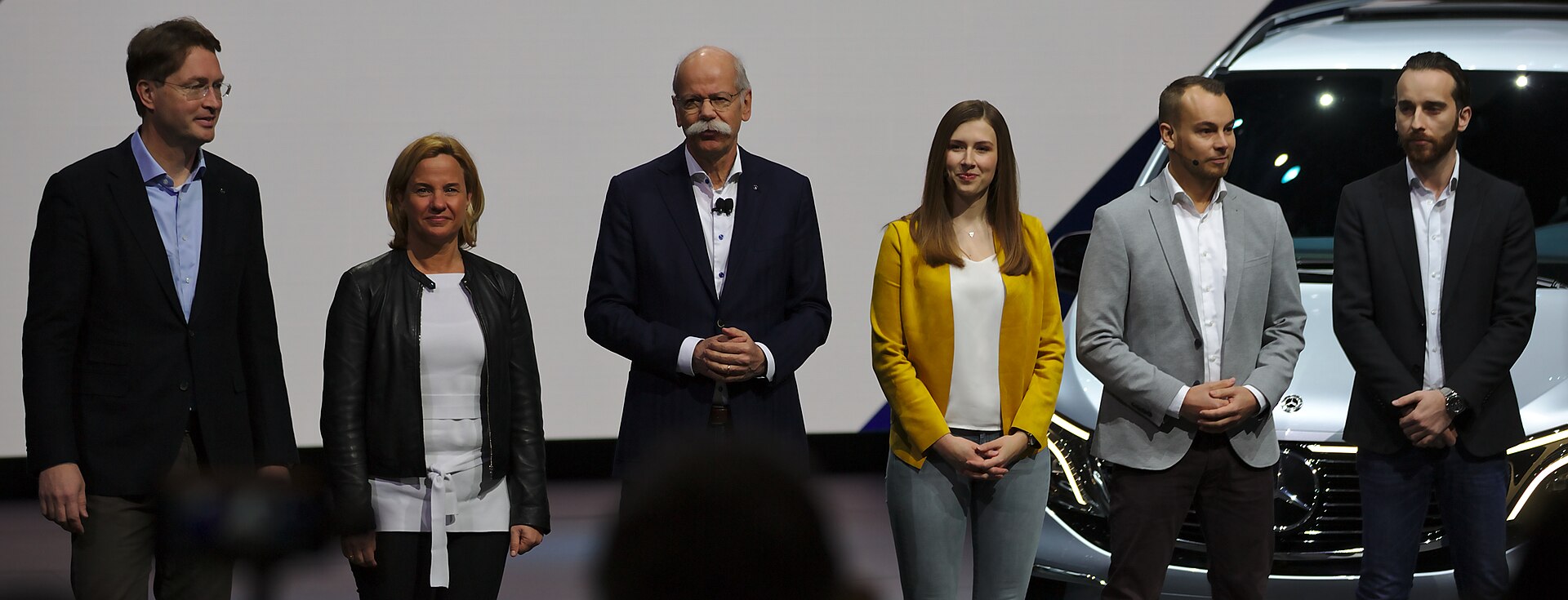
Ola Källenius became Chairman of the Board of Management of Daimler AG on 22 May 2019, succeeding Dieter Zetsche. He is the first non-German to lead the enterprise since its founding in 1926. The appointment ended a 93-year run of German chief executives at what was then Daimler AG, a holding that owned Mercedes-Benz cars, vans, trucks and buses.
Källenius was born in Västervik, Sweden, on 11 June 1969. He studied finance and accounting at the Stockholm School of Economics and later earned a Master's in International Management from the University of St. Gallen in Switzerland. He joined Daimler-Benz AG in 1993 as a trainee in the International Management Associate Program, a rotational scheme the group used to groom future leaders from outside Germany. That entry point matters: Källenius spent his entire career at one organisation, but he never worked in its home country's traditional manufacturing heartland until he was already a senior executive.

Early career and the Chrysler years
After the trainee programme, Källenius moved through finance and sales roles. In the early 2000s he worked at the DaimlerChrysler joint venture in the United States, a period that coincided with the troubled merger of Daimler-Benz and Chrysler. The deal, announced in 1998, was supposed to create a transatlantic automotive powerhouse. Instead it produced years of cultural clashes, write-downs and an eventual divestment of Chrysler in 2007 to Cerberus Capital Management.
Källenius was not a decision-maker in that era, but he was inside the American operation when the integration was failing. The experience is often cited by his biographers as formative: he saw what happens when a German parent tries to impose its engineering logic on a different market without adapting the product or the culture.
Turning around Mercedes-AMG
Källenius became Chairman of the Board of Management of Mercedes-AMG GmbH in 2010. AMG was then a wholly owned subsidiary, responsible for high-performance versions of Mercedes-Benz cars. Under his leadership the division expanded its model line-up beyond the traditional V8 coupes and sedans, introducing four-cylinder performance cars and, later, hybrid powertrains. He also pushed AMG to produce its own engine designs rather than modify existing Mercedes-Benz units, a move that preserved the brand's engineering credibility. Revenue grew during his tenure, though Daimler never published separate AMG financials. The AMG role mattered internally because it gave Källenius profit-and-loss responsibility for a distinct brand within the group, a credential that made him a credible candidate for the top job.
The 2019 succession and the Zetsche legacy
Källenius was appointed to the Board of Management of Daimler AG in 2015, responsible for Mercedes-Benz Cars sales. That put him in the line of succession behind Zetsche, who had led the firm since 2006. When Källenius took over on 22 May 2019, he inherited an enterprise that was profitable but structurally complex. Daimler AG at that point owned Mercedes-Benz cars and vans, Daimler Trucks and Daimler Buses, plus a financial services arm. The group also held a minority stake in the Chinese carmaker BAIC and a significant share of the electric-vehicle startup Tesla, which it sold down over time. Zetsche had already announced a cost-cutting programme, but the strategic direction was still heavily weighted toward internal combustion engines and the traditional dealership model.
The strategic pivot: electric vehicles and luxury
Betting on an electric architecture
Källenius moved quickly to change the product and market positioning. In 2020 he announced that Mercedes-Benz would launch an all-electric architecture, the EVA2 platform, for its core luxury sedans and SUVs. He also committed the brand to going all-electric by the end of the decade, though that target was later softened to allow for plug-in hybrids in markets where charging infrastructure was weak.
The shift to high-margin models
The more consequential move was his decision to focus on the top end of the market. Källenius argued that Mercedes-Benz could not compete on volume with mass-market brands and should instead concentrate on high-margin vehicles: the S-Class, the Maybach sub-brand, the G-Class and the AMG performance models. That strategy raised the average selling price but also reduced unit sales. In 2022, Mercedes-Benz sold about 2 million cars and vans, down from a peak of 2.4 million in 2017, but operating margins improved.

The Daimler Truck spin-off and the name change
In February 2022, Daimler AG was renamed Mercedes-Benz Group AG. The change followed the spin-off of Daimler Truck Holding AG, which was listed as a separate entity on the Frankfurt Stock Exchange in December 2021. The logic was that the truck operation had different customers, different regulatory cycles and different capital requirements from the car side. Investors had long complained that the combined structure made Daimler hard to value. After the split, Mercedes-Benz Group AG became a pure passenger car and van house, with a financial services arm. The truck operation retained the Daimler name. Källenius stayed with the car group. The spin-off was the most consequential structural change at the firm since the Chrysler merger, and it was completed in less than three years from his appointment.
Challenges and the state of play as of October 2023
Supply shocks that sharpened the strategy
Källenius's tenure has not been smooth. The group faced semiconductor shortages in 2021 and 2022 that disrupted production and forced it to prioritise high-margin vehicles, which actually helped the luxury strategy in the short term. The war in Ukraine cut off supply of wiring harnesses from Ukrainian suppliers and forced the closure of a plant in Russia.
Pressure in China
In China, Mercedes-Benz's largest single market, the firm faced a slowdown in demand for luxury goods and increasing competition from domestic electric-vehicle makers such as NIO and BYD. Källenius responded by deepening the partnership with BAIC and by building a dedicated research centre in Beijing.
The unsettled electric bet
Financially, the group reported an operating profit of 20.5 billion euros in 2022, the highest in its history, though much of that gain came from price increases and a shift to more expensive models rather than from volume growth. As of October 2023, the electric-vehicle transition was still underway. The group had launched the EQS and EQE sedans and SUVs, but their sales were well behind the equivalent Tesla and BMW models in most markets. Källenius had staked his legacy on the bet that customers would pay more for a Mercedes-Benz electric car than for a comparable car from a pure-play EV maker. That bet had not yet been settled.
Key facts
- Born: 11 June 1969, Västervik, Sweden
- Education: Stockholm School of Economics (finance and accounting); University of St. Gallen (Master's in International Management)
- Joined Daimler: 1993 as a trainee
- CEO of Mercedes-AMG: 2010
- Board of Management (Daimler AG): 2015 (Mercedes-Benz Cars sales)
- Chairman of the Board of Management: 22 May 2019
- Company renamed to Mercedes-Benz Group AG: February 2022
Mercedes-Benz Group AG under Källenius: selected figures
| Metric | 2019 | 2020 | 2021 | 2022 |
|---|---|---|---|---|
| Car and van sales (million) | 2.39 | 2.16 | 2.09 | 2.0 |
| Operating profit (billion euros) | 4.3 | 6.6 | 16.0 | 20.5 |
| Electric-vehicle share of sales | under 2% | about 5% | about 8% | about 11% |
Frequently asked questions
Why is Ola Källenius the first non-German CEO of Mercedes-Benz?
Mercedes-Benz was founded in Germany and had always been led by German executives. Källenius, who is Swedish, joined Daimler as a trainee in 1993 and rose through the ranks. His appointment in 2019 reflected the company's shift toward a more international management structure.
What did Källenius do at AMG?
He ran Mercedes-AMG from 2010, expanding the line-up beyond large V8 models to include four-cylinder and hybrid performance cars. He also pushed AMG to design its own engines rather than modify standard Mercedes-Benz units.
Did the Daimler Truck spin-off happen under his watch?
Yes. Daimler Truck was spun off in December 2021 and listed separately. The parent company was renamed Mercedes-Benz Group AG in February 2022. Källenius remained with the car and van business.
\nRelated reading: F1 Team Sponsors for the 2019 Season.