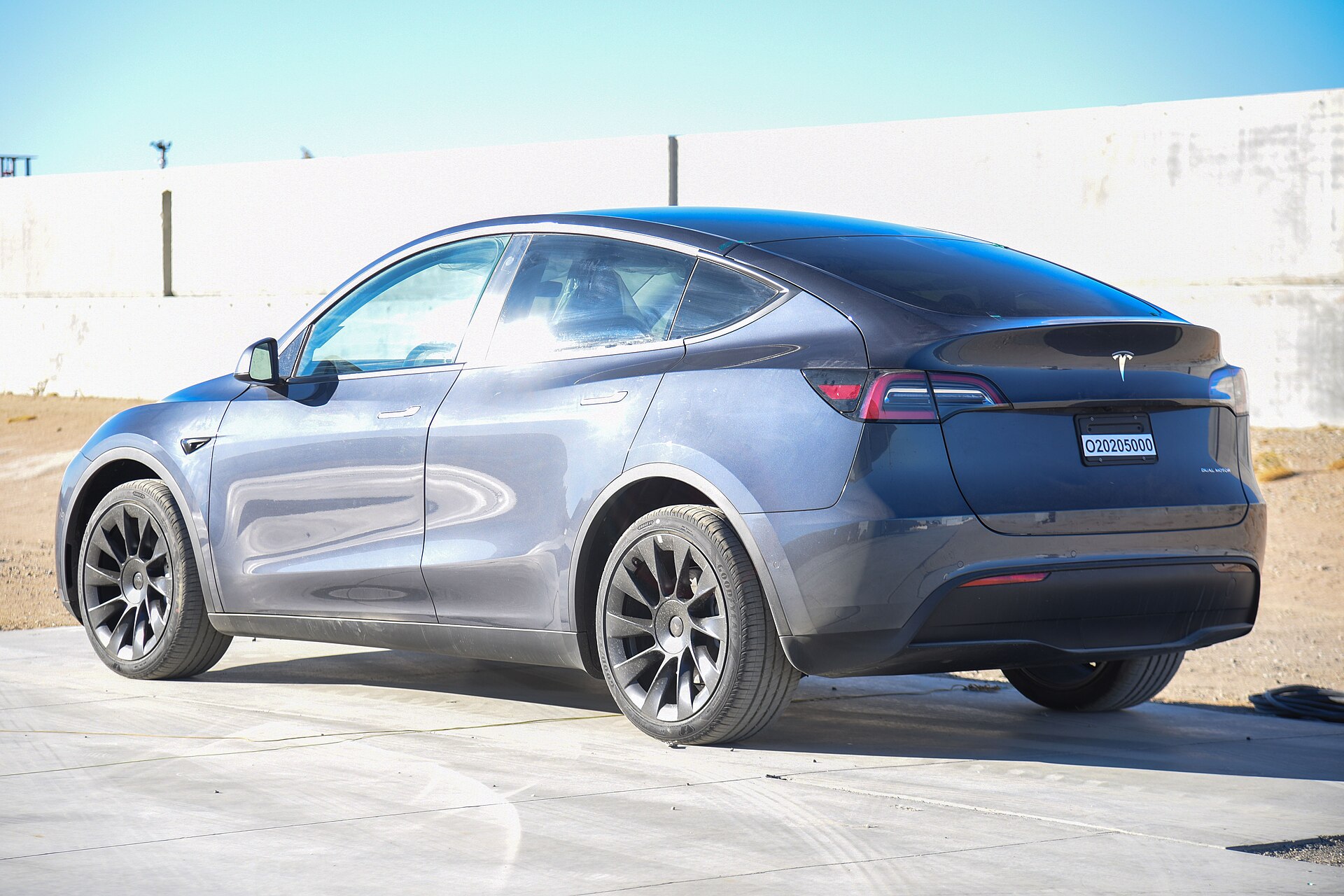
In 2022, an American automaker outsold every German luxury brand in the United States for the first time in a generation. Tesla recorded 484,351 new-vehicle registrations in the U.S. during the full calendar year, according to data from Experian. BMW, the previous segment leader, registered 327,929 units over the same period. Tesla's total was 48% higher than BMW's.
The gap was not close. Tesla's registrations grew 41% compared to 2021, while BMW's fell 5.3%. The outcome was conclusive: Tesla took the top-selling luxury automotive brand position in the U.S. for the first time, and no other American brand had held that spot in nearly 25 years.
The data covers new-vehicle registrations, not manufacturer-reported deliveries. Registration figures are generally considered more reliable for comparing market share because they capture units actually titled to owners, not just shipped to dealers.

The Scale of the Shift
Tesla's 2022 total of 484,351 registrations created a lead over BMW larger than the entire annual U.S. sales volume of several luxury brands. The 41% year-over-year growth for Tesla came despite supply chain disruptions that affected the entire auto industry in 2022. BMW's 5.3% decline, meanwhile, reflected both production constraints and a market that was shifting decisively toward battery-powered models.
Tesla sells only battery-electric cars. BMW sells a mix of internal combustion models, plug-in hybrids, and a small number of full battery-electric offerings such as the i4 and iX. In 2022, BMW's battery-electric sales in the U.S. were not sufficient to offset the decline in its combustion-engine lineup. The result was that Tesla, which did not exist as a car company 20 years ago, captured a segment that BMW had dominated for decades.
The two primary models behind Tesla's volume were the Model Y crossover and the Model 3 sedan. Experian's registration data does not break out model-level figures in the publicly available summary, but Tesla's global production and delivery reports show that the Model Y alone accounted for roughly two-thirds of the company's worldwide deliveries in 2022.
An American Brand at the Top, After 25 Years
The last time a U.S.-based brand led the luxury sales segment was in the late 1990s. Cadillac held the top position for much of the 20th century, but by the early 2000s it had been overtaken by Lexus, BMW, and Mercedes-Benz. No domestic automaker had ranked first in luxury sales since then.
Tesla is headquartered in Austin, Texas, and manufactures its cars in Fremont, California, and Austin. Its ascent to the top of the luxury segment is notable not only because it is a U.S. company, but because it sells exclusively battery-electric models. Every previous leader in the category relied on internal combustion engines. The shift in leadership reflects a broader change in consumer preference: in 2022, battery-electric cars accounted for 5.8% of all new vehicle sales in the U.S., up from 3.2% in 2021, according to Kelley Blue Book estimates.
Tesla does not market itself as a luxury brand in the traditional sense. It does not offer the wood trim, leather upholstery, or V8 engines that defined earlier luxury cars. But its average transaction price, which hovered around $65,000 in 2022 according to Kelley Blue Book, places it squarely in luxury territory. Experian classifies Tesla as a luxury make for its registration reporting.
How BMW Responded
BMW did not issue a public statement specifically about losing the U.S. sales crown to Tesla in 2022. The company had previously acknowledged that the transition to battery-electric cars would reshape the competitive landscape. In investor materials and media briefings, BMW executives emphasized that the company would protect profitability rather than chase volume in the electric segment.
BMW's 2022 U.S. sales decline of 5.3% was not uniform across its lineup. The company's combustion-engine models, including the 3 Series sedan and X5 SUV, lost ground. Its battery-electric offerings, the i4 and iX, sold in small numbers. BMW sold roughly 20,000 battery-electric cars in the U.S. in 2022, according to industry estimates, a fraction of Tesla's volume.
Industry analysts noted that BMW's position was not likely to recover quickly. Tesla's lead was built on a dedicated electric platform, a charging network, and a brand perception that BMW could not replicate with its existing product lineup. Analysts at Cox Automotive and Edmunds pointed out that Tesla's U.S. registrations in 2022 exceeded the combined luxury sales of BMW, Mercedes-Benz, and Lexus in several months of the year.
What the Numbers Do and Do Not Say
The Experian data that established Tesla as the 2022 leader is based on new-vehicle registrations, which are collected from state motor vehicle departments. This methodology differs from the sales or delivery figures that automakers report quarterly. Automaker-reported figures can include units that are shipped to dealers but not yet sold. Registration data captures cars that have been titled to owners, which makes it a more direct measure of consumer uptake.
Experian's classification of Tesla as a luxury brand is not universally accepted. Some industry observers argue that Tesla's pricing and feature set qualify it as luxury, while others point to its minimalist interiors and lack of traditional luxury appointments as reasons to classify it differently. In practice, most major data providers including Experian, Kelley Blue Book, and J.D. Power treat Tesla as a luxury make because its transaction prices overlap with brands like BMW, Mercedes-Benz, and Audi.
Whether Tesla held the top spot in 2023 or 2024 is not established here. The Experian data for 2022 is conclusive: Tesla registered 484,351 cars in the U.S., BMW registered 327,929, and a domestic brand led the luxury segment for the first time in 25 years. The broader trend of electrification made it possible, but the specific result was a matter of execution. Tesla built more cars that U.S. luxury buyers wanted to buy.
Key Facts
- Year: 2022 (full calendar year)
- Data source: Experian new-vehicle registration data
- Tesla U.S. registrations: 484,351 units
- BMW U.S. registrations: 327,929 units
- Tesla year-over-year change: +41%
- BMW year-over-year change: -5.3%
- Historical significance: First time in nearly 25 years an American brand led U.S. luxury auto sales
- Primary Tesla models: Model Y and Model 3
- Outcome: Tesla conclusively overtook BMW as the top-selling U.S. luxury automotive brand in 2022
2022 U.S. New-Vehicle Registrations: Tesla vs. BMW
| Brand | 2022 U.S. registrations | Change vs. 2021 | Segment rank |
|---|---|---|---|
| Tesla | 484,351 | +41% | 1st |
| BMW | 327,929 | -5.3% | 2nd |
Frequently Asked Questions
Did Tesla really outsell BMW in the U.S. luxury market?
Yes. Based on full-year 2022 new-vehicle registration data from Experian, Tesla recorded 484,351 registrations compared to BMW's 327,929. This gave Tesla the top-selling luxury brand position in the U.S. for the first time.
What time period does the data cover?
The data covers the full calendar year 2022, from January 1 through December 31.
Why is Tesla considered a luxury brand for this comparison?
Experian classifies Tesla as a luxury make in its registration reporting. Tesla's average transaction price in 2022 was approximately $65,000, which overlaps with traditional luxury brands like BMW, Mercedes-Benz, and Audi.
Is this the first time an American brand has led U.S. luxury car sales?
It is the first time in nearly 25 years. The last American brand to hold the top spot was Cadillac in the late 1990s.
Did Tesla maintain the top position after 2022?
The 2023 and 2024 data is not covered here. The outcome reported is specific to the full year 2022, and the position since then is not established in this analysis.