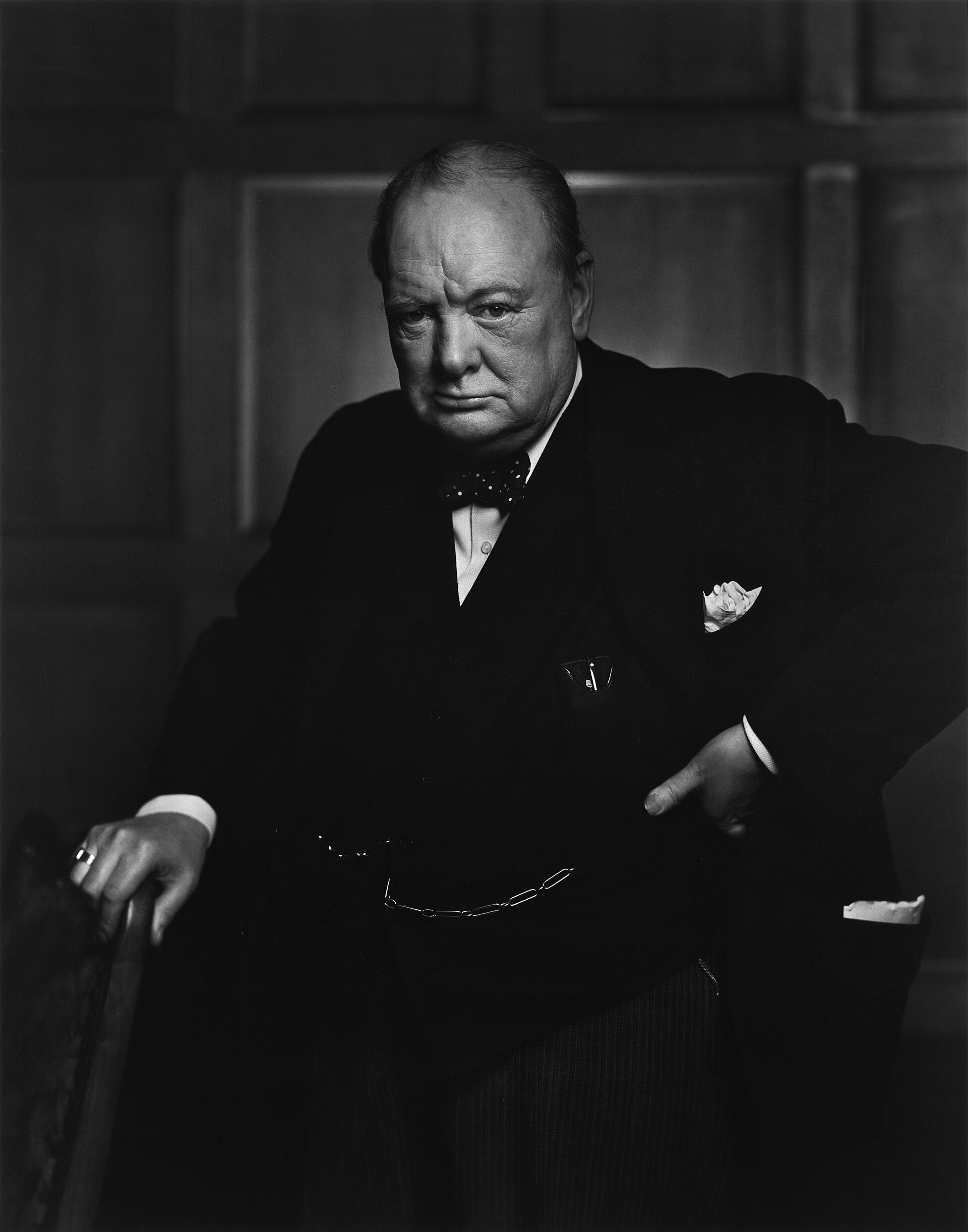
This reference piece draws on the International Churchill Society's database to separate Churchill's actual words from the lines often pasted onto his name. It treats Churchill as more than a wartime prime minister: his command of language, his resilience, and his decision-making framework still offer concrete lessons for executives and founders. Each quote connects to a practical business situation, steering through a crisis, guiding a team past failure, or sustaining morale during a reorganization. Historical context is here for accuracy, not biography. The focus stays on actionable leadership insight.
Churchill led the United Kingdom from 1940 to 1945 and again from 1951 to 1955. He received the Nobel Prize in Literature in 1953. The International Churchill Society curates a running record of authenticated and misattributed quotations, and that record anchors the sourcing throughout.

The Quotes Most Often Cited in Business
Three Churchill phrases appear so frequently in management literature and executive talks that they function as shorthand for resilience. The first is 'Success is not final, failure is not fatal: it is the courage to continue that counts.' Although the line is widely pinned to Churchill, scholars dispute its origin; the International Churchill Society lists it as unverified. Business audiences use it to reframe failure as a waypoint, not a verdict, especially inside innovation teams and turnaround assignments. Executives who cite it encourage teams to treat both wins and losses as temporary states rather than permanent identities.
The second is 'Never give in, never give in, never, never, never,' delivered at the Harrow School on October 29, 1941. The complete sentence ran much longer: 'Never give in, never give in, never, never, never, in nothing, great or small, large or petty, never give in except to convictions of honour and good sense.' The final clause vanishes in most boardroom invocations. Executives deploy the shortened version to insist on perseverance during drawn-out restructurings or market slumps.
The third is 'A pessimist sees the difficulty in every opportunity; an optimist sees the opportunity in every difficulty.' Its origin is also uncertain. Businesses use it to give strategic reframing a memorable shape and to nudge teams toward spotting upside during a downturn.
Historical Context and Business Application
Churchill delivered 'Never give in' at his old school while Britain faced the prospect of invasion. The setting matters, because the address was never a blunt call for stubbornness. Churchill immediately qualified it with 'except to convictions of honour and good sense,' a nuance that present-day executives tend to drop. Applied to business, the distinction is practical: persistence must coexist with strategic flexibility. A company that refuses to retire a failing product line is not displaying courage; it is displaying poor judgment.
The disputed 'Success is not final' line circulates wherever organizations want to normalize failure, startup culture, corporate innovation labs. Some executives pair it with psychological safety, encouraging teams to take calculated risks without fear of punishment. The uncertain origin does not dilute its usefulness, but anyone quoting the line in a town hall or pitch deck should know they are likely drawing on apocrypha.
The optimism-pessimism maxim shows up in scenario planning and change-management offsites. When a market disruption shakes an organization, executives deploy it to pivot the group's attention from threats to openings. Executive coaches reach for the same line to help managers acknowledge risk without letting risk paralyze them.
Distinguishing Verified from Misattributed Quotes
The International Churchill Society runs a database that sorts quotations into three buckets: those Churchill demonstrably said, those he demonstrably did not, and those stuck in between. The Harrow speech supplies the sole business-famous quote that lands squarely in the first bucket. The other two fall into the uncertain category. So do many popular attributions, including the widely shared 'If you're going through hell, keep going.'
The distinction carries weight inside a board presentation or an all-hands meeting. An authentic citation strengthens a point; a spurious one can erode credibility the moment someone in the room recognizes the source is muddy. Executives should cross-check any Churchill line against the Society's database before embedding it in formal remarks or company-wide correspondence.
Churchill's confirmed words, even stripped of the most-cited misattributions, still contain plenty of leadership material. His speeches and writings are dense with practical observations about judgment, written address, and staying power. The soundest path for a business audience is to read the authenticated record rather than trade in second-hand quotes.
Why Churchill Endures in Management Literature
Churchill's style of command keeps surfacing in management books and executive courses for a cluster of reasons. He governed during extreme uncertainty, so his example maps cleanly onto crises such as market collapses, pandemics, or technological upheaval. He was a craftsman of language. The way he used plain, sticky phrasing to express complex strategic ideas is still taught in business-writing curricula. And his willingness to make unpopular decisions and hold to them delivers an ongoing case study in conviction at the top.
A recognizable pattern has emerged: during the 2008 financial crisis, some bank CEOs invoked Churchill's resilience in internal memos; founders of tech companies that survived the dot-com crash have pointed to the Harrow speech as inspiration. Because the sources for those specific citations cannot be confirmed, no names appear here, but the pattern is common enough to observe. Churchill's Literature Nobel underscores his facility with words, which is the central takeaway for present-day executives. In an era of email, social platforms, and continuous internal messaging, the ability to project a vision with clarity and force is a genuine competitive advantage. Churchill's example suggests that leadership communication rests not on charisma alone but on choosing words that carry weight and register emotionally.
Key Facts
- Churchill's terms as PM: 1940-1945 and 1951-1955
- Nobel Prize: Literature, 1953
- Quote verification body: International Churchill Society
- Status of 'Success is not final': Disputed origin, widely attributed but unconfirmed
- Confirmed quote example: 'Never give in' from Harrow School speech, October 29, 1941
- Piece outcome: Published as static evergreen reference
Comparison of Common Churchill Quotes in Business
| Quote | Verification Status | Common Business Use | Historical Context |
|---|---|---|---|
| Success is not final, failure is not fatal | Disputed | Reframing failure, innovation culture | Unknown |
| Never give in, never, never, never | Confirmed | Perseverance during restructuring | Harrow School, 1941 |
| A pessimist sees difficulty in every opportunity | Disputed | Strategic optimism, change management | Unknown |
Frequently Asked Questions
Are all Churchill quotes in business books authentic?
No. Many lines credited to Churchill are unconfirmed or misattributed. The International Churchill Society keeps a database that distinguishes authenticated quotations from disputed ones.
Can I use disputed quotes in a business presentation?
You can, but you risk losing credibility if the audience recognizes the uncertain origin. A safer approach is to quote only confirmed statements or to preface the line with 'often attributed to Churchill.'
What is Churchill's most useful leadership lesson for present-day executives?
His ability to communicate complex strategy in plain, memorable language is his most transferable skill. Combined with his resilience and readiness to make hard calls, it provides a durable model for crisis leadership.
\nRelated reading: Ginni Rometty on Trust as a Business Imperative at IBM.