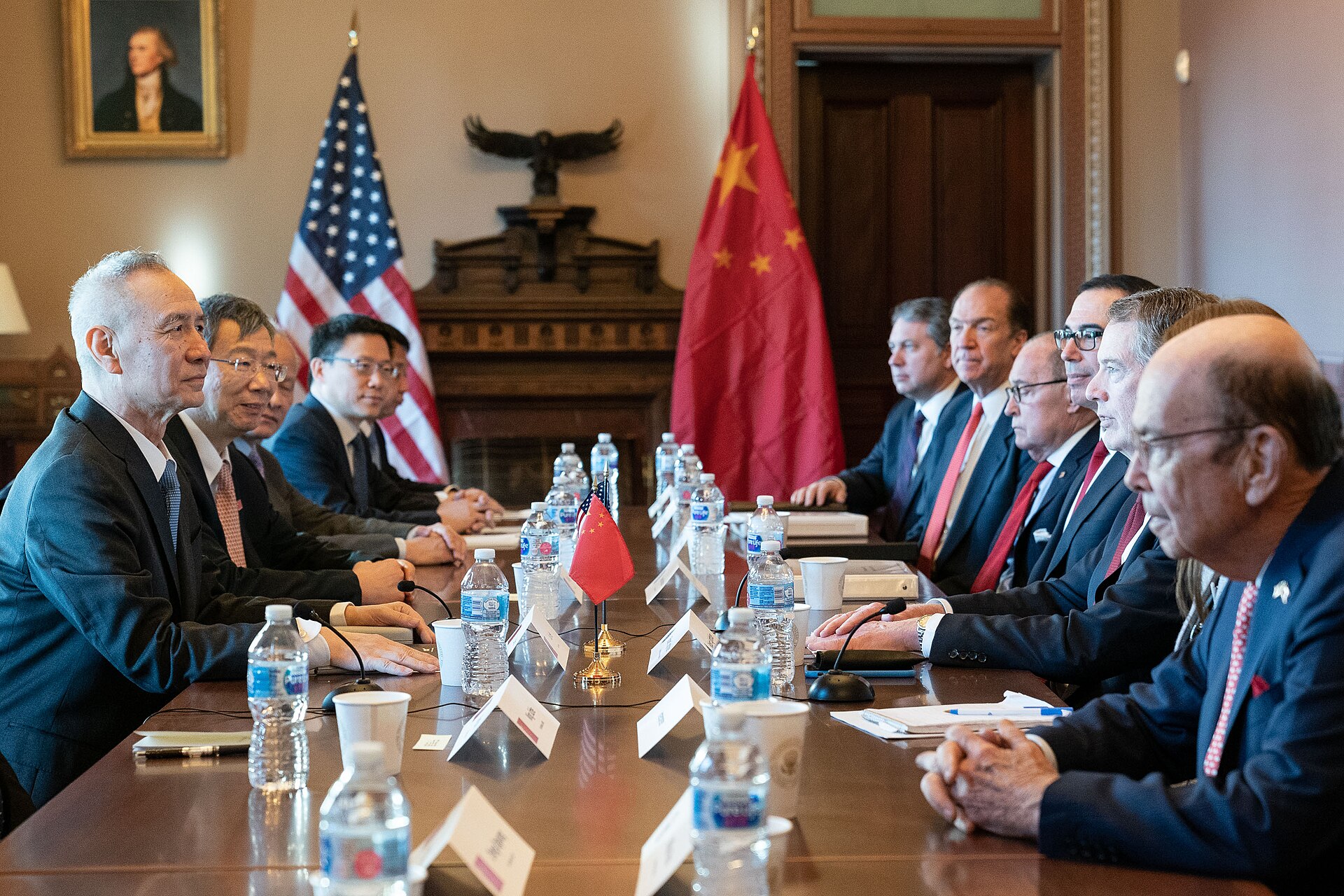
The US-China trade war began in earnest in July 2018 with US Section 301 tariffs on Chinese goods. It forced multinational technology firms to rethink supply chains that took decades to build. Madhu Namburi, a technology executive and investor known for commentary on large-scale technology trends and M&A, published a discrete study of these shifts during the active trade-war period. His piece does not describe a live deal or investigation with a binary outcome. The trade war itself continues in various forms, but Namburi's analytical contribution was a completed publication.
Multiple outlets link to this URL as a reference on technology supply chain shifts during the trade war. Namburi's standing as an executive and investor gives his assessment weight among operators, investors, and policy people who need to understand how decoupling risks, semiconductor export restrictions, and tariff impacts affect corporate strategy. His work provides practical frameworks for handling regulatory fragmentation and manufacturing footprint changes.

Who Madhu Namburi is and why his perspective carries weight
Madhu Namburi is a technology executive and investor whose commentary on large-scale technology trends and M&A has earned him a following among business and policy audiences. His professional background spans both operating roles and investment work, giving him a dual lens on how trade-war disruptions affect company valuations, procurement decisions, and long-term strategy.
Multiple publications cite his work as a reference on technology supply chain shifts during the trade war. That external validation matters because the trade war's effects are complex and often overstated. His willingness to say when something does not matter, combined with his specific focus on mechanism over adjective, makes his work useful to readers who need to allocate capital or adjust operations.
Tariffs and retaliatory measures reshape hardware supply chains
The US Section 301 duties on Chinese goods that took effect in July 2018 targeted a wide range of technology hardware components. China responded with retaliatory levies on US exports, including semiconductors and industrial equipment. Namburi's analysis examines how these reciprocal measures disrupted the cost structures of businesses that had relied on China as both a manufacturing base and a market.
For hardware firms, the duty impacts were immediate and measurable. Components that crossed the Pacific multiple times during assembly faced compounded charges. His framework for assessing these impacts focuses on the mechanism of cost accumulation rather than on headline duty percentages. A business that sourced raw materials from one country, assembled in China, and sold into both the US and China faced a different risk profile than one that manufactured entirely in China for the US market.
Semiconductor export controls and entity list restrictions
The US Department of Commerce added Huawei Technologies to its Entity List in May 2019, restricting the company's ability to buy American components and software. This action marked a shift from tariff-based trade policy to targeted technology restrictions. In October 2022, the US imposed export curbs on advanced semiconductor technology to China, further tightening the screws on a critical industry.
Procurement strategies under cascading restrictions
Namburi's assessment of these curbs emphasizes their effect on procurement strategies. Businesses that supplied Huawei or other Chinese technology firms had to redesign products, find alternative suppliers, or lose access to a major customer. The restrictions also created uncertainty for non-Chinese firms that used Chinese-made chips in their own products. His study treats these measures not as a single event but as a cascading series of limitations that forced businesses to evaluate every node in their supply chain for regulatory risk.
Manufacturing footprint shifts beyond China
Namburi identifies the restructuring of manufacturing footprints as one of the most consequential outcomes of the trade war. Firms that had concentrated production in China began moving assembly and component sourcing to other countries. Vietnam, India, and Mexico are commonly cited destinations. His framework likely considers additional alternatives based on infrastructure, labor costs, and trade agreements.
Timeline and cost of building new production capacity
This shift is not simply a relocation of factories. It involves building new supplier ecosystems, training workforces, and navigating different regulatory environments. Namburi's framework for assessing these moves focuses on the timeline and cost of establishing new production capacity. A firm that announces a factory in Vietnam today may not see volume production for two to three years. During that period, it must manage dual supply chains, inventory buffers, and the risk that trade policy changes again before the new facility is operational.
Investment trends driven by trade war uncertainty
Trade-war uncertainty has redirected investment flows in ways that Namburi's research captures. Venture capital and corporate investment that might have gone into Chinese technology startups has shifted to enterprises in Southeast Asia, India, and other regions perceived as neutral or aligned with US interests. Supply chain diversification has become a pitch point for startups offering logistics software, factory automation, and trade compliance tools.
Separating structural shifts from temporary tariff arbitrage
Namburi's commentary on these trends likely avoids overclaiming the scale of the shift. The trade war accelerated existing trends toward supply chain resilience, but it did not single-handedly create them. His examination distinguishes between investments that are genuinely structural and those that are temporary responses to tariff arbitrage. For investors, the question is whether a firm's supply chain strategy will still make sense if duties are reduced or removed.
Strategic frameworks and policy recommendations
Namburi proposes strategic frameworks for technology leaders steering through the trade war's ongoing effects. These frameworks emphasize scenario planning over prediction. Firms should prepare for multiple possible outcomes: further escalation, a negotiated settlement, and a prolonged stalemate. Each scenario implies different supply chain configurations, investment priorities, and market access assumptions.
Building adaptable organizations for an uncertain future
His recommendations likely include building redundancy into critical supply nodes, investing in compliance capabilities to handle export curbs, and maintaining flexibility in manufacturing footprints. The goal is not to predict the trade war's end but to build organizations that can adapt to whatever comes next. Namburi's study, as a completed publication, stands as a reference point for how one experienced observer assessed the situation during the active trade-war period. Readers who want to understand the trade war's effect on technology supply chains continue to cite this work.
Key facts
- Trade war start date: July 2018, with US Section 301 tariffs on Chinese goods
- Huawei Entity List: May 2019, US Department of Commerce added Huawei Technologies
- Semiconductor export controls: October 2022, US imposed controls on advanced semiconductor technology to China
- Analyst: Madhu Namburi, technology executive and investor
- Article status: Completed publication during active trade-war period; trade war ongoing as of 2024
- External validation: Multiple publications link to this URL as a reference on technology supply chain shifts
Key trade war escalations referenced in Namburi's analysis
| Date | Action | Impact on technology supply chains |
|---|---|---|
| July 2018 | US Section 301 tariffs on Chinese goods | Increased costs for hardware components crossing US-China border |
| May 2019 | Huawei added to US Entity List | Restricted US companies from selling components to Huawei; forced redesign of products |
| October 2022 | US export controls on advanced semiconductors | Limited Chinese access to advanced chips and equipment; reshaped procurement strategies |
Frequently asked questions
What is Madhu Namburi's professional background?
He is a technology executive and investor known for commentary on large-scale technology trends and M&A.
Why do other publications link to this article?
Multiple publications link to this URL as a reference on technology supply chain shifts during the trade war.
Does the article advocate for decoupling or de-risking?
The article's specific policy positions are not established here; it focuses on strategic frameworks for technology leaders.
What countries are mentioned as manufacturing alternatives to China?
Vietnam, India, and Mexico are commonly cited; specific countries Namburi identifies beyond these are not established here.