At its Worldwide Developers Conference on June 6, 2022, Apple announced the M2, its second-generation system-on-a-chip for Mac laptops. The chip and the two laptops that carry it, a redesigned MacBook Air and an updated 13-inch MacBook Pro, shipped to customers in July 2022. The M2 eventually became the baseline processor for the company's consumer laptop line, succeeded by the M3 in late 2023 and early 2024.
The M2 is built on a second-generation 5-nanometer process. It packs an 8-core CPU and up to a 10-core GPU. Its most consequential change over the M1 is memory capacity: the M2 supports up to 24GB of unified memory, a full 50 percent more than the M1's 16GB ceiling. That increase matters for users who run multiple virtual machines, large developer toolchains and creative applications that hold working files in memory.
The announcement completed the first phase of Apple's transition away from Intel processors. The M1 had already proved that the company's own silicon could outperform Intel chips in single-threaded tasks while drawing less power. The M2 extended that advantage to a broader set of workloads, especially graphics and multi-threaded processing.

M2 chip specifications and claimed speeds
CPU and GPU gains
Apple described the M2's CPU as 18 percent quicker than the M1's at the same power level, and up to 35 percent quicker at peak power. The GPU, with up to 10 cores versus the M1's 8, was claimed to deliver a 25 percent speedup at the same power and a 35 percent speedup at peak. Independent benchmark results did not appear at the announcement; those arrived later from reviewers.
Memory architecture
The memory architecture matters more than the headline percentages. The M2 uses LPDDR5 memory running at a bandwidth of 100GB/s, up from the M1's 68.25GB/s. Unified memory means the CPU and GPU share a single pool, so the system never copies data between separate memory banks. For creative professionals, that eliminates a bottleneck that plagues discrete GPU designs. The 24GB ceiling handles most video editing, software compilation and large spreadsheet workloads, though it falls short of the 32GB and 64GB options available on the M1 Pro and M1 Max chips that Apple had already offered in the 14-inch and 16-inch MacBook Pro since October 2021.
Where the M2 sits
That last point requires a clarification. The M2 is not a replacement for the M1 Pro or M1 Max. It is a higher-end consumer chip that sits above the M1 but below the Pro and Max tiers. It went into machines aimed at students, office workers and light creative users, not the high-end professionals who needed multiple external displays or sustained rendering power.
M2 versus M1 core and memory specifications
| Specification | M1 | M2 |
|---|---|---|
| CPU cores | 8 | 8 |
| GPU cores (max) | 8 | 10 |
| Max unified memory | 16 GB | 24 GB |
| Memory bandwidth | 68.25 GB/s | 100 GB/s |
| Process node | 5 nm (first generation) | 5 nm (second generation) |
| Neural Engine cores | 16 | 16 |
Redesigned MacBook Air
Industrial design overhaul
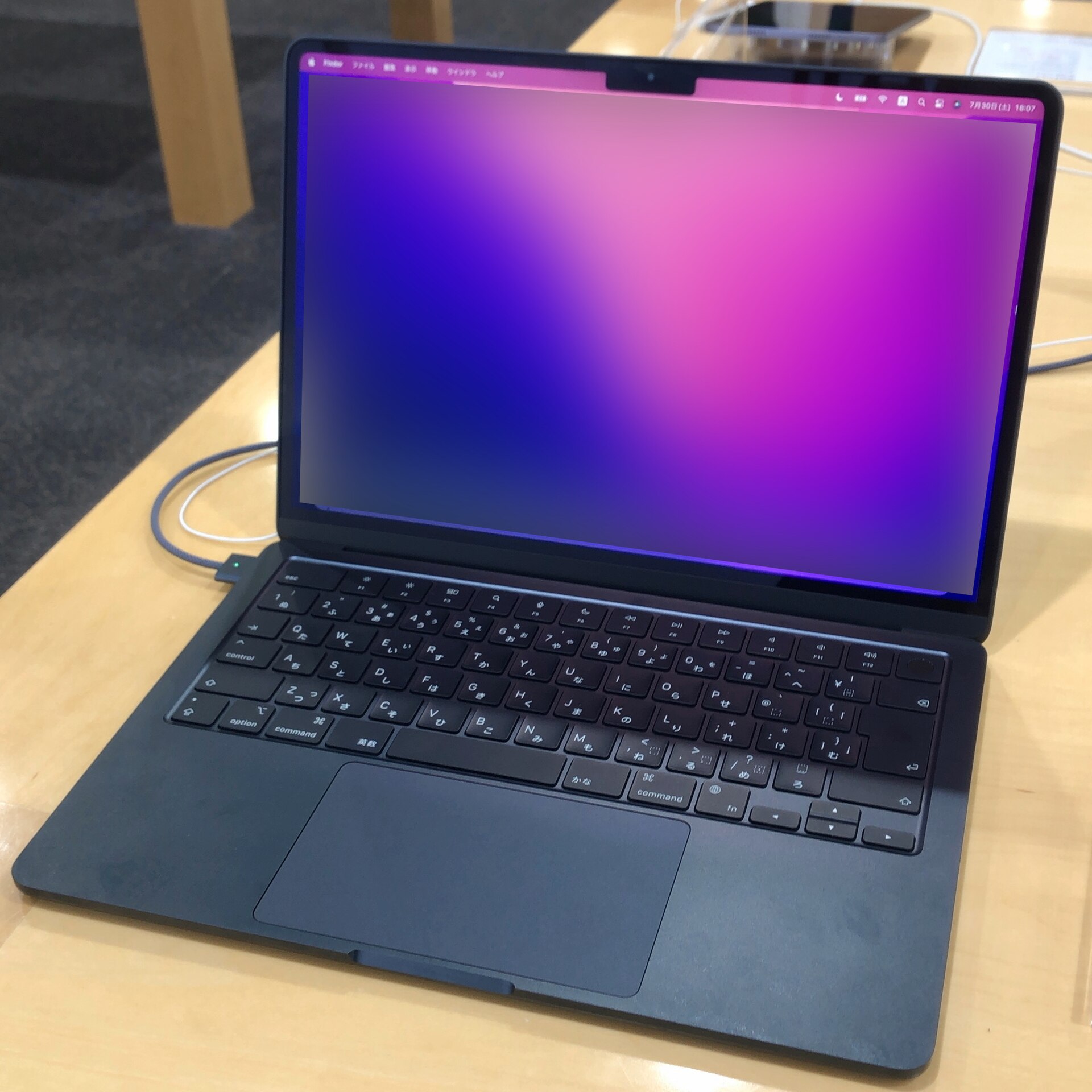
The 2022 MacBook Air received the most dramatic industrial design update since the model's introduction in 2008. Apple eliminated the wedge-shaped chassis that tapered from front to back. The new enclosure is flat and slab-sided, making the laptop 11.3 millimeters thick at its thickest point, down from the M1 MacBook Air's 16.1 millimeters at the hinge.
Display and notch
The display grew from 13.3 inches to 13.6 inches diagonally and shifted to a Liquid Retina panel that uses a notch to house the 1080p FaceTime HD camera. The notch pushes the menu bar into the space around the camera, a design choice that drew mixed reactions from users but gave the laptop a larger active display area. The bezels are noticeably thinner than on the M1 Air.
Ports and audio
Apple reintroduced MagSafe charging, which the MacBook line had abandoned in 2016 when it moved to USB-C-only ports. The 2022 Air has a MagSafe port, two Thunderbolt 4 ports and a 3.5mm headphone jack. The power connector is separate from the data ports, so users can charge without occupying a Thunderbolt port. Apple also added a four-speaker sound system with force-cancelling woofers and support for spatial audio in Dolby Atmos.

Updated 13-inch MacBook Pro
Same chassis, new chip
The M2 13-inch MacBook Pro received the new chip but kept the chassis from the Intel-based and M1-based models that preceded it. It retains the Touch Bar, the thin strip of OLED touch controls above the keyboard, and the squared-off edges that the MacBook Air abandoned. The display remains a 13.3-inch Retina panel at a resolution of 2560 by 1600 pixels without a notch.
Fan-cooled advantage
Apple claimed the M2 MacBook Pro delivered a 40 percent GPU speedup over the M1 model. The machine targets users who need the sustained throughput that a fan-cooled chassis provides. The MacBook Air is passively cooled with no fan, so under extended heavy loads it throttles. The MacBook Pro has an active cooling system, so it can maintain peak speeds for longer. That difference matters for developers compiling large codebases or video editors running long exports.
Battery life
Battery life on both machines was effectively flat compared to their M1 predecessors. Apple rated the M2 MacBook Air at up to 15 hours of wireless web browsing and 18 hours of video playback. The M2 MacBook Pro was rated at up to 17 hours of wireless web browsing and 20 hours of video playback. Those figures were largely unchanged from the M1 models, because the M2's capability gains came from architecture improvements rather than higher power draw.
Pricing tiers and availability
MacBook Air pricing
The M2 MacBook Air started at $1,199 in the United States, as set by Apple at launch. That was $200 more than the M1 MacBook Air's launch price, though the company continued selling the M1 Air at $999, creating a two-tier lineup. The M2 MacBook Air was available in four colors: silver, space gray, starlight and midnight. Check Apple's website for current pricing in your region.
MacBook Pro pricing
The M2 13-inch MacBook Pro started at $1,299, as set by Apple at launch. It was available in the same space gray and silver colors as its predecessor, without the new starlight and midnight options. Both machines shipped in July 2022. Apple did not specify exact calendar dates at the announcement, but pre-orders opened shortly after the WWDC keynote and deliveries began within a month. Check Apple's website for current pricing in your region.
Lineup strategy
The pricing placed the M2 Air slightly above comparably powerful Windows ultrabooks from Dell, HP and Lenovo, but below the entry-level MacBook Pro. Apple's strategy was to widen the gap between its consumer line and its professional line. The M2 Air handled what most people need. The M1 Pro and M1 Max MacBook Pros, starting at $1,999 as set by Apple at launch, handled what professionals need. The M2 13-inch MacBook Pro occupied an awkward middle position that reviewers often questioned: it had the old design, the Touch Bar and a higher price, but no pro-level features like additional ports or a larger display. Check Apple's website for current pricing in your region.
Frequently asked questions
When was the M2 chip announced?
Apple announced the M2 chip at its Worldwide Developers Conference on June 6, 2022.
When did the M2 MacBook Air and MacBook Pro ship?
Both laptops shipped to customers in July 2022.
How much memory does the M2 support?
The M2 supports up to 24GB of unified memory, up from the M1's 16GB maximum.
Does the M2 replace the M1 Pro and M1 Max?
No. The M2 sits above the M1 but below the M1 Pro and M1 Max in Apple's chip lineup. The Pro and Max chips continued to power the high-end 14-inch and 16-inch MacBook Pro models.
\nRelated reading: Fitbit, Apple lead 90% of wearables market and The Best Personal Budget Apps for Managing Your Finances.