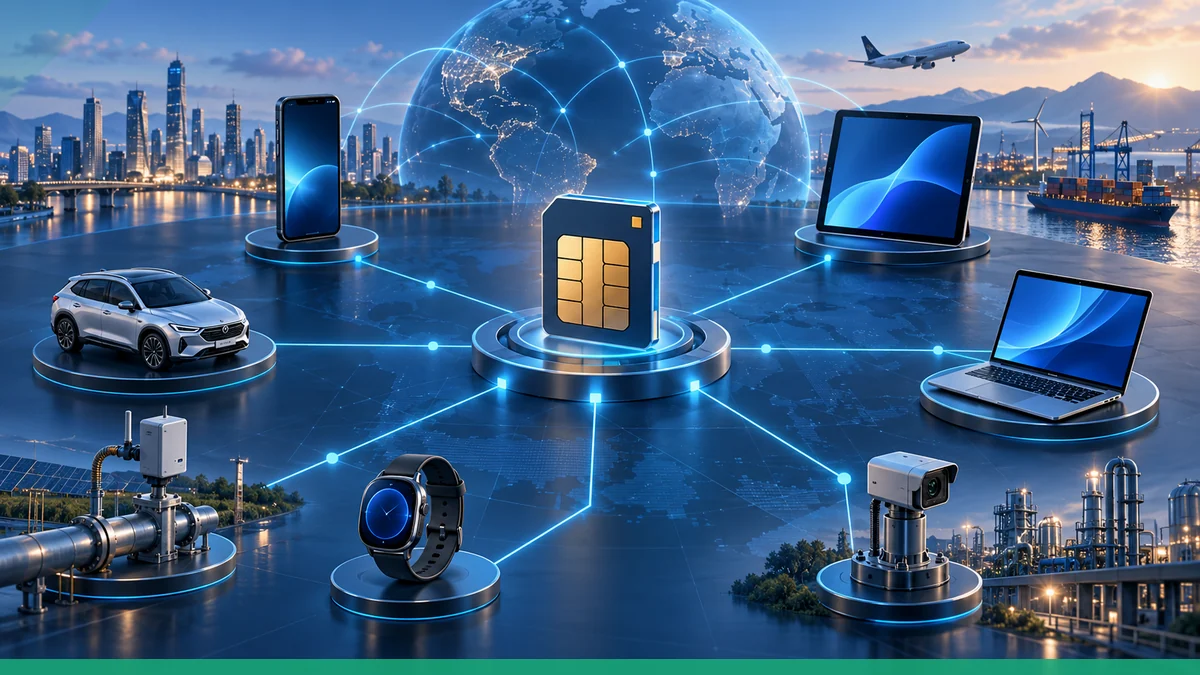
Commercial 5G services went live globally in 2019, with Verizon, AT&T and T-Mobile launching their first mobile offerings that year. By early 2025 the technology had settled into a pattern that looked more like a faster 4G than the revolution its early marketing promised. In November 2020 the International Telecommunication Union finalized the IMT-2020 specification, codifying three use-case pillars: enhanced mobile broadband, ultra-reliable low-latency communications and massive machine-type communications. Only enhanced mobile broadband delivered at scale in the first half-decade of deployment.
Peak data rates are designed to reach 20 Gbps downlink and 10 Gbps uplink, with latency targets of 1 millisecond for URLLC applications. No carrier achieved the full 20 Gbps peak in real-world consumer settings. The practical upgrade from 4G LTE was substantial but uneven, depending heavily on frequency band, cell density and backhaul quality. The 3GPP Release 15 standard, finalized in June 2018, provided the first full 5G specification, but the physical plant required to realize the more ambitious use cases was only beginning to be built as the 2020s progressed.
The three pillars and what they mean
Enhanced mobile broadband is the easiest to understand. It means faster downloads, better streaming and more consistent throughput in crowded venues. Carriers marketed this pillar first because it works on existing cell towers with upgraded radios. Sub-6 GHz frequencies, including bands around 3.5 GHz and the C-band, became the workhorse. They offer broader reach than high-band signals and better penetration through walls.
Spectrum above 24 GHz delivers the multi-gigabit speeds that appear in carrier advertisements. It also has very short range and struggles with trees, buildings and rain. Operators deployed these high-frequency radios mainly in dense urban pockets, stadiums and airports. For most subscribers the phone showed a 5G icon while connected to mid-band or low-band spectrum, not the airwaves that produced the dramatic speed tests.
Ultra-reliable low-latency communications and massive machine-type communications matured more slowly. URLLC targets 1 millisecond latency for applications such as industrial robot control, grid automation and autonomous vehicle coordination. mMTC is designed for environments dense with sensors: smart meters, agricultural monitors and logistics trackers reporting across a single facility. By January 2025 neither pillar had become routine outside controlled industrial trials.
Key facts
- ITU IMT-2020 specification finalized: November 2020
- 3GPP Release 15 (first 5G standard): June 2018
- Peak data rate design target (downlink): 20 Gbps
- Peak data rate design target (uplink): 10 Gbps
- URLLC latency target: 1 millisecond
- High-band spectrum: Bands above 24 GHz
- Sub-6 GHz spectrum examples: 3.5 GHz, C-band
- First US carrier mobile 5G services: 2019
Infrastructure densification is the real story
The physical demands of high-frequency cells
5G differs from 4G most sharply in what it demands from the physical plant. Cells using bands above 24 GHz have a radius measured in hundreds of meters, not kilometers. Covering a city with meaningful high-band service requires an order of magnitude more cell sites than 4G needed. Each of those sites needs fiber backhaul. The old T1 lines or microwave links that served some 4G towers cannot carry 5G capacity.
Small cells and municipal friction
Small cells became the standard deployment unit. These are low-power base stations mounted on streetlights, utility poles and building facades. They connect to a fiber aggregation point and then to the core. Securing permits for thousands of small cells per city slowed deployment in many municipalities. Zoning rules, aesthetic objections and negotiations over pole attachment fees added years to rollout timelines in some markets.
Network slicing and the virtualized core
Network slicing is the software layer that makes 5G more than a radio upgrade. It lets an operator carve a virtual partition with guaranteed bandwidth and latency for a specific customer. A factory could buy a slice that prioritizes its robot traffic over consumer video streaming on the same physical infrastructure. This capability depends on a 5G core built on virtualized cloud infrastructure rather than proprietary hardware. Ericsson, Nokia and Samsung supplied the radio and core equipment that enabled slicing, but enterprise adoption was slow. Operators had to build and bill for services they had not sold before.
Spectrum bands and characteristics
| Band type | Frequency range | Range | Penetration | Primary use |
|---|---|---|---|---|
| Sub-6 GHz (e.g. 3.5 GHz, C-band) | Below 6 GHz | Several kilometers | Good through walls | Broad coverage, enhanced mobile broadband |
| High-band | Above 24 GHz | Hundreds of meters | Poor; blocked by trees, rain, buildings | Ultra-high speed in dense areas |
Which industries benefit first
Media, logistics and live venues
The early adopter industries were those that could use enhanced mobile broadband without waiting for URLLC or mMTC maturity. Media and entertainment companies used 5G for live event production, replacing satellite trucks with bonded cellular links. Logistics operators deployed 5G-connected cameras and sensors in warehouses for real-time inventory tracking. Stadiums and arenas upgraded their in-venue infrastructure to handle crowds streaming video simultaneously.
Manufacturing and energy
Manufacturing and energy were the primary targets for URLLC and network slicing. A factory floor with autonomous guided vehicles, robotic arms and quality-control cameras needs deterministic latency. In practice, most of these deployments used private 5G installations built with equipment from Ericsson, Nokia or Samsung, operating on spectrum licensed to the enterprise or shared through CBRS in the United States. The cost of building a private installation meant that only large facilities with high automation requirements justified the investment during the early 2020s.
Agriculture and environmental monitoring
Agriculture and environmental monitoring fit the mMTC profile. Sensors for soil moisture, livestock location and weather stations can operate on low-power 5G connections that report data infrequently. The economics work only if coverage reaches rural areas. Rural deployment lagged urban coverage by several years because the business case for building small cells across low-population-density terrain is weak. The 5G for Rural America program and similar initiatives in other countries attempted to close this gap, but the gap remained wide as of 2025.
What 5G does not deliver
Does 5G enable widespread autonomous driving?
No. Autonomous driving requires latency and reliability guarantees that even URLLC cannot provide across a wide-area mobile network. The industry consensus as of 2025 was that autonomous driving would depend on on-vehicle sensors and edge computing, not on cellular connectivity.
Does 5G make remote surgery routine?
No. Remote surgery trials have been conducted using dedicated fiber links and private 5G networks in controlled hospital settings. The reliability and certification requirements for surgical applications mean that routine remote surgery over public 5G networks was not achieved by early 2025.
Will 5G replace home broadband for everyone?
Fixed wireless access using 5G became a viable alternative to cable and fiber in some markets, particularly where high-band spectrum could be deployed. It did not replace wired connections broadly. Most fixed wireless 5G customers were in areas where fiber was not available.
Is 5G more secure than 4G?
5G includes improved encryption and authentication in the standard. The security of any particular network depends on how operators implement the core, manage software updates and configure network slices. The standard itself is stronger than 4G, but real-world security depends on operational discipline.
The gap between marketing and reality
The three-pillar vision of eMBB, URLLC and mMTC was confirmed as the industry framework. But the timeline for URLLC and mMTC slipped from the early projections made when 3GPP finalized Release 15 in June 2018. Enhanced mobile broadband was the only pillar that delivered a clear consumer benefit in the first six years of commercial 5G. That benefit was real. Sub-6 GHz 5G offered download speeds two to three times faster than 4G LTE in most coverage areas, and high-band connections could reach ten times that in the right spot. But the applications that drove the hype, remote surgery, autonomous fleets, city-wide sensor fabrics, remained in pilot or pre-commercial stages.
For operators and investors, the lesson is that a radio standard alone does not create an application. The physical plant must be built, the devices must be available at a price that makes deployment economic, and the enterprise customer must reorganize its operations to take advantage of connectivity that did not exist before. Each of those steps takes years. The industries that benefited first were the ones that already had a use case for faster mobile connectivity and a budget to pay for it. The rest will wait for the second wave, which will arrive when network slicing and private 5G reach a price and complexity that small and medium businesses can manage.