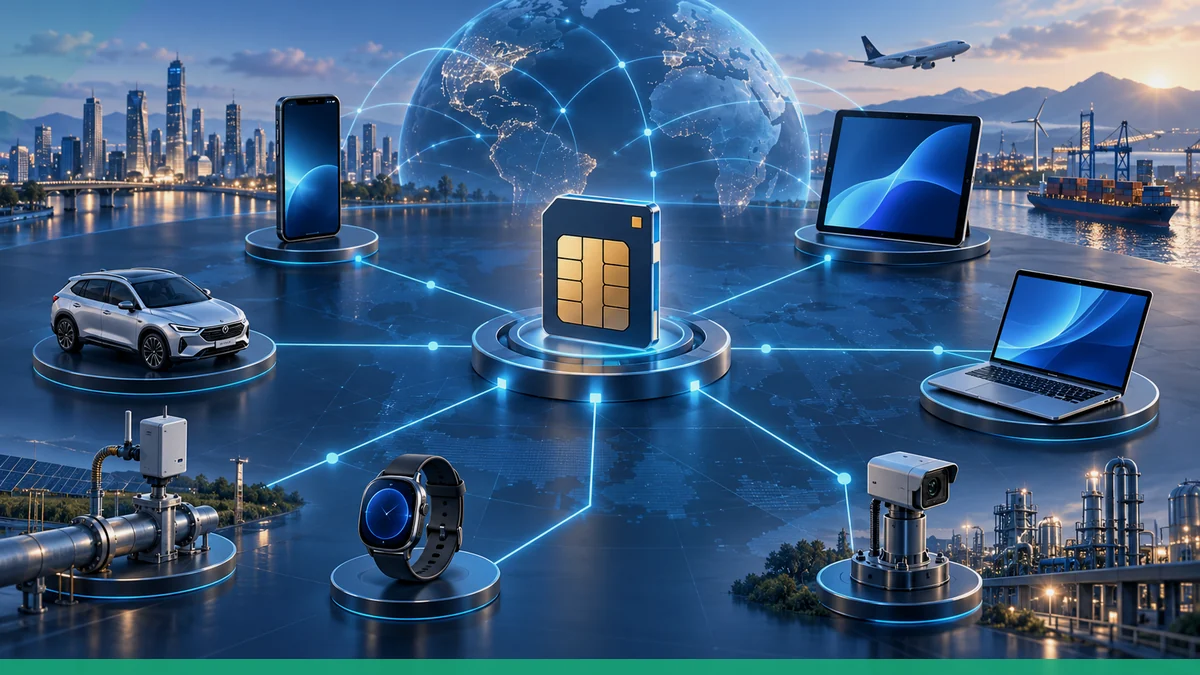
By the end of 2018, global mobile data volumes hit 28 exabytes per month, according to the Ericsson Mobility Report. That figure had doubled roughly every two years. Voice calls and text messages were not the engine. Video, smartphones, and cloud applications were, alongside a fast-growing wave of machine-to-machine connections. The shift forced carriers to abandon a decades-old investment model in which they upgraded networks on a predictable cycle and instead race continuously toward higher capacity, lower latency, and ubiquitous coverage.
Carriers had spent the 1990s and early 2000s building circuit-switched voice platforms that generated reliable per-minute income. SMS provided a second high-margin stream. Both collapsed as consumers adopted smartphones, streaming offerings, and over-the-top messaging tools. WhatsApp, acquired by Facebook in 2014, counted 1.5 billion monthly active users by early 2018 and had already displaced SMS income globally. Netflix, which launched its streaming product in 2007, reported over 130 million paid memberships by the fourth quarter of 2018. AT&T introduced the iPhone exclusively in the United States in June 2007, triggering the first major surge in consumer mobile data demand. The funding model that had sustained network buildouts was finished.
Here is how consumer behaviour forced a switch from circuit-switched to packet-switched infrastructure, how video created the business case for fiber, and why software-defined infrastructure became a survival imperative rather than an efficiency gain.
The collapse of voice and SMS income
For two decades, telecom firms earned most of their turnover from voice minutes and text messages. The economics were straightforward: each call or SMS consumed a tiny amount of capacity relative to the price charged. Margins were high, competition was limited, and network upgrades followed a predictable cadence tied to population growth and regulation.
Smartphones and over-the-top applications dismantled that model. Consumers began using data connections for voice calls and messaging, bypassing carrier billing entirely. WhatsApp alone replaced billions of SMS messages per day. Carriers watched text message volumes decline even as total subscriber counts rose. Voice income followed the same trajectory as consumers migrated to tools such as Skype and FaceTime.
The income lost to over-the-top substitution was not replaced by equivalent data earnings. Data plans were priced per gigabyte, not per message or per minute. Average monthly data consumption per smartphone in North America reached roughly 8.6 gigabytes in 2018, according to Ericsson, but the yield per gigabyte was far lower than the yield per SMS or per minute had been. Providers faced a structural problem: they needed to carry exponentially more throughput but could not charge exponentially more for it.
From circuit-switched to packet-switched infrastructure
The technical response was a fundamental architectural shift. Legacy telecom platforms were circuit-switched: a dedicated path was established for each call and held open for its duration, even during silence. That design was efficient for voice but wasteful for data, where bursts are the norm.
Carriers began migrating to all-IP, packet-switched networks in which data is broken into packets and routed dynamically. The transition let a single system carry voice, video, messaging, and internet flows over the same infrastructure. It also allowed providers to separate the control plane from the data plane, a prerequisite for software-defined networking and network functions virtualization.
ETSI founded its NFV Industry Specification Group in 2012, formalizing the industry push toward virtualized network functions. Instead of running each function on proprietary hardware, carriers could run them as software on standard servers. That lowered capital expenditure and enabled faster deployment of new capabilities. By the late 2010s, most large providers had committed to NFV and SDN architectures, though full implementation remained uneven.
Video streaming pushed fiber and DOCSIS over the edge
A non-negotiable upgrade
Fiber was not a discretionary upgrade. Any provider that failed to offer high-speed broadband lost subscribers to competitors that did. The business case for fiber was built on video, not on voice or legacy data products.
Smartphones, 5G, and the accelerating investment treadmill
A rhythm that broke the industry
The investment cycle had accelerated beyond anything the sector had experienced. Network upgrades that once arrived every seven to ten years were now required every two to three years. Carriers that had once controlled the services running over their systems now competed with over-the-top providers for customer attention while bearing the full cost of the infrastructure. The result was a permanent reversal: networks would be built for data first, with voice and SMS as applications running on top, and providers would spend the foreseeable future racing to keep pace with demand they no longer controlled.
Key facts
- Global mobile data traffic (end of 2018): 28 exabytes per month (Ericsson Mobility Report)
- Video share of mobile traffic (2017): 60 percent (Ericsson)
- Smartphone subscriptions (2019): Over 6 billion (Ericsson November 2019 Mobility Report)
- Average monthly data usage per smartphone, North America (2018): 8.6 gigabytes (Ericsson)
- FTTH/B homes passed, EU39 (September 2018): Over 60 million (FTTH Council Europe)
- WhatsApp monthly active users (early 2018): 1.5 billion
- Netflix paid memberships (Q4 2018): Over 130 million
- 3GPP 5G Phase 1 specification (Release 15): Finalized June 2018
- ETSI NFV Industry Specification Group founded: 2012
Related reading: TalkTalk Data Monitoring Platform Targets Business Customers.