In April 2009, the Zimbabwean government suspended its own legal tender, ending the most extreme hyperinflation episode of the 21st century. The Zimbabwean dollar was demonetized on 12 April 2009, replaced by a multi-currency system anchored by the US dollar and the South African rand. The move stopped hyperinflation cold, but at the cost of surrendering monetary sovereignty. The Reserve Bank of Zimbabwe lost its role as the primary monetary authority overnight. The crisis had peaked five months earlier, in November 2008, when the annual inflation rate hit 89.7 sextillion percent (8.97 × 10^22%).
The hyperinflation was not an accident. It was the direct result of government policy choices made over nearly a decade, starting with the Fast Track Land Reform Programme in 2000. That program seized white-owned commercial farms, collapsing agricultural output and export revenues. The government responded by instructing the central bank to print money to cover its spending. Gideon Gono, Governor of the Reserve Bank of Zimbabwe from 2003 to 2013, oversaw the monetary expansion that turned a fiscal crisis into a currency crisis.

The Land Reform That Broke the Economy
The Fast Track Land Reform Programme began in 2000. It was designed to redistribute land from white commercial farmers to black Zimbabweans, but it was executed through compulsory seizure. Commercial farming, the country's largest source of foreign exchange and employment, collapsed. Tobacco output plummeted. Maize and wheat production cratered. Export earnings dried up, and the government lost a major source of tax revenue.
Rather than adjust spending to match lower revenues, Robert Mugabe's government turned to the Reserve Bank. The central bank was directed to finance the budget deficit by printing money. This was not a one-time emergency measure. It became a permanent feature of fiscal policy for the rest of the decade. By 2008, the government was spending far more than it collected, and the central bank was creating new Zimbabwean dollars to make up the difference. Each new batch of notes reduced the value of every existing dollar.
The Mechanics of Monetary Collapse
Redenomination: The Zero-Stripping Illusion
Inflation accelerated from high to catastrophic in 2006. The Reserve Bank attempted to manage the crisis through redenomination: stripping zeros from the currency to make transactions manageable. The first redenomination came in August 2006, when three zeros were removed. A second followed in August 2008, removing ten zeros. The final redenomination in February 2009 removed twelve zeros. In total, the government erased 25 zeros from the currency over 30 months.
None of these measures worked. Removing zeros does not reduce the underlying supply of money, and government spending continued to outpace revenue. Prices rose so fast that the central bank was forced to issue ever-larger notes just to keep up with daily transactions.
The 100 Trillion Dollar Note
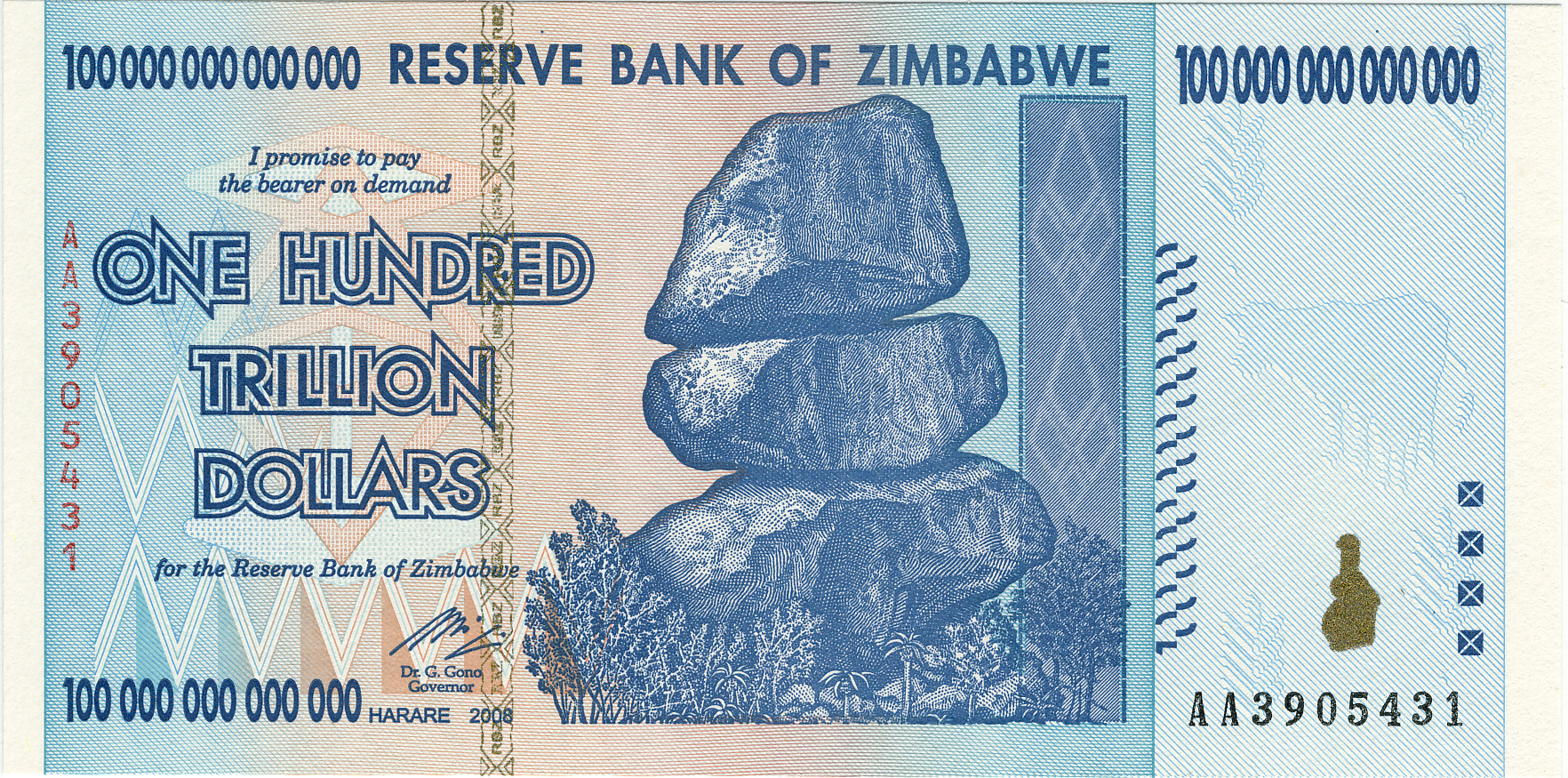
In January 2009, the Reserve Bank of Zimbabwe issued a 100 trillion Zimbabwean dollar note. At that point, a loaf of bread cost more than the note was worth within hours of its release. The denomination was a milestone of collapse, not a tool of commerce.
The Human Cost of the Hyperinflation
Savings Annihilated
The collapse destroyed savings, pensions, and any financial asset denominated in Zimbabwean dollars. People who had saved for decades found their entire life savings could not buy a single meal. Pensioners who had paid into state and private schemes for their entire working lives received payouts that were worthless by the time they were distributed.
Daily Survival
Salaries had to be paid daily or even twice a day, as prices doubled in hours. Basic goods became unaffordable for most of the population. The economy shifted to barter, with goods and services exchanged directly for other goods or for foreign notes. Those with access to US dollars or South African rand could preserve their purchasing power. Those without, particularly in rural areas lacking dollar earnings, faced severe deprivation. Between 2000 and 2008, Zimbabwe's GDP contracted by approximately 40 percent.

The Role of Gideon Gono and the Reserve Bank
Gideon Gono was appointed Governor of the Reserve Bank of Zimbabwe in 2003 and served until 2013. Under his leadership, the central bank operated less as an independent monetary authority and more as a financing arm of the government. The bank printed money to pay civil servants, fund state enterprises, and cover budget deficits. It also issued quasi-currency instruments and enforced price controls that drove goods into informal markets.
Gono's public statements during the crisis attributed inflation to foreign sanctions and speculation, not to monetary expansion. By the time the bank issued the 100 trillion dollar note in January 2009, the currency had lost all credibility. The decision to demonetize the Zimbabwean dollar on 12 April 2009 was an admission that the central bank's strategy had failed. After dollarization, the Reserve Bank effectively ceased to function as a monetary authority for years.
Dollarization and Its Aftermath
Immediate Stabilization
The multi-currency system adopted in 2009 ended hyperinflation immediately. Prices stabilized because they were set in US dollars or South African rand, currencies the Zimbabwean government could not print. Businesses resumed accepting cash payments, and the informal economy began to shrink. But dollarization was not a solution to Zimbabwe's underlying fiscal problems. It simply removed the government's ability to inflate away its debts.
Liquidity Traps and Credit Freezes
Severe liquidity shortages persisted after dollarization. The US dollars circulating in Zimbabwe came from remittances, tourism, and aid, not from exports. There was no central bank lender of last resort. Banks could not extend credit because they had no domestic currency base. The economy operated on a cash basis, and shortages of physical notes became a recurring problem. The government continued to run deficits, but it could no longer finance them by printing money.
Long-Term Consequences and Lessons
Broken Trust and a Lost Sector
The legacy of the hyperinflation extends beyond the abandonment of the currency. Trust in the state as a manager of the economy was destroyed. Zimbabweans who lived through the crisis retain a deep skepticism toward any government-issued currency. The land reform program that triggered the crisis did not reverse course. The commercial farming sector never recovered to its pre-2000 output levels.
A Textbook Case of Fiscal Dominance
The episode is studied by economists as a textbook case of hyperinflation caused by fiscal dominance: a government that cannot borrow from markets forces its central bank to print money, and the result is currency collapse. Zimbabwe's path out was extreme. It required the complete abandonment of the national currency and the surrender of monetary policy to the US Federal Reserve and the South African Reserve Bank. As of April 2025, the country had not fully restored a functioning domestic currency or regained the monetary independence it lost in 2009.
Key Facts
- Peak annual inflation: 89.7 sextillion percent (8.97 × 10^22%) in November 2008
- Largest note issued: 100 trillion Zimbabwean dollars, January 2009
- Total zeros removed via redenomination: 25 (August 2006: 3; August 2008: 10; February 2009: 12)
- Date of dollar demonetization: 12 April 2009
- Currencies replacing ZWL: US dollar and South African rand (primary), multi-currency system
- Central bank governor during crisis: Gideon Gono (2003-2013)
- Triggering policy: Fast Track Land Reform Programme, beginning in 2000
- GDP contraction (2000-2008): Approximately 40%
Related reading: Microsoft, Epic embed GPT-4 into healthcare EHR.