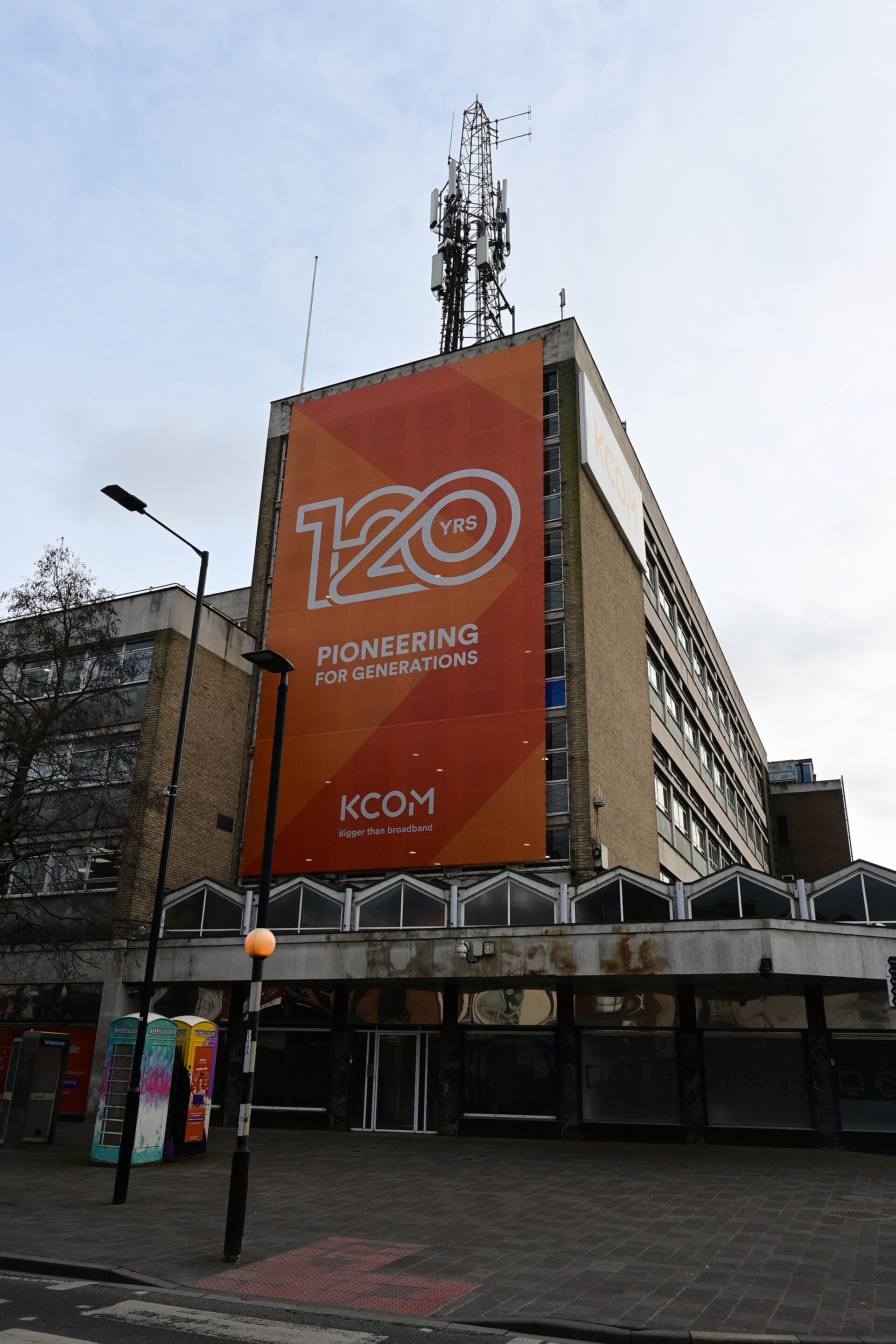
Kingston upon Hull is the only UK city where a single company still controls almost every phone line and broadband connection. KCOM, formerly Kingston Communications, has held that position since 1904, when the city chose to run its own telephone system rather than hand it to the Post Office. That decision created a monopoly that has survived privatisation, multiple regulatory reviews, and a full-fibre upgrade programme. As of 2025, Hull remains a market without serious retail competition, where the usual remedies that opened the rest of the UK to rival providers have never been applied.
The story matters beyond East Yorkshire. KCOM's exclusive grip on Hull's telecoms infrastructure is a real-world test of how a natural monopoly behaves when it is not forced to share its lines. The outcome, so far, is heavy investment in fibre alongside prices unconstrained by the wholesale rules that bind BT Openreach. For regulators and policy makers, the question is whether that trade-off is acceptable, or whether the Hull exception has become an anomaly that no longer makes sense in a full-fibre world.

How Hull kept its own telephone network
In 1904, the Hull Corporation obtained a licence from the Postmaster General to operate its own telephone system. The Post Office was building a national network under a state monopoly, but Hull was allowed to opt out. The municipally owned system grew over the following decades, eventually becoming Kingston Communications in the 1980s. When British Telecom was privatised in 1984, Hull was not included. The city's network stayed in public ownership, run by the local authority.
That arrangement lasted until 1999, when KCOM was privatised and listed on the London Stock Exchange. The sale raised money for the city council, but it also transferred a complete, vertically integrated telecoms network into private hands. Unlike BT, which was broken up structurally and subjected to wholesale access rules, KCOM emerged from privatisation still owning every exchange, every copper line, and every subscriber in Hull. The regulatory framework that followed treated Hull as a special case, and the remedies that opened BT's network to competitors were never applied with the same force.
The infrastructure that rivals cannot reach
The core of KCOM's advantage is physical. The company owns the ducts, the poles, and the copper that connect almost every home and business in Hull.
A competing provider that wants to offer broadband in the city must either build its own infrastructure from scratch or negotiate wholesale access to KCOM's lines. The second option has proved difficult. Ofcom has repeatedly reviewed the Hull market but has not imposed wholesale access obligations equivalent to those it places on BT Openreach elsewhere in the UK.
Without mandated wholesale products, alternative ISPs cannot buy access to KCOM's lines at regulated prices and then compete on service or price. A few providers have tried to enter the market using KCOM's own wholesale products, but those products are voluntary and priced on terms that KCOM sets. The result is that retail competition in Hull is minimal. Most residents have a choice of KCOM's own broadband packages or nothing. The lack of wholesale regulation has preserved KCOM's control over both the infrastructure and the subscriber relationship.
Full fibre, same monopoly
In 2019, KCOM announced a 100 million pound investment programme to upgrade Hull and East Yorkshire to full-fibre broadband. By 2023, the company reported that its fibre network covered over 200,000 premises. That investment has given Hull some of the fastest broadband speeds in the UK, but it has not changed the competitive structure. The fibre is owned by KCOM, and the same barriers that prevented rivals from using the copper network now apply to the new infrastructure.
The fibre upgrade also came at a time when KCOM was under new ownership. In 2019, Macquarie Infrastructure and Real Assets acquired KCOM in a deal valued at approximately 627 million pounds. The Competition and Markets Authority cleared the acquisition without imposing structural remedies. That meant Macquarie, an Australian infrastructure investor, took control of Hull's monopoly with no obligation to open the network. The CMA's decision reflected the regulator's long-standing view that Hull is a distinct market where standard remedies may not apply.
Rival builders arrive, but slowly
From around 2021 to 2022, alternative network providers MS3 Networks and Connexin began building competing fibre infrastructure in parts of Hull and East Yorkshire. These are small-scale builds, not city-wide overbuilds. They target business parks, new housing developments, and areas where KCOM's network is older or less dense. Neither company has announced plans to cover the entire city, and the economics of duplicating KCOM's existing duct network are unfavourable.
The arrival of these rivals is significant as a sign that the market is not completely sealed. But it does not yet amount to meaningful competition. KCOM still passes well over 200,000 premises with fibre, while the combined footprint of MS3 and Connexin is a fraction of that. The incumbency advantage that KCOM holds is not just about ownership of the network. It also includes brand recognition, customer inertia, and the operational cost advantage of maintaining a single infrastructure that already reaches every home.

What Hull pays for its monopoly
KCOM's pricing has been a recurring concern for consumer groups and some local politicians. Without wholesale competition, KCOM can set retail prices that are higher than the UK average for equivalent speeds. The company has argued that its prices reflect the cost of building and maintaining a network in a relatively low-density region, and that Hull's full-fibre coverage is among the best in the country. That argument has some force. Hull residents have access to gigabit-capable broadband that many parts of the UK still lack.
But the trade-off is that they pay more for it, and they have no alternative supplier if they are unhappy with the service. Customer satisfaction data for KCOM is not systematically collected in a way that allows direct comparison with national averages, but anecdotal evidence and local reporting suggest that complaints about pricing and customer service are common. The lack of competition means that KCOM has little incentive to improve either. For businesses in Hull, the monopoly is a constraint on choice and a fixed cost that competitors in other cities do not face.
Regulatory inertia and the Hull question
Ofcom has reviewed the Hull telecoms market several times since the 2000s. In each review, the regulator has concluded that the market is not sufficiently competitive to justify deregulation, but it has also declined to impose the kind of access remedies that would force KCOM to share its network. The reasoning has been that Hull is small, that the cost of regulation would be disproportionate, and that KCOM's full-fibre investment should not be discouraged. That logic has preserved the status quo.
The broader question for policy makers is whether the Hull exception is a model or a warning. If the goal of telecoms regulation is to promote investment while ensuring affordable access, Hull shows that the two can conflict. KCOM invested in fibre because it could expect to capture all the returns. But those returns come from a captive customer base. The rest of the UK, where Openreach is subject to wholesale access rules, has also seen significant fibre investment, but with more retail competition. Whether Hull's monopoly has delivered better outcomes than the regulated alternative is a question that the data, as of 2025, has not settled.
Key facts
- Year Hull's municipal network was established: 1904
- Year KCOM was privatised: 1999
- Acquisition value paid by Macquarie (2019): Approximately £627 million
- KCOM full-fibre investment announced 2019: £100 million
- Full-fibre premises passed as of 2023: Over 200,000
- CMA decision on Macquarie acquisition: Cleared without structural remedies
- Alternative fibre builders active in Hull area: MS3 Networks and Connexin (from c. 2021-2022)
FAQ
Why is Hull the only UK city not served by BT or Openreach?
Hull's city council established its own municipal telephone network in 1904 under a licence from the Postmaster General. That network was never absorbed into the Post Office or British Telecom, and when BT was privatised in 1984, Hull was excluded. The network later became Kingston Communications, now KCOM.
Has Ofcom ever forced KCOM to open its network to competitors?
Ofcom has reviewed the Hull market repeatedly but has not imposed wholesale access obligations equivalent to those on BT Openreach. KCOM offers voluntary wholesale products, but they are not regulated, and competitors have found them unattractive.
Are there any other broadband providers in Hull?
MS3 Networks and Connexin have begun building competing fibre infrastructure in parts of Hull and East Yorkshire since around 2021-2022. Their coverage is far smaller than KCOM's, and they do not yet represent a competitive threat to the incumbent.