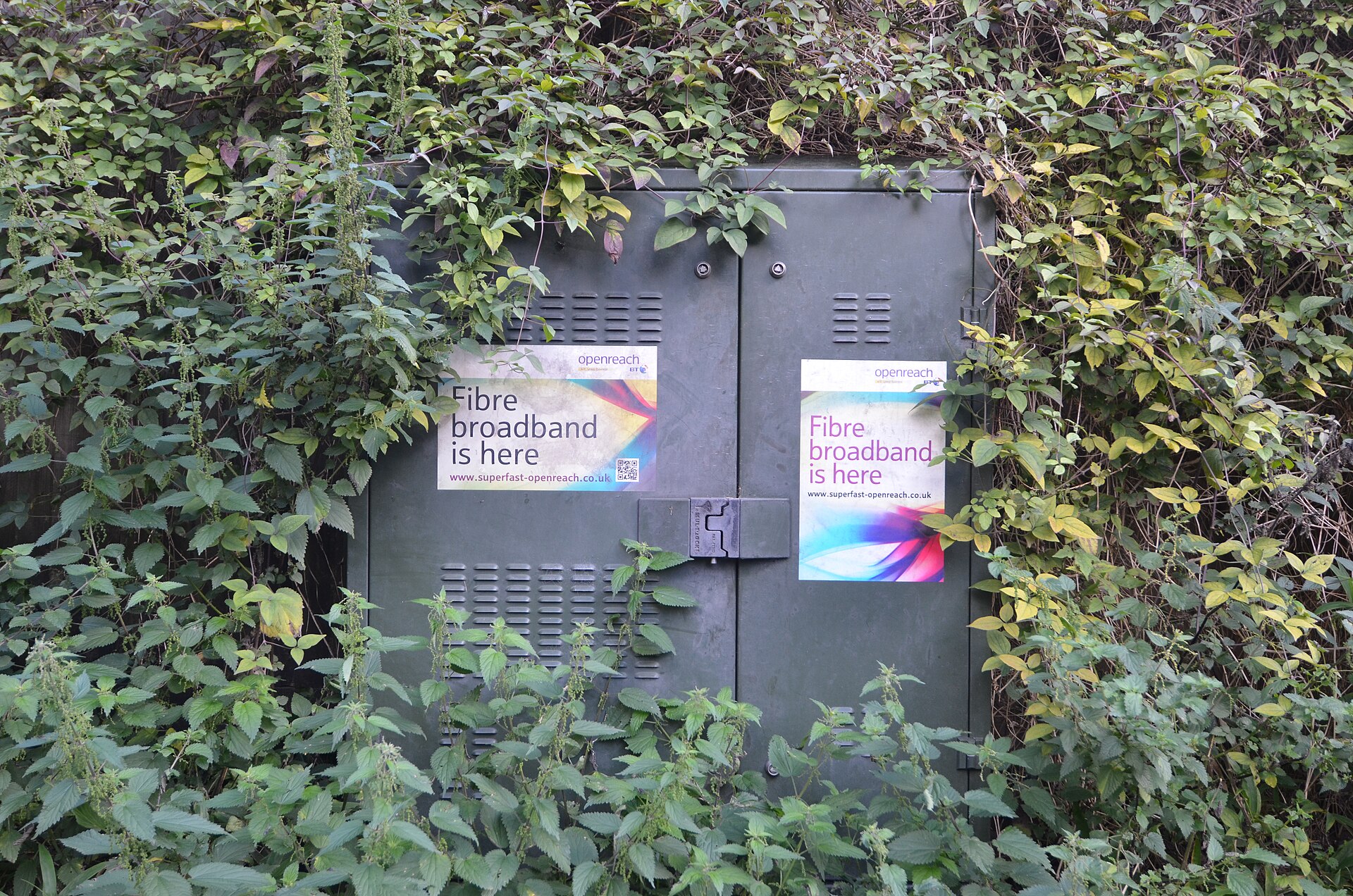
Broadband labelled superfast and ultrafast names two distinct service tiers, but those labels map to specific infrastructure choices, not just marketing. Superfast broadband, defined by Ofcom and the EU as at least 30 Mbps downstream, arrived mostly through Fibre to the Cabinet (FTTC) using VDSL2 across copper telephone lines. Ultrafast, pegged by Ofcom at 300 Mbps and above, came via Fibre to the Premises (FTTP), DOCSIS 3.1 cable, or G.fast. Of the three, G.fast had the shortest lifespan. It was a copper-based stopgap engineered to wring more speed from existing lines before full fibre became cheaper to deploy. In practice, G.fast was commercially rolled out but ultimately overtaken. Openreach halted its G.fast programme in 2019, covering roughly 2.8 million premises, to prioritise full fibre expansion. That move ended G.fast's role as a major strategic platform in the UK.
The split between superfast and ultrafast turns on more than speed; it turns on where the fibre stops. With FTTC, fibre runs from the exchange to a street cabinet, and the final stretch to the home travels over copper. That copper leg caps performance and makes it sensitive to distance. With FTTP, fibre runs all the way to the building, erasing the copper bottleneck entirely. G.fast sat between them: it used fibre to a distribution point (often a pole or pavement box) and then copper for the last few tens of metres. That short copper loop was the key to its performance, and also its weakness.

How Superfast Broadband Works: FTTC and VDSL2
Defining the superfast floor
Superfast broadband, defined by Ofcom and the EU as offering at least 30 Mbps downstream, became the baseline upgrade from standard ADSL in the UK and Europe. The dominant delivery method was FTTC using VDSL2. Very High Speed Digital Subscriber Line 2 is a copper-based protocol that can yield higher throughput than ADSL over short distances. In practice, UK FTTC connections typically supplied between 30 Mbps and 80 Mbps downstream, with upload speeds much lower. Actual throughput depended heavily on the length of the copper line from the cabinet to the home. Customers close to the cabinet got the higher end of the range. Those further away, especially beyond one kilometre, saw rates fall below the superfast threshold.
Ofcom and the EU set the 30 Mbps floor as a regulatory benchmark, not a technical limit. It became the dividing line between basic and superfast broadband. Most UK homes had access to superfast speeds by the late 2010s, but the underlying gear was always a compromise. FTTC could not supply the symmetrical rates that fibre could, and performance eroded with distance. That limitation created the commercial opening for both G.fast and FTTP.
VDSL2’s distance penalty
VDSL2 encodes data at high frequencies that attenuate rapidly on copper pairs. That physics dictated the speed gap: a line 1.5 kilometres from the cabinet might manage only 20 Mbps, below the superfast mark, even when the product was sold as superfast. Because the network reused existing telephone wiring, small variations in copper gauge, joins and corrosion produced unpredictable outcomes street by street. This inconsistency fuelled demand for a technology that could offer ultrafast numbers without fresh digging, and G.fast was the direct answer.
Ultrafast Broadband and the Role of G.fast
The three paths to 300 Mbps
Ultrafast broadband, defined by Ofcom as at least 300 Mbps downstream, represented a step change from superfast. The EU definition sat at 100 Mbps, a lower bar, but in the UK market the 300 Mbps figure became the practical benchmark. Ultrafast speeds arrived through three technologies: FTTP, DOCSIS 3.1 cable networks, and G.fast. Of those, G.fast was the only one that relied on existing copper telephone lines for the final connection. It was an ITU-T protocol (G.9700 and G.9701) designed for local-loop copper access. G.fast could theoretically supply aggregate rates up to 1 Gbps over very short copper loops under 100 metres. In real-world deployments, throughput fell sharply with distance, typically yielding 150 to 300 Mbps at 300 to 500 metres.
Openreach began G.fast trials in 2015 in Huntingdon, Cambridgeshire, and Gosforth, Newcastle. It commercially introduced G.fast in January 2017. The product was touted as a way to offer ultrafast numbers without the cost and disruption of digging fibre to every home. For a period, it was presented as a pragmatic substitute for FTTP. But the speed-distance trade-off was severe. A customer whose copper line stretched beyond 100 metres saw performance dip beneath the ultrafast threshold. The technology was also asymmetric, with upload speeds much lower than downstream, which mattered for applications like video conferencing and cloud uploads.
The G.fast performance envelope
G.fast’s headline figures depended on ideal conditions: pristine copper shorter than 100 metres, minimal crosstalk, and a distribution point powered and connected without faults. Outside that narrow window, real-world results diverged fast. At 300 metres a line might still rate as ultrafast, but at 400 or 500 metres it often fell closer to VDSL2 territory. This steep falloff meant operators could only promise ultrafast service to a subset of homes passed, complicating marketing and consumer expectations. Competing platforms such as DOCSIS 3.1 delivered top speeds over longer reaches from a street cabinet, making G.fast look fragile by comparison.
Why G.fast Was Deployed and Why It Was Halted
The economic pitch for copper reuse
The commercial case for G.fast was straightforward. Running FTTP to every building was expensive and slow. It demanded trenches, new ducts, and wayleave agreements from property owners. G.fast reused the existing copper network, with fibre extended only to a distribution point sitting close to the home. That slashed civil-engineering costs and accelerated rollouts. For an operator like Openreach, G.fast was a way to offer ultrafast speeds to a large base of customers quickly while full fibre was built out over a longer timeline. Other operators in the EU also trialled or adopted G.fast for similar reasons, though the UK was one of the more prominent markets.
The pivot to full fibre
By 2019, the calculus had changed. The cost of FTTP deployment had fallen, and the limitations of G.fast were plain. Openreach announced it would stop G.fast rollout at around 2.8 million premises and shift focus to full fibre. The decision reflected a strategic judgment that FTTP was the better long-term investment. G.fast had served as a bridge, but it was a bridge to full fibre, not a destination. The system was not a failure: it yielded ultrafast speeds to hundreds of thousands of homes. But it was a stopgap, and once the economics of FTTP improved, that stopgap was no longer necessary.
Advertised Speeds versus Real World Performance
Why copper headlines misled
The gulf between advertised speeds and actual throughput was especially wide for G.fast, because its output was acutely sensitive to line length and copper quality. An ISP could promote up to 1 Gbps, but a customer 300 metres from the distribution point would see 150 to 300 Mbps. That was still quick, but it was not the headline figure. For FTTC, the gap was also significant and distance-driven. A line 1.5 kilometres from the cabinet might yield only 20 Mbps, beneath the superfast mark, even though the package was sold as superfast. FTTP was less affected by span, because light does not suffer the same attenuation as electrical signals on copper. An FTTP connection could provide symmetrical speeds of 1 Gbps and beyond regardless of how far the home sat from the exchange, provided the fibre was properly installed and spliced.
The physical ceiling no copper could break
For operators and investors, the lesson was that copper-based systems hit a hard physical ceiling. G.fast pushed that ceiling higher, but it could not shatter it. The speed drop with distance was not a bug; it was the nature of copper transmission. Full fibre removed that constraint completely. That reasoning is why Openreach paused G.fast at 2.8 million premises and why most major UK and EU operators have since prioritised FTTP. G.fast was a useful transitional platform, but it was never the long-term answer. The distinction between superfast and ultrafast mattered most when copper was the limiting factor. With full fibre, that distinction thins, because the medium can sustain speeds far beyond either administrative threshold.
Key Facts
- Superfast broadband definition (Ofcom/EU): At least 30 Mbps downstream
- Ultrafast broadband definition (Ofcom): At least 300 Mbps downstream
- Ultrafast broadband definition (EU): At least 100 Mbps downstream
- G.fast theoretical maximum: Aggregate speeds up to 1 Gbps over very short copper loops (under 100 metres)
- G.fast real-world speeds at 300-500 metres: Typically 150-300 Mbps
- G.fast standard: ITU-T G.9700 and G.9701
- Openreach G.fast trials began: 2015 in Huntingdon, Cambridgeshire and Gosforth, Newcastle
- Openreach G.fast commercial launch: January 2017
- Openreach halted G.fast rollout: 2019 at approximately 2.8 million premises
- FTTP capability: Symmetrical speeds of 1 Gbps and beyond
Broadband Technology Comparison
| Technology | Infrastructure | Typical Speed Range | Key Limitation |
|---|---|---|---|
| Superfast (FTTC/VDSL2) | Fibre to cabinet, copper to home | 30-80 Mbps downstream | Speed drops with copper line length |
| Ultrafast (FTTP) | Fibre to premises | 1 Gbps and beyond, symmetrical | Higher deployment cost and time |
| Ultrafast (G.fast) | Fibre to distribution point, short copper loop | 150-300 Mbps at 300-500 metres | Speed drops sharply beyond 100 metres |
| Ultrafast (DOCSIS 3.1) | Hybrid fibre-coaxial cable | Up to 1 Gbps downstream | Shared bandwidth in peak times |
Frequently Asked Questions
What is the difference between superfast and ultrafast broadband?
Superfast broadband is defined by Ofcom and the EU as offering at least 30 Mbps downstream. Ultrafast broadband is defined by Ofcom as at least 300 Mbps, and by the EU as at least 100 Mbps. Superfast typically arrived via FTTC using VDSL2, while ultrafast came via FTTP, DOCSIS 3.1, or G.fast.
Why was G.fast deployed if full fibre is better?
G.fast reused existing copper telephone lines, which cut the cost and disruption of deployment compared with digging fibre to every home. It allowed operators to offer ultrafast speeds faster while FTTP was built out over a longer timeline. Once FTTP deployment costs fell, the stopgap was no longer necessary.
What happened to G.fast in the UK?
Openreach began G.fast trials in 2015 and commercially launched the system in January 2017. In 2019, it stopped the rollout at roughly 2.8 million premises to prioritise full fibre (FTTP) expansion, ending G.fast's role as a major strategic platform in the UK.
How fast is G.fast in practice?
G.fast can theoretically reach aggregate speeds up to 1 Gbps over very short copper loops under 100 metres. In real-world conditions at 300 to 500 metres, it typically yields 150 to 300 Mbps. Throughput drops sharply with distance.