Ofcom's Chief Technology Officer sat down with LeadMonitor in mid-2021 to answer a question that mobile operators were spending heavily to avoid: when will 5G actually change anything for the person holding the phone? The CTO's answer, delivered without the usual regulatory caution, was that the first few years of 5G would deliver incremental improvements to mobile broadband, not the factory-floor transformations that marketing campaigns promised. The revolution, if it came at all, would arrive late in the decade.
The interview came as the UK's four mobile carriers were racing to light up 5G in city centres, each claiming faster speeds and lower lag. Ofcom's job in that moment was to allocate the physical resource that makes 5G work and to prevent the hype from creating expectations that physics could not meet. The CTO described the gap between what the technology could do in a lab and what it could do across a congested city as the central problem of UK 5G deployment. That gap is closing slowly. As of mid-2025, 5G coverage in the UK remains patchy outside major urban areas, and the applications that were supposed to justify the investment, autonomous vehicles, remote surgery, immersive augmented reality, are still mostly demonstrations. The CTO's assessment from four years ago holds up better than the carrier press releases that were running at the same time.
The spectrum puzzle and its trade-offs
The CTO described spectrum allocation as the single most consequential decision Ofcom would make for 5G. Different frequency bands have fundamentally different physical properties, and no single band can deliver coverage, capacity, and low lag at the same time. The regulator's task was to make bands available in a sequence that gave carriers something to build now while reserving higher frequencies for later, denser deployments.
Low-band airwaves, around 700 MHz, travel far and penetrate walls. It is what makes a signal work indoors and in rural areas. But it carries relatively little data. Mid-band frequencies, around 3.6 GHz to 3.8 GHz, offer a balance of coverage and capacity and became the workhorse of early UK 5G. High-band airwaves, sometimes called millimetre wave at 26 GHz and above, carry enormous amounts of data but barely reach the next street. A single tree can block it.
The trade-off meant early 5G would look like faster 4G for most users, because carriers would deploy on mid-band first and use it to increase capacity in dense areas. The low-band frequencies would come later for coverage. The high-band airwaves would come much later, and only in places where carriers could afford to install small cells every few hundred metres. That sequencing was not a failure of regulation, the CTO argued. It was a recognition of how radio waves actually behave.
Why the transition is evolutionary, not revolutionary
Mobile generations do not switch on like a light. A 5G base station requires new radio equipment, new software, and a connection back to the core that can handle the data load. Most UK sites in the early years were what the industry calls non-standalone 5G, meaning the radio was new but the core behind it was still 4G. That configuration improves speed but does not deliver the ultra-low lag that the futuristic use cases require.
The CTO compared the transition to the shift from 3G to 4G. That move took roughly a decade from first deployment to widespread meaningful use. 4G enabled the app economy, but not in year one. The first 4G phones were expensive. The coverage was spotty. The applications that defined the generation, Uber, Snapchat, mobile video streaming, arrived years after the networks were built. The CTO expected a similar pattern for 5G.
The evolutionary nature of the rollout was not a criticism of the technology. The CTO said 5G was genuinely different from 4G in its architecture, particularly in its ability to slice the network into virtual segments for different uses. But that capability required software upgrades and standards that were still being written when the interview took place. The revolution would arrive when the standards matured, not when the first mast went live.
What consumers and businesses actually get in the near term
Consumer gains: consistency, not transformation
For the first few years of deployment, the CTO said the main benefit for consumers would be more consistent mobile broadband in places where 4G was congested. Train stations, stadiums, city centre shopping streets, anywhere that hundreds of people tried to stream video at the same time. 5G on mid-band frequencies adds capacity, which means fewer dropped connections and less buffering. That is a real improvement, but it is not the kind of improvement that changes how people live.
Business applications: early wins and distant promises
For businesses, the near-term use cases were narrower. Fixed wireless access, where a 5G signal replaces a wired broadband connection, was the CTO's example of a practical early application. A small business in a city centre could get gigabit speeds without waiting for a fibre installation. That had real economic value. But the factory automation, the autonomous guided vehicles, the real-time remote control of machinery, those required the standalone 5G core and the low lag that came with it, and those were years away.
The regulator's stance on overpromising
The CTO said that Ofcom's role was to make sure the airwaves were available when the technology was ready, not to force the technology faster than the standards and the equipment could support. Carriers who claimed to be building the factory of the future in 2021 were, in the CTO's view, selling a vision that the network could not yet deliver.
The infrastructure challenge that slows everything down
The fibre bottleneck
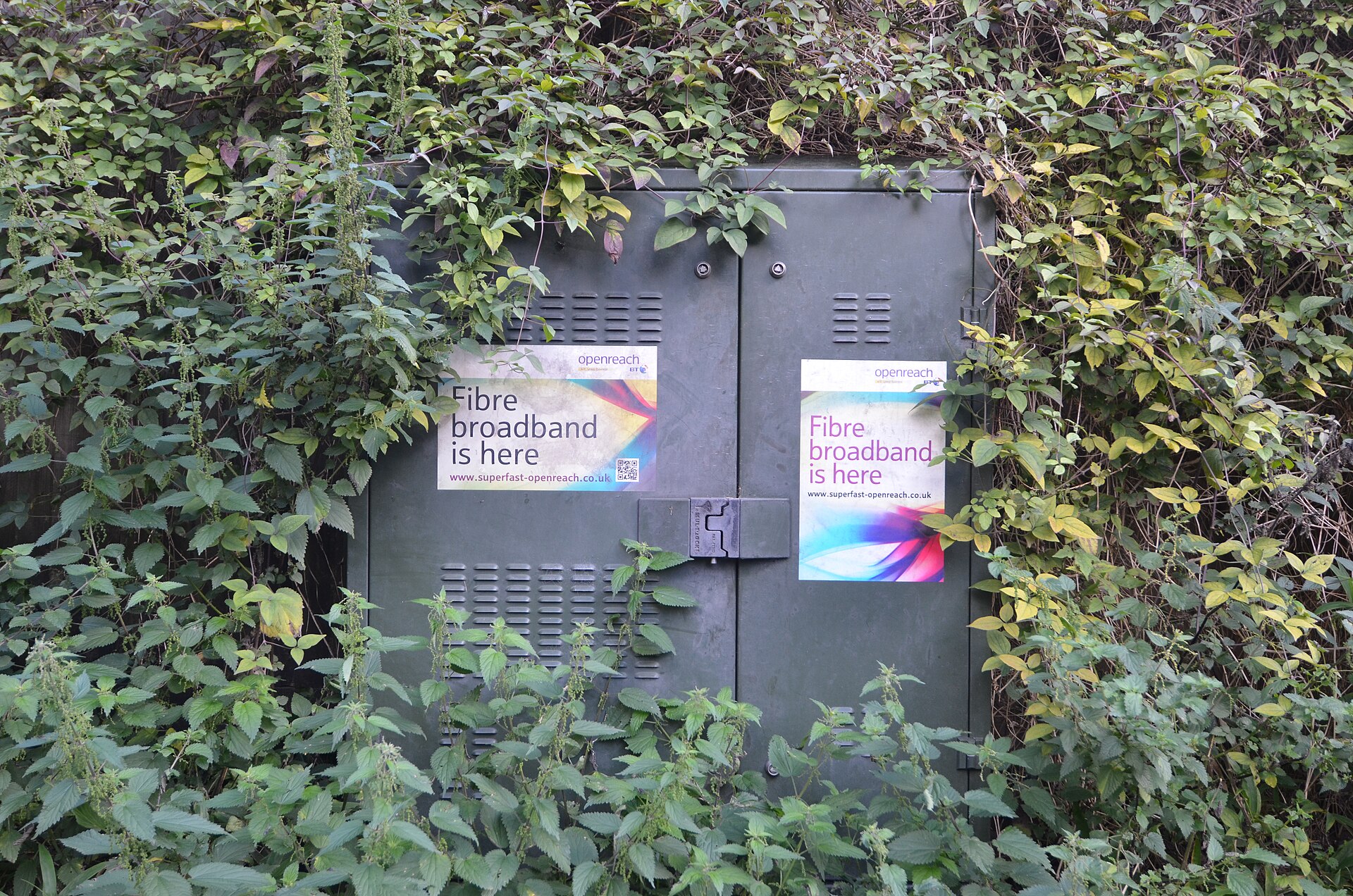
The CTO spent a significant portion of the interview on infrastructure, specifically the parts of the network that are not radio waves. Every 5G base station needs a fibre connection back to the core. Without that backhaul, the radio can send data at gigabit speeds to the phone, but the data has nowhere to go. The CTO said that in many UK locations, the fibre does not exist, and laying it is expensive and slow.
The small-cell slog
Small cells, the compact base stations that high-band 5G requires, present a different set of problems. They need to be mounted on street furniture, lampposts, bus shelters, building facades. Each installation requires planning permission, wayleave agreements with the landowner, and a power supply. The CTO said that Ofcom had been working with local authorities to streamline the process, but the pace of deployment was still constrained by the physical reality of installing thousands of small boxes across thousands of streets.
How the UK compares
The CTO acknowledged that the UK was not alone in facing these problems. Every country deploying 5G was discovering that the hardest part was not the radio technology but the civil engineering. The difference was that some countries, particularly in East Asia, had more centralised control over street furniture and faster planning processes. The UK's system, which gives significant power to local councils, was not built for a technology that requires a new antenna every few hundred metres.
The CTO's timeline versus the operators' marketing
The gap between what carriers claimed and what the CTO believed was measurable. Carrier marketing in 2020 and 2021 promised gigabit speeds everywhere, sub-10 millisecond lag, and use cases that included remote surgery and autonomous driving. The CTO said that the speeds were real in ideal conditions, but ideal conditions meant standing directly under a mast with a clear line of sight and no other users sharing the cell. The lag improvements required the standalone core, which was still being deployed in trials.
The CTO did not name any carrier directly, but the implication was clear. Marketing departments were using the peak performance numbers from technical specifications as if they were the typical experience. Ofcom's own testing had shown that real-world 5G speeds varied enormously depending on location, time of day, and network load. The CTO said that the regulator's job included making sure that consumers had accurate information about what they were buying, and that meant pushing back on claims that the network could not support.
Ofcom had published consumer guidance on 5G that emphasised the variability of real-world performance. The CTO said that guidance was not intended to dampen enthusiasm. It was intended to prevent disappointment. A customer who buys a 5G phone expecting a revolution and gets a slightly faster 4G experience is a customer who loses trust in the technology and the regulator.
The regulatory decisions that shaped the rollout
Spectrum auctions and coverage strategy
Ofcom's most concrete action to facilitate 5G was the auction of airwaves in the 700 MHz and 3.6 GHz bands. The CTO said that the regulator had designed the auction to ensure that all four mobile carriers could acquire enough frequencies to compete, while also reserving some for new entrants or shared access models. The 700 MHz band was particularly important for rural coverage, because its propagation characteristics meant fewer masts were needed to cover the same area.
Shared access: squeezing more from what exists
The CTO also described Ofcom's work on spectrum sharing. Not all frequencies are used all the time. The 3.8 GHz to 4.2 GHz band, for example, was used by satellite ground stations and other incumbent users, but it sat idle in many locations. Ofcom was developing a framework that would allow 5G carriers to use those frequencies when the incumbents were not transmitting, effectively creating new capacity without a full clearance process. That approach, the CTO said, could open up significant additional airwaves without the years of negotiation that a full band clearance would require.
Updating the rules for a small-cell world
On the regulatory front, Ofcom was preparing to update the Electronic Communications Code to make it easier for carriers to install infrastructure on private land. The CTO said the existing code, written before 5G was conceived, did not adequately address the need for thousands of small cells on street furniture. The update would give carriers stronger rights to access land and street assets, while protecting the interests of landowners and local communities. Those changes, the CTO argued, were as important as the frequency auctions in determining how quickly 5G would actually matter.
Key facts from the interview
- Regulator: Ofcom, the UK's communications regulator
- Interviewee: Ofcom's Chief Technology Officer (exact name not confirmed for the date of the interview)
- Focus: Realistic timeline and practical impact of 5G in the UK
- Core argument: 5G rollout would be evolutionary, not revolutionary, with near-term benefits limited to faster mobile broadband
- Spectrum strategy: Sequential release of low-band (coverage), mid-band (capacity), and high-band (dense urban) spectrum
- Infrastructure bottleneck: Fibre backhaul and small cell deployment, not radio technology, were the main constraints
- Regulatory actions: Spectrum auctions, shared access frameworks, and updates to the Electronic Communications Code
Questions the CTO answered
Will 5G be a revolution?
No, the CTO said it would be an evolution similar to the 3G-to-4G transition, taking roughly a decade for transformative use cases to emerge.
What will consumers notice first?
More consistent mobile broadband in congested areas like train stations and stadiums, not ultra-low latency or new applications.
Why is deployment so slow?
The main constraints are fibre backhaul, small cell planning permissions, and the time needed to mature network standards, not the radio technology itself.
What is Ofcom doing to help?
Auctioning spectrum in multiple bands, developing shared access frameworks, and updating the Electronic Communications Code to ease infrastructure deployment.
Are operator claims realistic?
The CTO said peak performance numbers from marketing are not representative of typical real-world experience, which varies significantly by location and network load.