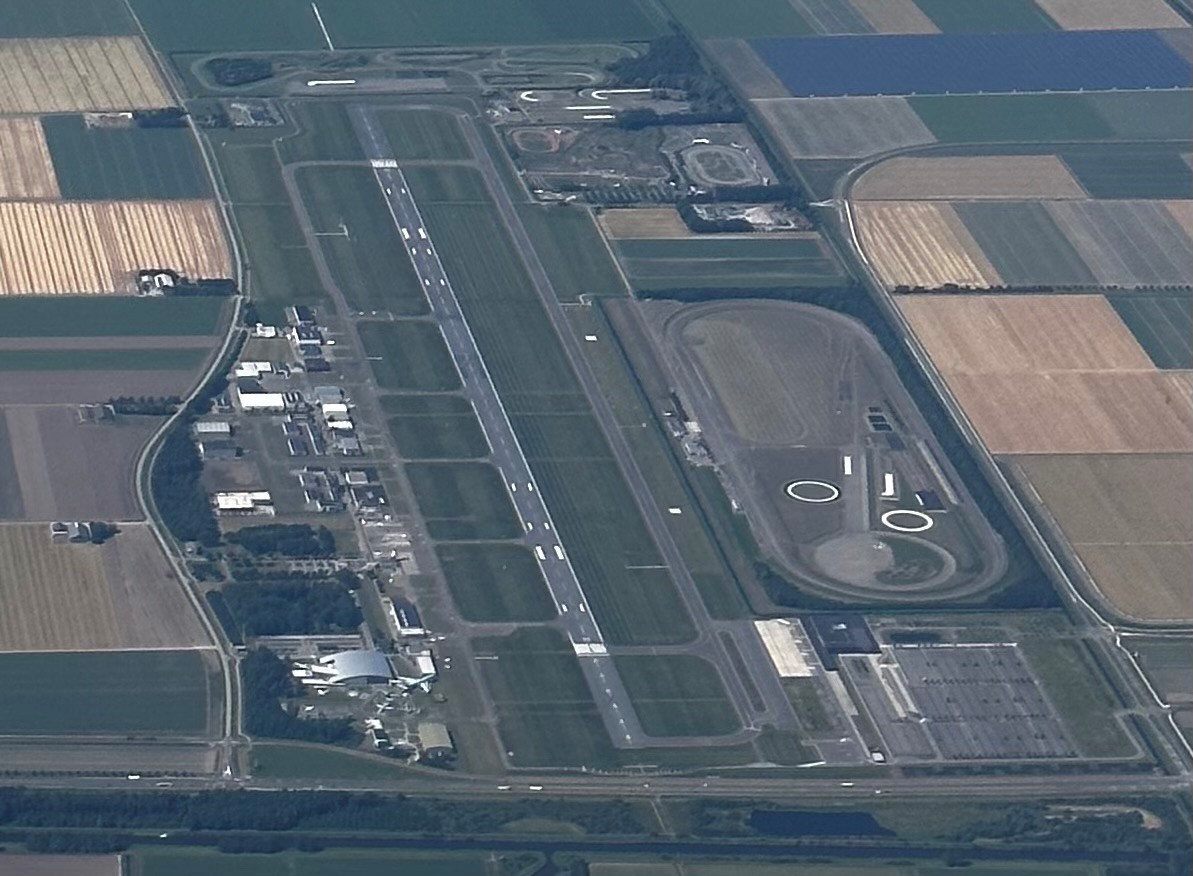
The Smart Town project in Lelystad, Netherlands, was conceived as a large-scale, real-world testing ground for 5G and smart-city technologies. It was to be built on a site near Lelystad Airport. VodafoneZiggo was the lead corporate partner. The municipality of Lelystad was the key public-sector partner. The project was officially cancelled in 2019 after the Dutch Radiocommunications Agency could not grant the necessary trial 5G spectrum licence. The 3.5 GHz band, which the project required, remained occupied by an Inmarsat satellite ground station in Burum that had precedence over the frequency. The municipality and VodafoneZiggo jointly announced the termination. The planned testbed was never built.
The project was intended to test a range of smart-city applications: connected traffic management, autonomous vehicles, smart energy grids, public safety systems, and advanced logistics using 5G's low latency and high bandwidth. The site near Lelystad Airport was chosen for its relatively open, controlled environment, which would have allowed partners to deploy infrastructure and run experiments without interfering with a dense urban population. The ambition was to create a blueprint for other European cities looking to adopt 5G-based urban services.
The failure of Smart Town is instructive because it was not a technology or funding problem that killed it. It was a regulatory problem: a single satellite ground station in the north of the Netherlands, operated by Inmarsat, had long-standing precedence on the 3.5 GHz spectrum band. The Dutch Radiocommunications Agency could not issue a trial permit for that band without interfering with that existing user. No alternative band was offered that would have served the project's technical requirements. The termination was announced in 2019, and the site was never developed.

What the Smart Town project was meant to be
The Smart Town project was a planned development on a greenfield site near Lelystad Airport, about 60 kilometres east of Amsterdam. It was designed as a dedicated test environment for 5G-enabled smart-city technologies. Unlike many smart-city pilots that retrofit sensors and connectivity onto existing infrastructure, Smart Town was to be built from scratch: roads, buildings, utilities, and communications networks would all be designed around 5G from the outset.
A greenfield urban laboratory
The project's vision was to attract technology companies, researchers, and public-sector agencies to collaborate on real-world trials. Applications planned for testing included connected and autonomous vehicles communicating with traffic infrastructure, smart street lighting that adjusts to pedestrian and vehicle presence, real-time air quality monitoring, and intelligent waste collection systems. The testbed was also expected to host trials of drone-based delivery and inspection services, advanced public safety communications for emergency services, and energy grids that balance supply and demand using 5G data flows.
Partners and governance
VodafoneZiggo, the joint venture between Vodafone and Ziggo that is one of the Netherlands' largest telecom operators, was the lead corporate partner. It would have provided the 5G network infrastructure and expertise. The municipality of Lelystad contributed the land and local regulatory support. Other technology partners were expected to join as the project developed, though the cancellation came before any wider consortium was formally assembled.
The spectrum problem that stopped the project
The central obstacle was the 3.5 GHz spectrum band. This band is widely considered a prime frequency for 5G because it offers a good balance of coverage and capacity. The Smart Town project required a trial permit to use this band for its testbed. The Dutch Radiocommunications Agency, the national authority responsible for spectrum allocation, could not grant that permit.
The Burum ground station
The reason was a satellite ground station in Burum, a small village in the province of Friesland. The station is operated by Inmarsat, a British satellite telecommunications company. It uses the 3.5 GHz band for satellite-earth communications, and it holds precedence rights that predate the 5G era. The agency determined that any trial 5G transmissions in that band could cause harmful interference to the satellite station. No technical mitigation, such as geographic separation or power limits, was deemed sufficient to resolve the conflict.
A dead end, not a delay
This was not a case of bureaucratic delay. The agency's hands were tied by international spectrum coordination agreements and Inmarsat's existing authorisation. The 3.5 GHz band was simply not available for new uses in the Netherlands as long as the Burum station remained operational. The project's partners explored options, but no alternative spectrum band was offered that would meet the technical requirements for the planned 5G trials. The regulatory path was a dead end.
The cancellation and the public announcement
The Smart Town project was officially cancelled in 2019. The municipality of Lelystad and VodafoneZiggo issued a joint statement announcing the termination. The statement attributed the decision to the inability to secure the necessary 5G spectrum permit. No specific date within 2019 was given in public reports, but the cancellation was confirmed by both parties and widely covered in Dutch technology and local news media.
Partner reactions
The municipality expressed disappointment. It had invested time, staff resources, and political capital in the project, which was seen as a way to position Lelystad as a hub for technology and innovation. The city had also hoped that the project would attract businesses and jobs to the region. VodafoneZiggo, for its part, said it remained committed to 5G development in the Netherlands but acknowledged that the Smart Town site could not proceed under the existing spectrum constraints.
Financial and contractual aftermath
Neither side disclosed any financial penalties or compensation. The land near Lelystad Airport that had been earmarked for the project was not developed for smart-city purposes. The precise financial value of the project, and any investments already made, were not publicly detailed. The cancellation was final; there was no plan to relocate the project to another Dutch site, at least not under the Smart Town name or with the same partnership structure.
What happened to the spectrum after the cancellation
The 3.5 GHz band remained in use by the Inmarsat ground station in Burum after the Smart Town project was cancelled. The band was not immediately reallocated for 5G. The Dutch government, through the Radiocommunications Agency, continued to manage the band in accordance with international agreements and Inmarsat's existing rights.
The evolving European landscape
In the years that followed, the broader European spectrum landscape for 5G evolved. The 3.5 GHz band was designated as a primary band for 5G in many EU countries, and national regulators began auctioning or assigning licences for it. In the Netherlands, however, the Burum station remained a constraint. The Dutch government eventually worked on a plan to relocate or compensate Inmarsat to free up the band for mobile use. That process was ongoing as of late 2023 and was not directly related to the Smart Town project, which had already been abandoned.
A lasting regulatory lesson
The Smart Town experience demonstrated that trial spectrum permits, while intended to foster innovation, are subject to the same precedence rules as commercial licences. A project that depends on a specific band cannot proceed if that band is occupied by an incumbent user with superior rights, regardless of the project's public interest or innovative potential. The spectrum was not reallocated to Smart Town or any similar project after the cancellation.

Reactions from the partners and the precedent set
The municipality of Lelystad and VodafoneZiggo both stated that the cancellation was a direct result of the spectrum issue, not a failure of the project concept or partnership. The municipality noted that the project had strong local support and that the technical planning was advanced. VodafoneZiggo indicated that it would focus its 5G testbed efforts on other sites where spectrum was available, though it did not name specific alternatives.
A precedent for European testbeds
The Smart Town cancellation set a precedent for other European 5G testbeds that rely on trial spectrum allocations. It showed that a single incumbent user with precedence on a frequency band can block a project, even when the project has government backing and corporate resources. This was not a theoretical risk; it was a concrete outcome that other projects had to consider when choosing sites and spectrum bands.
Policy takeaways
For policy makers, the lesson was that trial spectrum permits need to be secured early in the project planning process, and that the status of incumbent users must be fully understood before commitments are made. The Dutch Radiocommunications Agency was not at fault; it followed its legal obligations. But the episode highlighted a gap between the ambitions of smart-city promoters and the realities of spectrum management, where international agreements and existing authorisations can override national innovation goals.
Broader implications for European smart-city initiatives
The Smart Town failure is a case study for any European city or region planning a 5G testbed. The most obvious implication is that spectrum availability is not a secondary concern; it is the primary constraint. A project that requires a specific band cannot assume that a trial permit will be granted, even if the project has political support and commercial partners.
What worked elsewhere
Several European 5G testbeds have succeeded where Smart Town failed. Projects in Turin, Barcelona, and Hamburg, for example, secured spectrum access through national regulators before breaking ground. Those projects typically used bands that were already cleared for mobile use or that had no incumbent users with precedence. The contrast with Smart Town is instructive: the Dutch project failed not because the technology was unproven or the partners were unwilling, but because the spectrum was simply not available.
A fragmented regulatory reality
The broader lesson for investors and operators is that the regulatory environment for trial spectrum is fragmented across Europe. Each national regulator has its own rules, and each band has its own history of incumbent users. A project that works in one country may be impossible in another, even if the technology and business case are identical. The Smart Town project in Lelystad was a well-conceived initiative that collapsed on a single regulatory obstacle. That obstacle has not been removed, and the site remains undeveloped as of late 2023.
Key facts
- Project name: Smart Town
- Location: Lelystad, Netherlands, near Lelystad Airport
- Lead corporate partner: VodafoneZiggo
- Lead public-sector partner: Municipality of Lelystad
- Primary regulatory body: Dutch Radiocommunications Agency
- Spectrum band required: 3.5 GHz
- Incumbent spectrum user: Inmarsat satellite ground station in Burum
- Outcome: Cancelled in 2019; testbed never built
Frequently asked questions
Why was the Smart Town project cancelled?
The project was cancelled because the Dutch Radiocommunications Agency could not grant a trial 5G spectrum permit for the 3.5 GHz band. The band was already occupied by an Inmarsat satellite ground station in Burum, which had precedence.
Who were the main partners in Smart Town?
VodafoneZiggo was the lead corporate partner, and the municipality of Lelystad was the key public-sector partner.
What technologies were going to be tested at Smart Town?
The project planned to test connected and autonomous vehicles, smart traffic management, smart energy grids, public safety systems, drone services, and other 5G-enabled smart-city applications.
Did the project relocate to another site after the cancellation?
No. The project was cancelled and not relocated. No alternative site was announced under the Smart Town name or with the same partnership structure.
What happened to the 3.5 GHz spectrum after the cancellation?
The band remained in use by the Inmarsat ground station. The Dutch government later worked on plans to relocate or compensate Inmarsat to free the band for mobile use, but that process was separate from the Smart Town project.