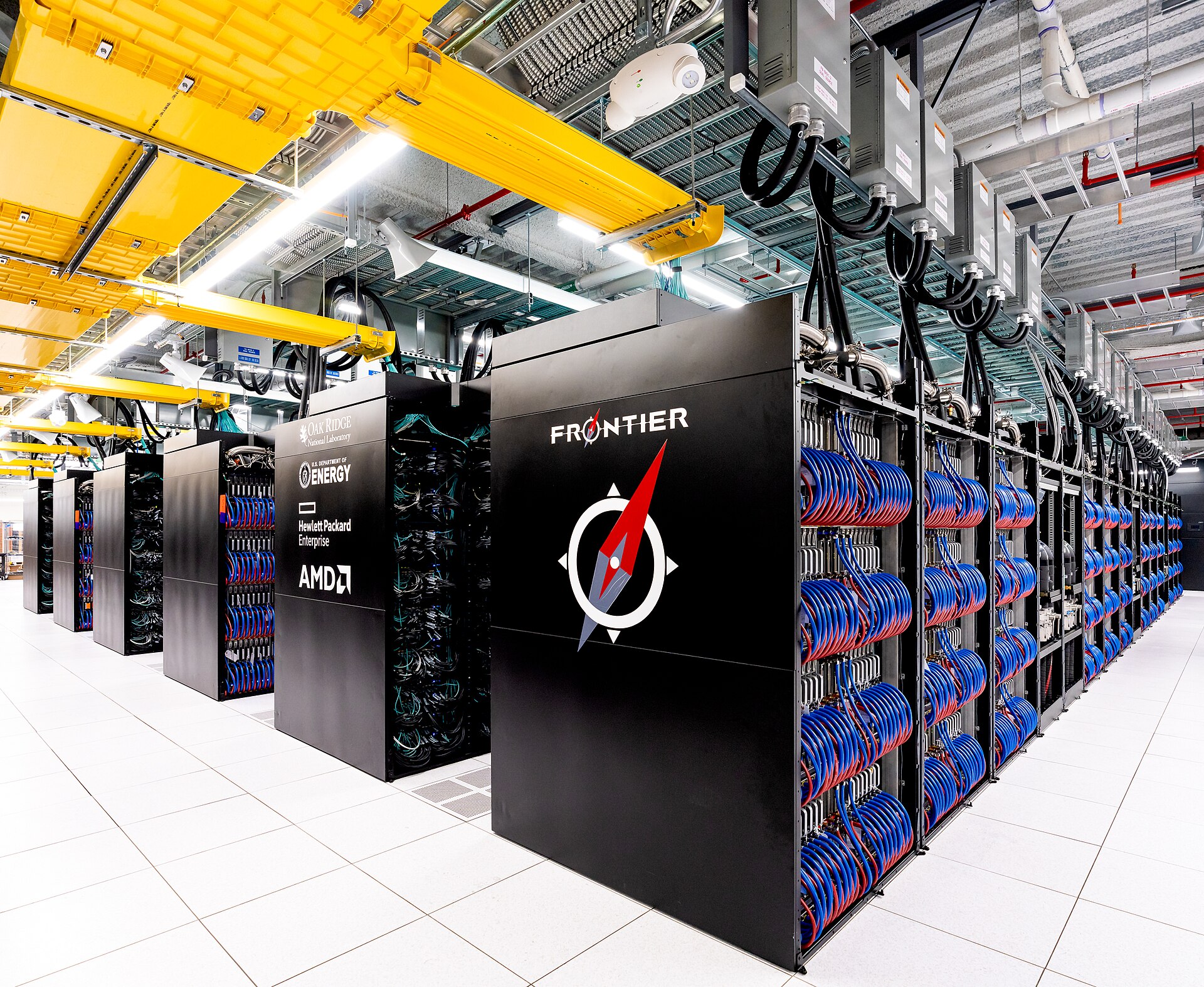
A supercomputer is a machine engineered to deliver the highest possible floating-point throughput, measured in FLOPS. The TOP500 project has ranked installations by their LINPACK benchmark score since 1993, and the list remains the de facto yardstick for national and corporate bragging rights. Frontier, at Oak Ridge National Laboratory, was the first to officially break the exascale barrier, reaching 1.1 exaflops in 2022.
That milestone carries less weight than it seems. China has previously led the TOP500 with Sunway TaihuLight and Tianhe-2, and Chinese exascale installations are believed to be operational but have never submitted official benchmarks. The gap between the public ranking and real capability is now a political question, not a technical one.
The field is splitting into two workload families. Traditional HPC runs scientific modeling, climate simulation and weather forecasting, where double-precision arithmetic dominates. Modern AI training uses lower-precision math and demands a different hardware mix. A single machine often runs both workloads, but the processor architectures that win each market are diverging fast.

How the TOP500 defines a supercomputer
The TOP500 ranks installations by their score on the LINPACK benchmark, which solves a dense linear-equation set. The test rewards architectures with fast matrix-multiplication pipelines and generous memory bandwidth, which explains why GPU-accelerated setups now own the top slots. The benchmark has drawn criticism for not reflecting genuine application throughput, yet no alternative has displaced it.
The list updates twice a year, at the International Supercomputing Conference in June and the SC conference in November. Vendors submit results voluntarily, and national labs and universities are the primary submitters. The US Department of Energy operates several of the world's most powerful installations, including Frontier and its predecessors. China stopped submitting new entries after 2017, so its current capability is inferred rather than measured.
The migration from monolithic custom builds to clusters of commodity hardware is complete. Every installation in the top ten uses off-the-shelf processors or GPUs from Intel, AMD, or NVIDIA linked by proprietary interconnects. The era of bespoke vector processors is over.
Exascale: Frontier, Aurora, and the Chinese question
Frontier: the first public exaflop
Frontier reached 1.1 exaflops in 2022 using AMD EPYC CPUs and AMD Instinct MI250X GPUs. It is housed at Oak Ridge National Laboratory under the US Department of Energy. The installation serves materials science, climate modeling and fusion energy research.
Aurora and Intel's comeback bid
The Aurora exascale installation at Argonne National Laboratory was originally slated for 2018 but has faced repeated delays. Its full deployment status as of October 2023 is not established here. Aurora pairs Intel Xeon CPUs with Intel Data Center GPU Max accelerators, making it the test case for Intel's return to the HPC top tier.
China's invisible exascale fleet
China is believed to operate at least two exascale installations, the Sunway Oceanlite and the Tianhe-3. Neither has submitted a LINPACK result. The government has offered no explanation, and the TOP500 project cannot rank what it cannot measure. The practical effect: the US leads the public list while China likely leads in total deployed capacity. The stakes are plain. Supercomputing is a dual-use technology with direct applications in weapons design and signals intelligence, and both countries treat it as a strategic asset.
The processor landscape: x86, ARM, and GPU accelerators
The x86 core battle
Intel's Xeon line served as the default CPU for HPC clusters for two decades, but AMD's EPYC processors have gained share through higher memory bandwidth and more PCIe lanes per socket. Frontier uses AMD exclusively, a visible shift from the Department of Energy's Intel-dominated fleet.
NVIDIA's accelerator grip
NVIDIA holds the dominant position in GPU accelerators. Its A100 and H100 chips power most AI training clusters and many TOP500 entries. AMD's Instinct line competes on raw FLOPS but lacks the software ecosystem of NVIDIA's CUDA platform, which remains the standard for scientific GPU computing.
ARM's quiet momentum
ARM-based builds are a smaller but expanding segment. The Fugaku installation at RIKEN in Japan uses Fujitsu's A64FX ARM processor and held the number-one TOP500 slot from 2020 to 2022. Fugaku is tuned for physical modeling workloads, it tackled COVID-19 drug discovery and tsunami simulation, and demonstrates that ARM can deliver lower power consumption per core, a decisive metric at exascale power budgets. ARM has not yet displaced x86 across the broader HPC market.
Applications driving demand and the European response
Traditional modeling still dominates capacity
Scientific computing remains the largest HPC workload category. Climate models, molecular dynamics and computational fluid dynamics all require sustained double-precision throughput. Weather agencies, including the European Centre for Medium-Range Weather Forecasts, operate dedicated installations that appear on the TOP500. The calculus is direct: a faster forecast saves lives and money.
AI training reshapes the hardware mix
AI training has become the fastest-growing HPC workload, but it leverages different silicon. Most AI models train in single-precision or half-precision floating point, letting GPU accelerators deliver several times their double-precision throughput. This pattern has fueled demand for NVIDIA's H100 and AMD's Instinct MI300 series, which are tailored for matrix math rather than traditional physical modeling.
Europe's pooled response
Europe has countered the US-China competition by forming the European High Performance Computing Joint Undertaking (EuroHPC JU). The initiative pools member-state funding to acquire and operate pre-exascale and exascale installations, including LUMI in Finland and Leonardo in Italy. The aim: give European researchers and companies access to competitive HPC capacity without depending on non-European resources. Major system vendors include Hewlett Packard Enterprise (HPE, which absorbed Cray), Atos, Fujitsu and Lenovo. HPE has been the most successful supplier for US Department of Energy builds, while Lenovo has constructed several of China's largest clusters.
Key facts
- First exascale system: Frontier, Oak Ridge National Laboratory, 1.1 exaflops in 2022
- Ranking authority: TOP500 list, LINPACK benchmark, updated twice yearly since 1993
- Top processor vendors: Intel, AMD, NVIDIA
- Major system vendors: Hewlett Packard Enterprise (HPE/Cray), Atos, Fujitsu, Lenovo
- Chinese exascale status: Believed to exist, no official benchmarks submitted
- European HPC initiative: EuroHPC Joint Undertaking, funds pre-exascale and exascale systems
Leading exascale-era systems (as of October 2023)
| System | Location | Peak performance (estimated) | Processor architecture |
|---|---|---|---|
| Frontier | Oak Ridge National Laboratory, US | 1.1 exaflops (confirmed) | AMD EPYC + AMD Instinct GPUs |
| Fugaku | RIKEN, Japan | 0.5 exaflops | Fujitsu A64FX (ARM) |
| Sunway Oceanlite (unconfirmed) | China | Believed >1 exaflop | Sunway SW26010-Pro |
| LUMI | CSC, Finland | 0.5 exaflops | AMD EPYC + AMD Instinct GPUs |
Frequently asked questions
What is the difference between HPC and cloud computing?
HPC installations are purpose-built for sustained floating-point throughput, with high-bandwidth interconnects and specialized cooling. Cloud instances offer general-purpose compute, but HPC workloads that need tight coupling between nodes typically run on dedicated clusters rather than virtualized infrastructure.
Why does China not submit its exascale systems to the TOP500 list?
China stopped submitting new entries after 2017. The official reason has not been stated, but the practical result is that the country's actual capacity is not publicly measured. Analysts believe the absence is deliberate, either to avoid revealing technical details or to downplay capability for strategic reasons.
Is exascale computing useful for AI?
Yes, but mostly for training large models, not for inference. AI training uses lower-precision arithmetic, which GPU accelerators handle at several times the throughput of double-precision simulation. Exascale installations designed for AI may use different hardware ratios than those built for traditional modeling.