Professional sports venues spent the 2020s layering on digital tools that promised to make the live event better than watching from a couch. The results have been uneven. Tap-to-pay terminals and reliable Wi-Fi genuinely changed how fans spend time and money. Augmented reality games and seat-upgrade auctions, by contrast, have mostly been novelties that generate press releases but little income.
The business logic is straightforward. Teams and venue operators need fans to arrive earlier, stay later, and spend more per visit. At the same time, they compete with the at-home viewing experience, which offers better camera angles, instant replay, and no lines for the restroom. Tech investments are supposed to close that gap. Whether they do depends on whether the tool solves a real problem or just adds a screen.

The Technology Stack That Matters
The most consequential change in the 2020s was the shift away from cash. Mercedes-Benz Stadium in Atlanta, which opened in 2017, was an early adopter of a fully cash-free model. By the middle of the decade, most major NFL and NBA venues had followed suit. Fans tap a card or phone at concessions and merchandise stands. The transaction time drops from about 30 seconds to under 10. That shorter queue means more sales per hour, and fans spend more because they are not counting bills.
In-seat delivery via mobile apps became common around the same time.
Fans place food orders from their phones and a runner brings the items to their section. The approach shifts spending from the concourse to the seat, and it captures a transaction that might not have happened at all if the fan had to leave during a critical play. Teams report that in-seat checks carry a higher average than walk-up purchases.
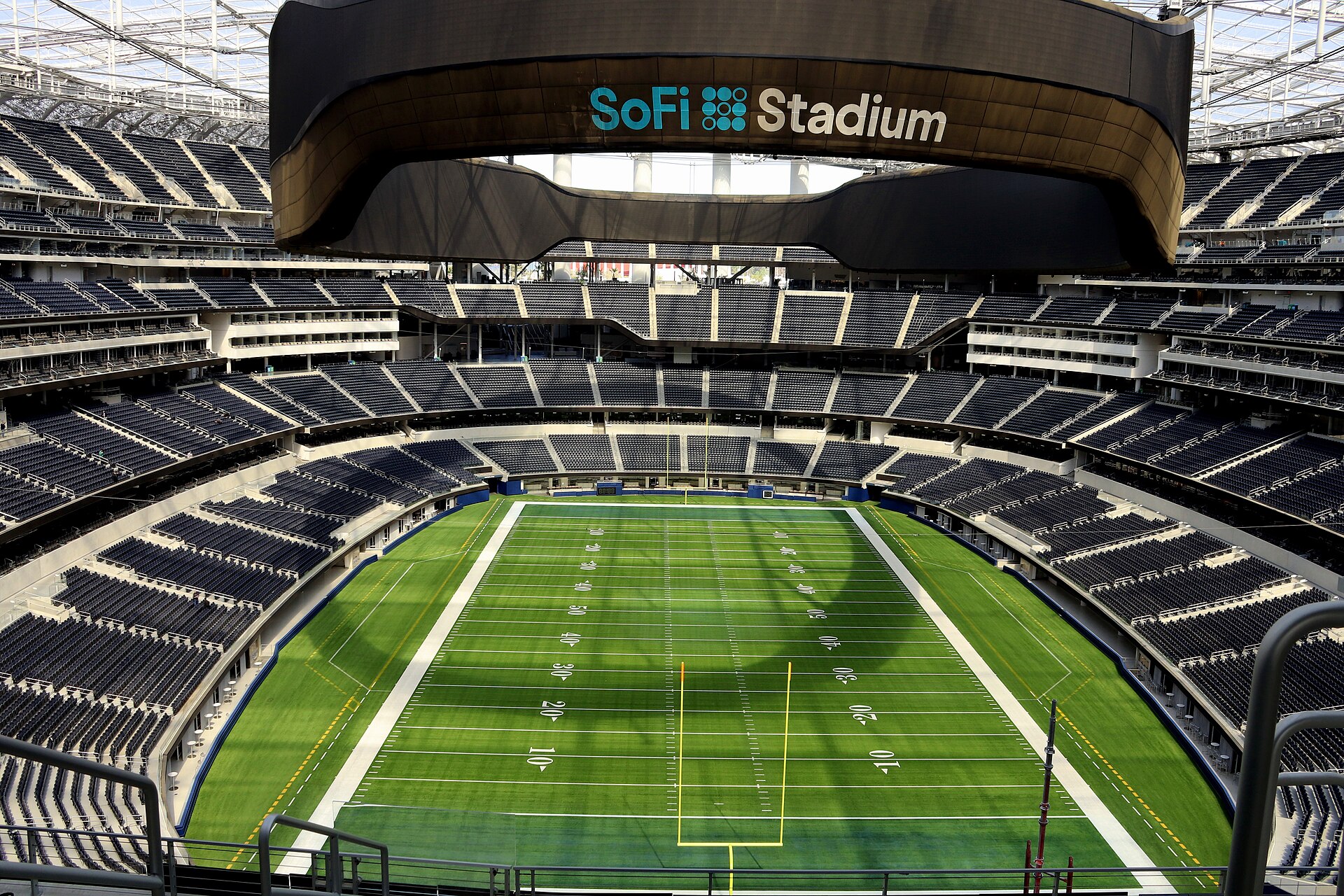
Less visible but more fundamental is the connectivity infrastructure. SoFi Stadium in Inglewood, California, which opened in 2020, was designed around a distributed antenna setup and Wi-Fi 6 that can handle the data demands of a capacity crowd simultaneously. Without that backbone, app-based ordering, video replay on phones, and social media sharing all fail. Verizon, AT&T, and T-Mobile made stadium 5G a priority starting around 2019, because the venue is one of the few places where a carrier can demonstrate capacity to millions of people at once.
Where the Revenue Comes From
Speed and Spend Per Fan
Digital payments and mobile ordering accelerate throughput and raise per-fan spending. But a third category matters too: new product categories.
In-App Upgrades
A fan who bought a seat in the upper bowl can, during the game, bid on a vacant seat closer to the field. The venue captures income from an asset that would have otherwise gone unused. The NBA and NFL both experimented with these dynamic upgrade tools in the early 2020s.
The Augmented Reality Misfire
Augmented reality has been a harder sell. Teams deployed features that let fans point their phone at the court or field and see player stats overlaid on the live action. The software works in demos but competes with the actual live action for attention. Fans at the game are watching the game, not their phones. AR has found a more natural home in the concourse, where fans can point their phone at a wall to see a replay or a 3D model of a player. Those installations are more about brand engagement than direct sales.
The Data Engine
Data collection is the income story that operators do not advertise as loudly. Every tap, every app interaction, every seat upgrade bid generates a data point. Teams use that data to segment fans and send targeted offers. A fan who always buys a beer in the second quarter might receive a push notification with a discount on that beer just before the second quarter starts. The mechanism increases conversion rates and trains fans to keep their phone out and their wallet open.
The Backbone Problem
Every fan-facing tool depends on the network. If the Wi-Fi or cellular connection drops, mobile orders stop, the video replay buffers, and the AR experience freezes. That is why connectivity infrastructure is the first investment any venue should make, and why it is also the most expensive. Retrofitting an older stadium like Lambeau Field or Madison Square Garden with modern distributed antenna arrays and fiber backhaul costs tens of millions of dollars and requires construction during the offseason.
The partners in this space are companies like Cisco, which sells the networking hardware, and Intel, which provides edge computing and data processing for real-time analytics. Verizon and the other carriers lease space on the stadium infrastructure and install their own equipment. The business model is usually a cost-sharing arrangement: the venue builds the backbone, the carriers pay to put their radios on it, and the team gets a cut of the data income.
Newer venues have an advantage. SoFi Stadium and Mercedes-Benz Stadium were built with the connectivity layer already planned. Older venues have to retrofit, and the cost often delays or kills projects.
A venue that cannot get reliable Wi-Fi to the upper deck cannot offer app-based ordering to those sections, which means those fans spend less. The gap between the best-connected venues and the worst is a direct driver of income inequality across leagues.
Privacy, Adoption, and the Limits of Tech
What Teams Know About You
The data that teams collect on fans is extensive. Location tracking through the app shows how long a fan stays in the concourse versus their seat. Purchase history reveals preferences and price sensitivity. Some venues have experimented with facial recognition for entry and payments, which raises obvious privacy concerns. As of January 2024, no major data privacy lawsuit had resolved against a league or team in this area, but the regulatory landscape is shifting. The sports venue digitization market is a multi-billion dollar industry, and data is a growing share of its value.
The Adoption Gap
Fan adoption is a separate challenge. Not every fan wants to use their phone during a game. Older fans and families with children may not have the latest smartphone or may not want to download another app. Teams have to maintain parallel operations: cash-free and cash, app-based ordering and walk-up counters, digital tickets and paper backups. The cost of running two tracks eats into the efficiency gains of the new one.
The Honest Answer
Most digital investments in stadiums produce marginal gains, not transformations. Tap-to-pay and reliable Wi-Fi genuinely improve the experience and increase spending. Everything else is a bet that may or may not pay off. The teams that are best at this are not the ones with the most impressive vendor logos. They are the ones that know which problems to solve and which ones to leave alone.
Key Facts
- Market: Sports venue digitization is a multi-billion dollar industry focused on fan engagement and venue operations.
- Major technology partners: Cisco, Intel, Verizon, and specialized startups.
- Benchmark venues: SoFi Stadium (Los Angeles) and Mercedes-Benz Stadium (Atlanta).
- Cash-free standard: Tap-to-pay transactions and app-based ordering became standard in many venues during the 2020s.
- 5G rollout: Verizon, AT&T, and T-Mobile prioritized stadium 5G starting around 2019-2020.