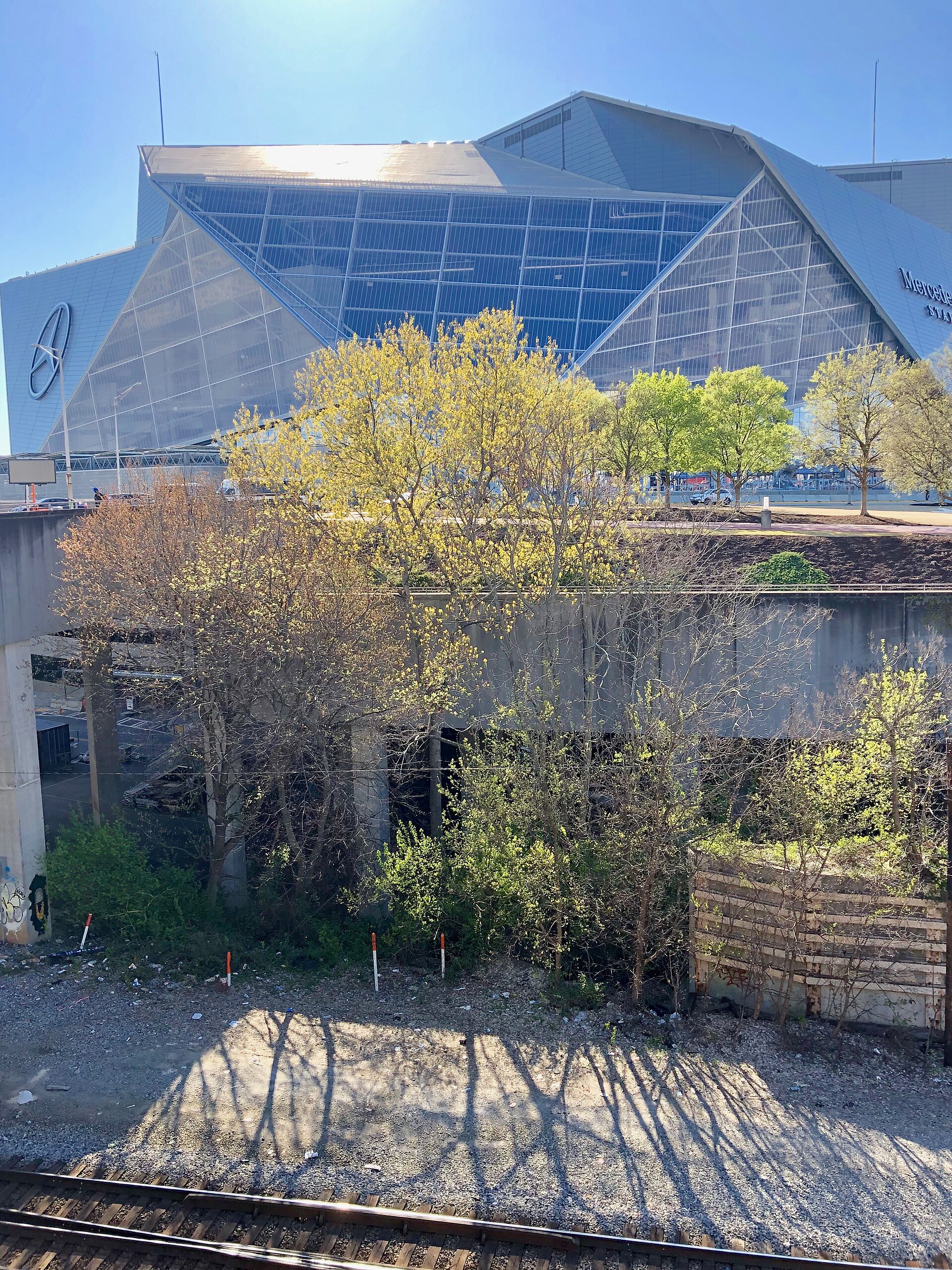
In August 2017, the Atlanta Falcons moved into a new $1.6 billion stadium, replacing the Georgia Dome. The venue, now called Mercedes-Benz Stadium, was built through a public-private partnership that combined city and state funds with private capital from Falcons owner Arthur Blank and a naming rights deal with Mercedes-Benz. The stadium opened on schedule and has since hosted a Super Bowl, an MLS Cup, and the 2019 College Football Playoff National Championship. The Georgia Dome was demolished in November 2017.
The choice to build new rather than renovate the Georgia Dome came down to revenue. The Georgia Dome opened in 1992 and lacked the premium suites, club seating, and technology that NFL teams now expect. The Falcons wanted a retractable roof to attract major events that required a covered or open-air venue. The Georgia World Congress Center Authority, which owned the Georgia Dome, agreed to a new stadium after studies showed that a renovation would cost nearly as much as a new build and would not solve the capacity or amenity issues.

The financing structure
The total build cost was approximately $1.6 billion. The public share came from the city of Atlanta and the state of Georgia, which contributed about $700 million through hotel-motel taxes and car rental fees. The private share, roughly $900 million, came from Arthur Blank and the Falcons organization. The Georgia World Congress Center Authority owns the stadium and leases it to the Falcons and Atlanta United FC.
The public contribution was controversial. Opponents argued that taxpayer money should not subsidize a for-profit sports franchise, especially when the Georgia Dome was still functional. Supporters pointed to the financial impact projections, which estimated that the new stadium would generate billions in new spending and create thousands of building and permanent jobs. As of March 2025, whether those projections were met is not established here.
The naming rights deal
Mercedes-Benz acquired the naming rights in August 2015, changing the name from New Atlanta Stadium to Mercedes-Benz Stadium. The deal runs for 27 years and includes a provision that allows Mercedes-Benz to display its three-pointed star logo prominently on the exterior. The exact annual value has not been disclosed, but the total value was reported at the time as one of the largest naming rights agreements in NFL history.
The deal was part of Mercedes-Benz's broader strategy to increase brand awareness in the United States. The company already had naming rights to the Mercedes-Benz Superdome in New Orleans, but that stadium was built before the automotive brand bought the rights. In Atlanta, Mercedes-Benz was involved from the start, and the logo is integrated into the architecture rather than added as an afterthought.
Signature design features
The stadium's most visible feature is its retractable roof, which opens in about eight minutes. The roof is a pinwheel design with eight petals that slide along rails. When closed, it provides a weathertight seal. When open, the field is exposed to the sky. The mechanism is complex and expensive; the exact cost has not been disclosed.
The other headline feature is the halo video board, a 360-degree display that rings the upper deck. It is the largest in the NFL and shows live game action, replays, and statistics from every angle. The board is 58 feet tall and 1,100 feet in circumference. It replaced the traditional end-zone scoreboards and allows every seat to see the same content.
Technology and fan experience
The stadium was designed with a focus on mobile connectivity and cashless transactions. It has more than 1,800 Wi-Fi access points and a distributed antenna system that supports all four major U.S. carriers. Concession stands accept only credit cards and mobile payments, a move that reduced transaction times and eliminated the need for cash handling. The stadium also uses a food and beverage system that adjusts prices based on demand, a feature that attracted attention during its first season.

Build timeline
Ground was broken in May 2014. The stadium was built on a site adjacent to the Georgia Dome, which remained open during the work. The project took about three years and three months, from groundbreaking to opening day on August 26, 2017. The architects were HOK, the same firm that designed the Georgia Dome.
The schedule was tight. The Falcons played the 2016 season at the Georgia Dome and moved into the new stadium in time for the 2017 preseason. The final cost came in at $1.6 billion, within the budget announced when the project was approved. There were no significant delays or cost overruns.
Financial impact and event hosting
The stadium's retractable roof and central location made it a strong candidate for major events. In February 2019, it hosted Super Bowl LIII, the first Super Bowl held in Atlanta since 2000. The game generated an estimated $400 million in economic impact for the region, according to the Atlanta Sports Council. The stadium also hosted the 2018 MLS Cup, the 2019 College Football Playoff National Championship, and the 2020 SEC Championship Game.
The financial projections used to justify the public subsidy have been a source of debate. Independent economists have questioned whether stadiums generate the promised returns, noting that spending at the stadium often displaces spending elsewhere in the local economy. As of March 2025, the question of whether Mercedes-Benz Stadium met its economic targets has not been resolved.
The transition from the Georgia Dome
The Georgia Dome was demolished in November 2017, about three months after the new stadium opened. The site was converted into a parking lot and green space, and it is now used for tailgating and special events. The demolition was done by implosion, a controlled collapse that took about 15 seconds.
The transition was smooth because the Falcons and Atlanta United FC had overlapping schedules. Atlanta United played its first two seasons at the Georgia Dome before moving into Mercedes-Benz Stadium in 2017. The Falcons played one preseason game at the new stadium in August 2017 and then opened the regular season there in September. The old stadium's demolition was timed to avoid disrupting either team's schedule.