Climate change is creating new revenue streams for a growing number of businesses. These companies are not just managing risk. They are selling goods and services that depend on a hotter planet. The global market for climate resilience technologies was projected to reach tens of billions of dollars annually in the 2020s. That figure includes drought-resistant seeds, flood defenses, parametric cover, and Arctic shipping lanes opened by melting ice.
The opportunity is large enough that major corporations now frame these activities in investor materials and sustainability reports as growth businesses. But profiting from a crisis that causes widespread harm carries reputational risk. Critics use the term disaster capitalism, popularized by author Naomi Klein in her 2007 book The Shock Doctrine, to describe the exploitation of crises for profit. Companies must balance revenue against the perception that they are betting against the planet's stability.
This survey covers the sectors and specific companies turning climate impacts into direct income, the financial instruments being sold, the commercial opening of the Arctic, and the ethical debate that follows.
Seeds, seawalls and the adaptation market
Drought-resistant seeds
Agricultural companies sell seeds engineered to withstand hotter, drier conditions. Bayer and Corteva have invested in genetically modified drought-resistant varieties. These offerings command premium prices because farmers in water-stressed regions have few alternatives. The revenue is directly tied to climate conditions that did not exist at the same scale a generation ago.
Flood defenses and coastal infrastructure
Engineering and construction firms have secured government contracts for flood-defense and coastal-resilience projects. AECOM and Arcadis are two of the companies that have won such work. As sea levels rise and storms intensify, public spending on seawalls, drainage systems, and barrier islands increases. These contracts are multiyear and often run into hundreds of millions of dollars. The business model depends on climate shifts making existing infrastructure inadequate.
Parametric insurance and climate-linked financial products
Insurers have introduced parametric policies that pay out automatically based on climate triggers. Instead of adjusting losses after a disaster, these policies release a fixed sum when rainfall exceeds a threshold or wind speeds hit a certain level. The structure removes the need for claims adjustment and speeds up payment. It also lets carriers price risk more precisely as climate data improves.
Parametric cover is sold to farmers, municipalities, and energy companies. The market grew during the 2010s and early 2020s as traditional underwriters pulled back from high-risk zones. The product is profitable because the triggers are objective and the capital required to back them is lower than for conventional policies. Critics argue that the industry is profiting from volatility it helped create through fossil-fuel underwriting. Insurers respond that parametric offerings are a form of resilience that keeps coverage available where it would otherwise disappear.
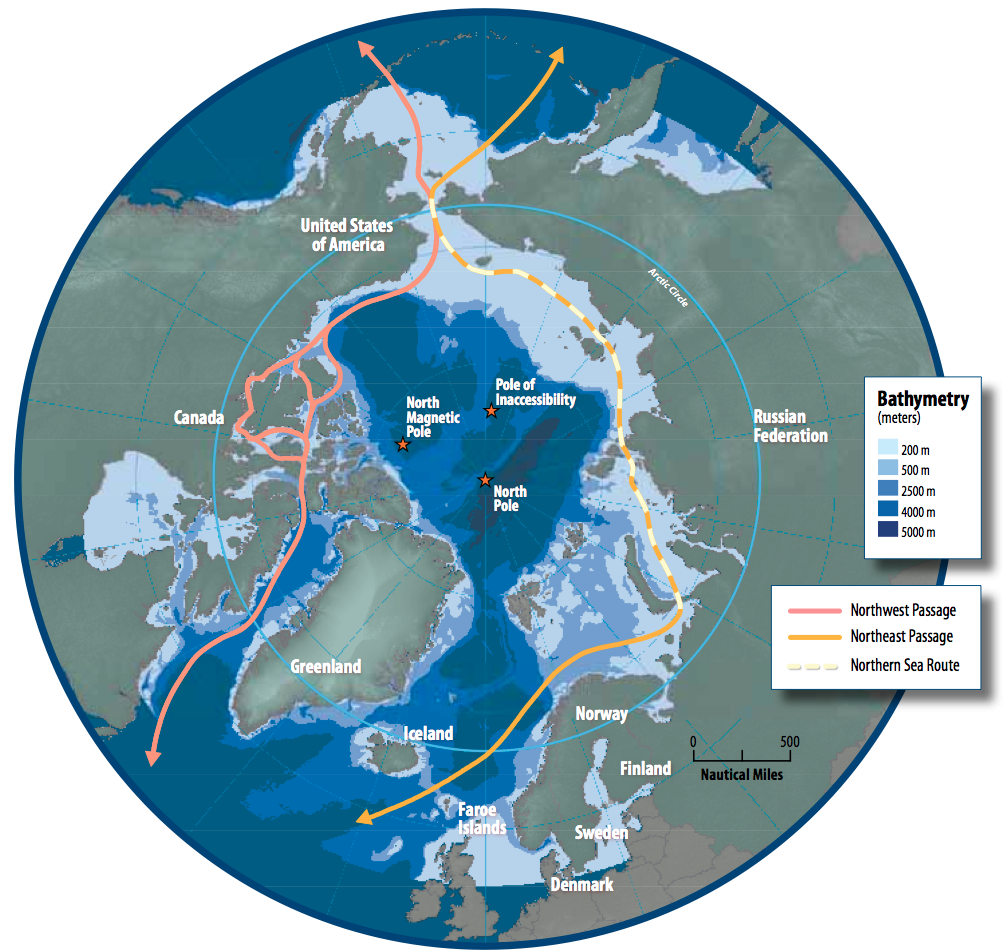
The Arctic shipping lane that melting ice created
The Arctic is heating roughly four times faster than the global average. Arctic sea ice extent has declined by approximately 13% per decade since satellite records began in 1979. That physical change has opened a commercial route that was impassable for most of the year a generation ago. Shipping traffic along Russia's Northern Sea Route increased significantly during the 2010s and early 2020s as ice receded.
The route cuts transit time between Asia and Europe by roughly a third compared with the Suez Canal. Russia's government has actively promoted the Northern Sea Route to international carriers, offering icebreaker escort services and port infrastructure. The revenue comes from transit fees, port charges, and fuel sales. The same heating that threatens coastal communities creates a new asset for the shipping and logistics industry. The tension is direct: the route's viability depends on continued ice loss.
How companies frame climate profit in public disclosures
Companies that profit from climate impacts do not typically say so in those terms. In annual reports and sustainability filings, they describe resilience offerings as solutions to a shared challenge. Bayer presents drought-resistant seeds as part of its commitment to food security. AECOM and Arcadis frame coastal resilience work as infrastructure modernization. Insurers call parametric policies innovation in risk management.
The framing matters for investor relations and public perception. A company that explicitly markets climate shifts as a profit center invites criticism. A company that presents the same offerings as tools for resilience attracts ESG-focused capital. The distinction is often a matter of language rather than substance. Investors and regulators are beginning to look past the framing. In 2022 and 2023, several shareholder resolutions asked companies to disclose how much of their revenue depends on continued temperature rise or extreme weather.

The ethical debate: disaster capitalism or adaptation necessity
Naomi Klein's term disaster capitalism describes the pattern of using crises to push through unpopular policies or extract profit. Critics apply it to climate resilience businesses. They argue that selling solutions to problems caused by fossil fuel emissions lets the same economic system avoid fundamental change. The revenue from seawalls, seeds, and parametric cover, in this view, creates a constituency that benefits from continued heating.
Companies and some economists counter that adjustment is necessary regardless of mitigation efforts. Even if the world stopped emitting carbon tomorrow, the climate would continue to change for decades. Drought-resistant seeds and flood defenses are needed now. The profit motive, they argue, attracts capital and innovation faster than government programs could. The debate is not settled. What is clear is that the market for climate response goods will grow as long as the climate continues to change.
Do profit motives accelerate or delay the energy transition
There is no single answer. Some resilience businesses are neutral with respect to fossil fuels. A flood-defense contractor does not care whether emissions fall. Other businesses, such as Arctic shipping operators, have a direct interest in continued ice loss. The same heating that opens the Northern Sea Route also reduces demand for heating fuel in some regions but increases demand for air conditioning in others.
As of October 2023, no comprehensive study had measured whether resilience profits delay the transition. The incentives cut both ways. A company that sells both fossil fuels and drought-resistant seeds may hedge its bets. A pure-play resilience firm has no reason to oppose mitigation but also no reason to accelerate it. The question matters because public policy often assumes that business interests align with decarbonization. In the resilience market, that assumption is weak. Regulators and investors who want to align profit with climate goals will need to distinguish between companies that adjust to a shifting climate and those that depend on it.
Key facts
- Arctic warming rate: Roughly four times faster than the global average
- Arctic sea ice decline: Approximately 13% per decade since 1979
- Northern Sea Route traffic: Increased significantly during the 2010s and early 2020s
- Climate adaptation market: Tens of billions of dollars annually in the 2020s
- Key agricultural players: Bayer, Corteva (drought-resistant seeds)
- Key infrastructure players: AECOM, Arcadis (flood defenses, coastal resilience)
- Insurance innovation: Parametric insurance triggered by climate data
- Origin of 'disaster capitalism': Naomi Klein, The Shock Doctrine (2007)
Frequently asked questions
What is parametric insurance?
Parametric insurance pays out automatically when a climate trigger, such as a specific rainfall level or wind speed, is met. It does not require a claims adjuster to assess damage. The product is sold to farmers, municipalities, and energy companies.
Why is the Northern Sea Route becoming commercially viable?
Arctic sea ice extent has declined by about 13% per decade since 1979, and the Arctic is warming four times faster than the global average. This has opened a shorter shipping route between Asia and Europe that was previously impassable for most of the year.
What is disaster capitalism?
The term was popularized by Naomi Klein in her 2007 book The Shock Doctrine. It describes the exploitation of crises, including natural disasters and wars, to push through policies or generate profit that would not be accepted under normal circumstances.