Smartphones look clean. They sit in a pocket, draw a few watts, and last two or three years. But the carbon and ecological weight of the device is almost entirely front-loaded. Producing a single handset can account for 85 to 95 percent of its total lifetime CO2 emissions. Once the phone leaves the factory, its use phase, including charging, cellular data, and network overhead, contributes a small fraction of that total.
That ratio flips consumer intuition. Most people assume the energy used to charge a phone every night is the main environmental cost. In reality, the energy and raw inputs required to build the device, especially the chipset, display, and power cell, dominate. A single smartphone requires over 60 different elements from the periodic table, including rare-earth metals like neodymium, dysprosium, and praseodymium, plus cobalt and tantalum. Extracting and refining those substances is energy-intensive, water-heavy, and often takes place in regions with weak environmental regulation.
The consequence is simple. Extending a phone's life by one or two years has a larger climate benefit than buying a slightly more efficient new model. The question is whether the industry and regulators can make that extension easier than it is today.

Where the Carbon Lives: Manufacturing vs. Use
The 85-95 percent figure is not a rounding artifact. Lifecycle analyses from multiple research groups converge on it. The production phase includes everything from raw material extraction to component assembly. The integrated circuits, which are fabricated in highly controlled clean rooms with enormous energy demands, account for a large share. The display, glass, and lithium-ion cell each add significant weight. Even packaging and transport contribute more than the phone's charging over its lifetime.
Use phase emissions, by contrast, are small. A typical smartphone consumes roughly 5 to 10 kWh of electricity per year when charged daily. The grid mix matters, but even a coal-heavy grid generates far less CO2 over three years than the production phase. The gap is wide enough that replacing a phone after two years instead of four roughly doubles the per-year carbon footprint of the product, even if the new phone is more efficient.
This is why software support timelines matter. A phone that stops receiving security updates after two years pushes users toward replacement sooner, regardless of the device's physical condition.
Key Facts: Smartphone Environmental Cost
- Manufacturing share of lifetime CO2: 85-95%
- Elements required per smartphone: Over 60 different elements from the periodic table
- Key rare-earth metals: Neodymium, dysprosium, praseodymium
- Global e-waste generation: Exceeds 50 million metric tons annually
- Major cobalt source: Democratic Republic of Congo supplies a significant portion of the world's cobalt
The Periodic Table in Your Pocket
A smartphone is not a simple assembly of glass, plastic, and silicon. It contains more than 60 elements, many of which are classified as critical or conflict minerals. Rare-earth metals such as neodymium, dysprosium, and praseodymium are used in the phone's vibration motor, speakers, and camera components. Cobalt, a key ingredient in lithium-ion power packs, is largely sourced from the Democratic Republic of Congo, where extraction practices have been linked to human rights concerns and environmental damage.
Tantalum, used in capacitors, comes primarily from the African Great Lakes region, often from mines that have been associated with armed conflict. Tin and tungsten face similar sourcing challenges. Extracting these metals requires moving large volumes of ore. For rare earths, the refining process involves acids and solvents that generate toxic waste. The water consumption for producing a single smartphone has been estimated at several thousand liters, when the full supply chain from mine to assembly is included.
The Mining Footprint
Open-pit mining for cobalt and rare earths strips vegetation, erodes soil, and contaminates water tables. In China's Inner Mongolia region, rare-earth mining has created large areas of polluted groundwater. In the DRC, artisanal cobalt mining often involves hand-digging tunnels that collapse frequently. The environmental cost is not evenly distributed. The burden falls on communities near mines, while the benefits accrue to global supply chains.
E-Waste: 50 Million Tons and Rising
Global e-waste generation now exceeds 50 million metric tons annually. Handsets form a major and growing fraction of that total. Unlike larger electronics, phones are small enough to be tossed into household waste bins, where they are landfilled or incinerated. The typical fate of a discarded device is not formal recovery. Many units are hoarded in drawers, sold to informal scrap dealers, or shipped to developing countries for manual dismantling.
Those informal recovery operations often involve burning cables to recover copper or using acid baths to extract gold. The methods release toxic fumes and contaminate soil and water. The reclamation rate for valuable substances from handsets is low. Precious metals such as gold and silver are partly recovered, but rare-earth metals are almost never extracted. The technical challenge is that those elements are present in tiny quantities and are dispersed across many components.
Recovery Rates and Limits
Exact global recovery rates for handsets are not established here, but the consensus among waste management researchers is that the majority of phones are not processed through formal channels. Even when a phone enters a dedicated facility, the process destroys most of the value. Shredding a phone produces a mixed metal and plastic stream that is cheap to process but loses the ability to recover high-purity individual metals. Achieving higher recovery rates would require disassembly, sorting, and component-level separation, which is labor-intensive given the glued and soldered construction of most devices.
Comparison: Repair vs. Replacement Environmental Impact
| Activity | CO2 impact | Material consumption | E-waste generated |
|---|---|---|---|
| Replace phone after 2 years | High (new manufacturing) | High (60+ elements mined) | One whole device discarded |
| Replace battery after 2 years | Low (small component) | Low (new battery materials) | One battery |
| Replace screen after break | Moderate (component) | Moderate (glass, digitizer) | One screen module |
| Keep phone 4 years with one battery swap | Lowest per year | Lowest per year | One phone, one battery over 4 years |

Planned Obsolescence and Software Lock-In
Production dominates the footprint, but the replacement cycle is driven by factors beyond hardware failure. Software support timelines and power cell degradation are the two main forces. Apple and Samsung typically provide major operating system updates for three to four years. After that, apps stop working smoothly, security patches end, and the phone feels obsolete. The user replaces a perfectly functional device because it no longer receives updates.
Cell chemistry accelerates this. Lithium-ion packs lose capacity after repeated charge cycles, which for most users means roughly two years. A phone that cannot hold a full day's charge is a candidate for replacement, even if the logic board, camera, and screen are in good condition. Swapping the power cell would solve the problem, but the repair is often inconvenient or expensive. Apple introduced a Self Service Repair program in 2022, providing parts, tools, and manuals to consumers for iPhone repairs. But the program is limited to certain models and requires a level of technical confidence that most users do not have.
Right to Repair Momentum
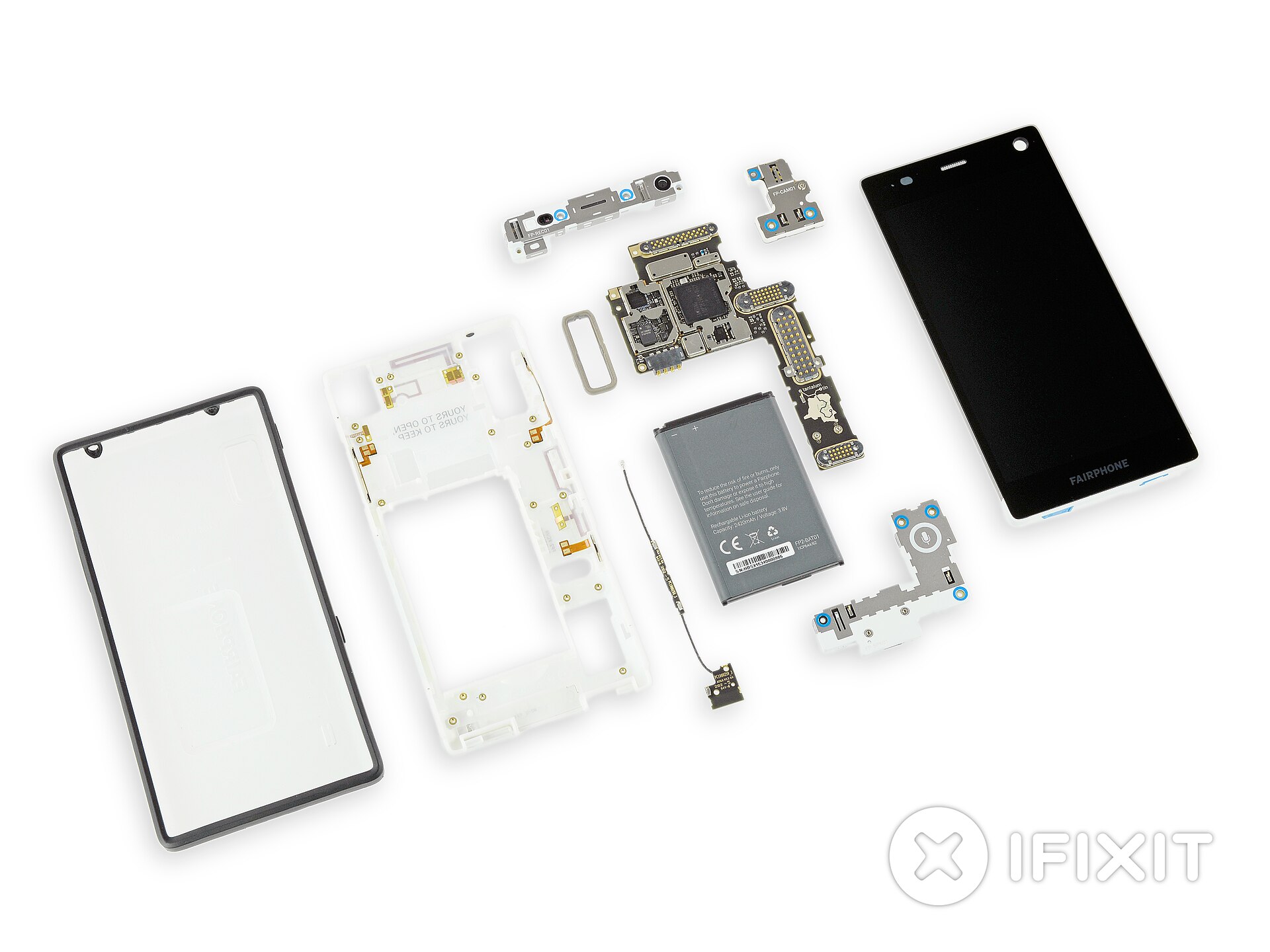
The European Union adopted a regulation in 2022 mandating USB-C as a common charging port for mobile devices by the end of 2024. That reduces cable waste but does not address the deeper problem of repairability. Right to repair legislation that forces manufacturers to provide spare parts, repair manuals, and fair pricing for repairs could shift the economics. The Fairphone, first released in 2013 by the Dutch social enterprise Fairphone B.V., is a modular phone designed for repairability and ethical material sourcing. It has a small market share, but it demonstrates that an alternative model is technically feasible.
Frequently Asked Questions
What percentage of a smartphone's lifetime CO2 comes from manufacturing?
Between 85 and 95 percent. The use phase, including charging, accounts for the remaining 5 to 15 percent.
Which rare-earth elements are in a smartphone?
Neodymium, dysprosium, and praseodymium are used in speakers, vibration motors, and camera components. Cobalt is a key battery material, largely sourced from the Democratic Republic of Congo.
How much e-waste do smartphones generate each year?
Global e-waste exceeds 50 million metric tons annually. Smartphones are a major and growing fraction, but most are not formally recycled.
Is it better for the environment to repair or replace a smartphone?
Repairing a broken screen or degraded battery has a much lower carbon and material impact than buying a new phone, because manufacturing accounts for the vast majority of the footprint.
What systemic changes could reduce smartphone environmental impact?
Modular design, right to repair legislation, longer software support timelines, and mandatory recycled content in new phones are the most impactful levers.
Systemic Changes That Would Actually Matter
Individual actions like turning off push notifications or dimming the screen have tiny effects compared to the production footprint. The meaningful changes are systemic. Modular design, as demonstrated by the Fairphone, allows users to replace a broken screen or degraded power cell with standard tools. That reduces the number of phones that are discarded because of a single component failure.
Right to repair legislation, if it becomes comprehensive, would force manufacturers to supply spare parts and repair documentation for a set number of years. That would lower the cost and difficulty of repairs. Longer software support timelines would reduce the pressure to upgrade even when the hardware is still functional. Currently, security updates and app compatibility are the main drivers of replacement after three years.
Circular Economy Models
Circular economy approaches aim to keep substances in use rather than extracting new ones. That means designing phones that are easier to disassemble, establishing take-back programs that actually lead to high-grade recovery, and creating markets for refurbished devices. The European Union's USB-C regulation reduces charger waste but is a small step. A more ambitious policy would mandate that a percentage of the inputs in a new phone must come from reclaimed sources, creating a demand pull for recovered metals. Without that, the economics of recovery remain unfavorable compared to mining virgin ore.