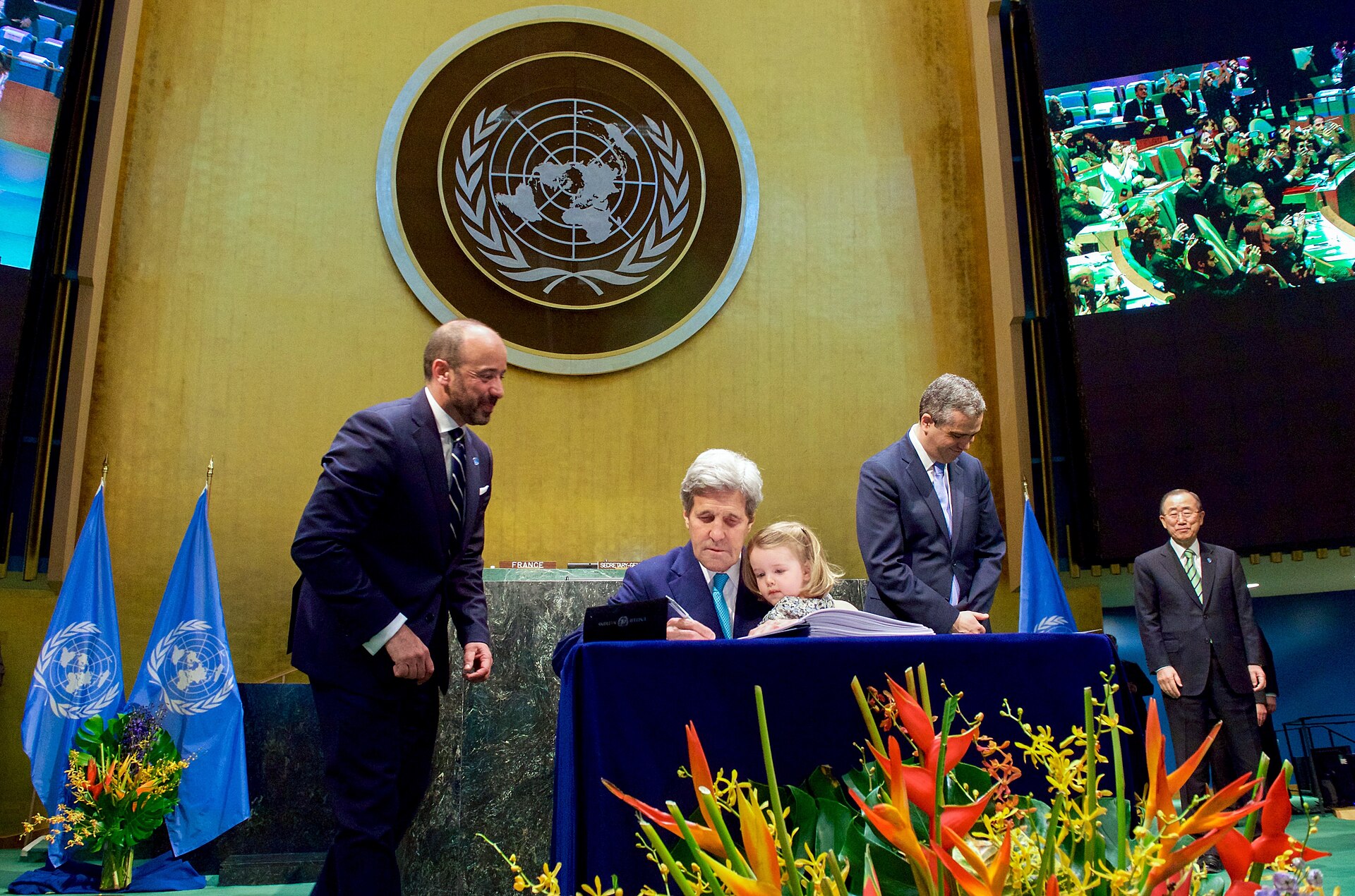
The Paris Agreement is the primary global legal instrument for addressing climate change. Adopted by 196 Parties at COP21 in Paris on December 12, 2015, it entered into force on November 4, 2016.
The treaty's central goal: hold the global average temperature increase to well below 2 degrees Celsius above pre-industrial levels and pursue efforts to limit the increase to 1.5 degrees.
The United States formally exited the agreement on November 4, 2020 under the Trump administration and officially rejoined on February 19, 2021 under President Biden. That four-year gap was the most consequential geopolitical event in the treaty's short history.
This explainer covers the temperature targets, the nationally determined contribution mechanism, the US exit and reentry process, climate finance commitments, and how the Paris Agreement differs from its predecessor, the Kyoto Protocol.

The Temperature Target: Well Below 2 Degrees, Pursue 1.5 Degrees
Article 2 states the Paris Agreement's central aim: holding the global average temperature increase to well below 2 degrees Celsius above pre-industrial levels, and pursuing efforts to limit the increase to 1.5 degrees.
The 1.5-degree target was not in early drafts. Those texts referenced only the 2-degree threshold that had appeared in earlier UNFCCC decisions. Small island states and other vulnerable nations pushed for stronger language. The final text includes both numbers, creating a dual target that has shaped every subsequent scientific assessment and policy debate.
The Intergovernmental Panel on Climate Change has since produced special reports on the difference between 1.5 and 2 degrees of warming. Those reports are separate from the treaty itself, but the agreement's language created the mandate for that work.
Nationally Determined Contributions and the Ratchet Cycle
The Paris Agreement does not impose emissions reduction targets from the top down. Instead, each party submits a nationally determined contribution, or NDC, stating its own plan for reducing emissions and adapting to climate impacts. Every party must submit a new NDC every five years.
Each successive NDC must represent a progression beyond the previous one. This is the ratchet mechanism. A nation cannot submit a weaker target than its earlier commitment.
The five-year cycle was a compromise. Some negotiators wanted more frequent updates. Others argued that domestic planning cycles required longer horizons.
The NDC system replaced the Kyoto Protocol's model. Kyoto set binding emissions targets only for developed nations and gave developing economies no obligations. Under Paris, every party has a responsibility to submit and implement an NDC, though the agreement acknowledges different national circumstances.
The US Exit: Process and Effective Date
The United States joined the Paris Agreement in 2016 under President Barack Obama. On June 1, 2017, President Donald Trump announced the US intention to pull out.
Article 28 stipulates that a party cannot give notice of departure within the first three years of the agreement's entry into force. That period expired on November 4, 2019. The US formally notified the United Nations of its exit that same day.
The agreement then required a one-year waiting period. The departure took effect on November 4, 2020, one day after the US presidential election.
During the waiting period, the US continued to participate in UNFCCC negotiations but had reduced influence. Other nations proceeded with implementing the agreement without the world's second-largest emitter, weakening the collective effort.
The US Reentry Under Biden
President Joe Biden signed an executive order to rejoin the Paris Agreement on his first day in office, January 20, 2021. The UNFCCC process for reentry took 30 days. The United States officially re-entered on February 19, 2021.
Reentry was faster than exit because the agreement does not require a waiting period for accession. The US returned to the same commitments it had when it left, including its original NDC target. The Biden administration later submitted a new, more ambitious NDC, but that submission occurred after reentry and is a separate action.
The US exit and reentry demonstrated a structural feature of the Paris Agreement: the treaty is designed to make participation easy and departure slow. A president can rejoin with a single executive order. Leaving requires a three-year wait after entry into force plus a one-year notice period, totaling four years.

Climate Finance: The $100 Billion Commitment
Developed nations committed under the Paris Agreement to mobilize $100 billion annually in climate funding for developing economies by 2020. The goal was extended through 2025. The money is meant to support both mitigation, reducing emissions, and adaptation, adjusting to climate effects already underway.
The $100 billion figure originated in a 2009 pledge at COP15 in Copenhagen. The Paris Agreement incorporated and formalized it.
Developing nations argued the amount was insufficient and should be increased. Developed economies pointed to difficulties in mobilizing private capital and in defining what counts as climate funding.
The commitment is not a binding legal obligation in the same way a treaty article is binding. It appears in the agreement's decision text rather than in the treaty's operative articles. This distinction matters for enforcement: there is no dispute resolution mechanism for a party failing to meet its funding pledge.
Global Stocktake and Legal Distinction From the Kyoto Protocol
How the global stocktake works
The Paris Agreement includes a global stocktake process to assess collective progress toward the agreement's goals. The stocktake happens every five years, with the first one concluding in 2023.
It evaluates mitigation, adaptation, and means of implementation, including funding. The stocktake does not impose new targets on individual nations. It informs the next round of NDCs.
How Paris differs from Kyoto
The Paris Agreement differs from the Kyoto Protocol in several structural ways. Kyoto imposed binding emissions reduction targets only on developed nations listed in Annex I of the UNFCCC. Developing economies, including major emitters like China and India, had no targets. Paris applies to all parties, though it allows each to set its own level of ambition.
Kyoto had a compliance mechanism that could impose consequences on non-compliant parties. The Paris Agreement relies on transparency and peer review rather than enforcement. A nation that fails to meet its NDC faces no penalty under the treaty.
The theory: public accountability and the five-year ratchet cycle will produce stronger action than top-down enforcement.
Key Facts About the Paris Agreement
- Date adopted: December 12, 2015 at COP21 in Paris
- Entry into force: November 4, 2016
- Temperature goal: Well below 2 degrees Celsius above pre-industrial levels, pursuing 1.5 degrees Celsius
- US exit effective: November 4, 2020
- US reentry effective: February 19, 2021
- NDC update cycle: Every five years
- Climate funding goal: $100 billion annually by 2020, extended through 2025
Paris Agreement vs. Kyoto Protocol
| Feature | Paris Agreement | Kyoto Protocol |
|---|---|---|
| Adopted | 2015 | 1997 |
| Targets | All parties submit NDCs | Binding targets only for developed (Annex I) nations |
| Legal form | Treaty with non-binding NDCs | Treaty with binding emissions targets |
| Compliance | Transparency and peer review | Compliance mechanism with potential consequences |
| Coverage | 196 Parties | 192 Parties (US signed but never ratified) |
| Temperature goal | Well below 2 degrees, pursuing 1.5 degrees | No explicit temperature goal |
Frequently Asked Questions
Is the Paris Agreement legally binding?
The treaty itself is a legally binding international agreement under international law. However, the nationally determined contributions within it are not legally binding. A country cannot be penalized for failing to meet its NDC targets.
How long did it take the US to leave the Paris Agreement?
The process took about three and a half years. President Trump announced the intention to pull out on June 1, 2017. The agreement's rules prevented formal notification until November 4, 2019. The one-year waiting period meant the departure took effect on November 4, 2020.
Can the US leave the Paris Agreement again?
Yes. Any party can exit under Article 28. The process requires a three-year wait after the agreement's entry into force for that party, plus a one-year notice period. For the US, which rejoined in 2021, a new departure would take effect four years after the decision to initiate it.