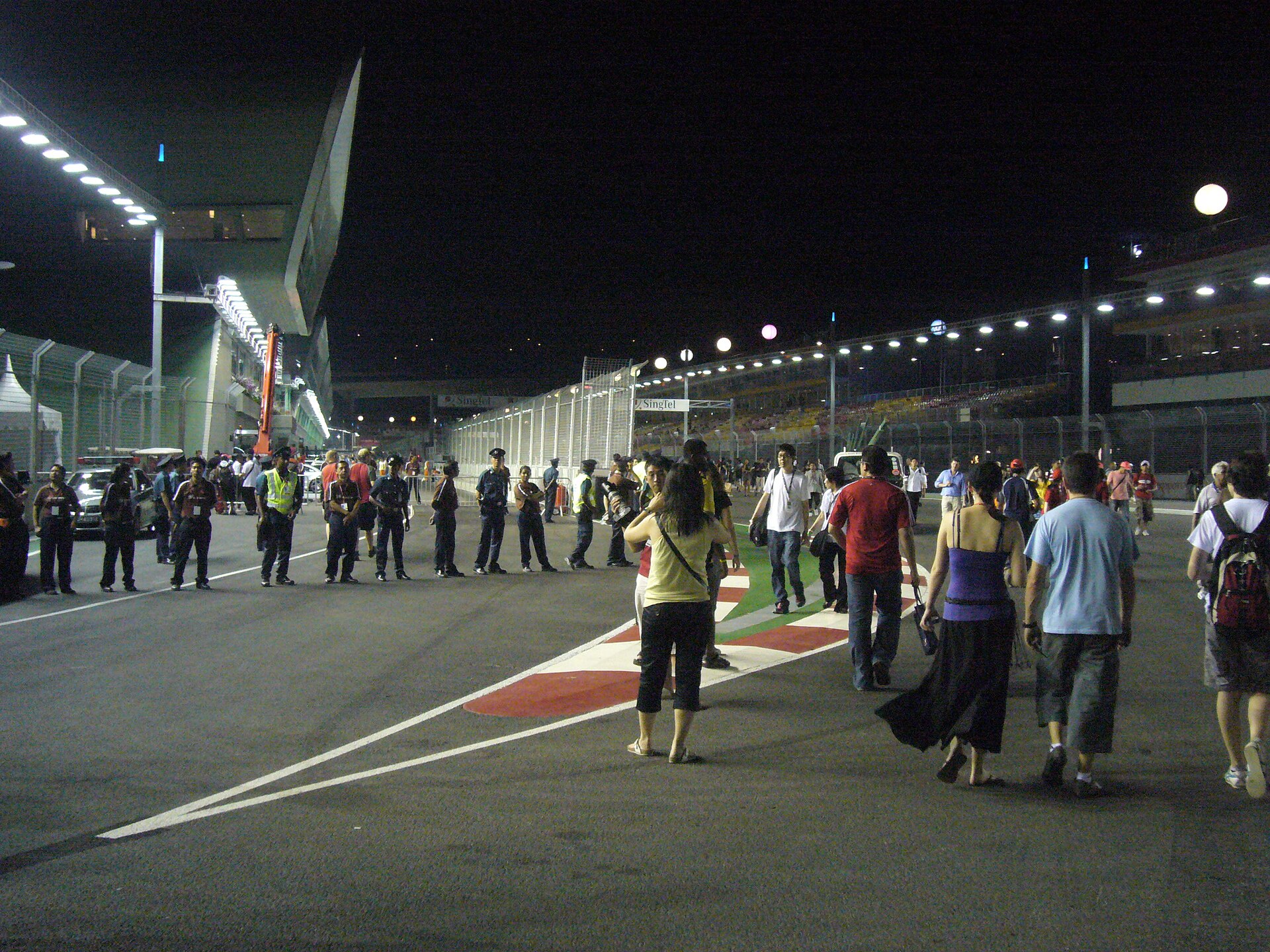
In September 2022, Sergio Perez crossed the finish line of the Singapore Grand Prix at the Marina Bay Street Circuit two seconds ahead of Charles Leclerc. That gap was shaped months earlier, inside cloud servers running computational models of the car and the track. Engineers call such models a digital twin: a live representation of a physical system that ingests sensor readings, historical race data, and environmental measurements to predict outcomes.
In Formula 1, the digital twin is not a single object. It is a family of computational models, each tuned to a distinct question. The most famous, built in partnership with Amazon Web Services since 2018, tracks how a leading car disturbs the air behind it. That phenomenon, dirty air, costs a following car downforce and tire grip. At a tight street circuit like Marina Bay, 4.94 km long with 23 corners, dirty air is not an inconvenience. It dictates qualifying strategy, tire choice, and overtaking risk.
What follows explains how F1 and the Singapore Grand Prix build, run, and use these models. It covers the specific data sources that feed them, the AWS partnership that provides the compute, and the limits of simulating a public road circuit rebuilt every year.

What a Digital Twin Means in Formula 1
Outside motorsport, a digital twin often means a 3D model of a factory floor or a building, updated by sensors so operators see a live state on a screen. Formula 1 uses a narrower definition. The F1 digital twin is a physics-based model, updated with readings from the car and track, that exists to make predictions. It does not try to render every bolt. It computes what will happen if the driver brakes two meters later into Turn 14 at Marina Bay or if the ambient temperature rises by five degrees.
F1 and AWS started working together in 2018. The initial project was a machine learning model that predicted when a car would pass another based on historical race data. That model evolved into a full computational fluid dynamics engine, using the AWS cloud to run millions of calculations per instant. The result is a digital twin that can model the aerodynamic wake of a car across an entire lap, on any circuit in the calendar, including the street circuit in Singapore.
What separates a digital twin from a conventional simulation is feedback. During a race weekend, the twin receives live data: tire temperature, suspension loads, engine torque, brake pressure. If the model predicted a following car would lose 35 percent of its downforce at 20 meters, and the readings show a different figure, the twin adjusts. It learns. That is the key distinction, and it is why teams invest in keeping the twin running after the chequered flag.
Data Sources That Build the Marina Bay Twin
Track geometry
Because the circuit is built on public roads, its shape changes slightly every year as Singapore resurfaces sections, adjusts kerbs, or modifies the pit entry. Teams use LIDAR scans and photogrammetry to capture the track surface at a resolution that catches bumps the width of a coin. That point cloud becomes the mesh on which the CFD engine runs.
Environmental conditions
Marina Bay is a night race, which means track temperatures drop as the race progresses. Humidity is high, and the circuit is open to the sea breeze. All of these factors change air density and tire grip. The digital twin ingests weather station data from the circuit, tracks cloud cover from satellite feeds, and processes track temperature measurements from sensors embedded in the asphalt.
Car telemetry
Every F1 car carries roughly 300 sensors that generate thousands of data points per instant. That data streams to the cloud during practice, qualifying, and the race. The digital twin compares the car's real behavior, for example, how much speed it carried through Turn 10, against the model. When they diverge, the engineers update the model. By Sunday, the twin is accurate enough to run thousands of what-if scenarios before the lights go out.
How AWS Makes the Simulation Possible
A computational fluid dynamics model of a full Formula 1 car on a 4.94 km circuit requires more compute power than any team owns on site. In 2018, F1 announced a multi-year partnership with Amazon Web Services to use machine learning and cloud services. The arrangement gives F1 access to AWS's Elastic Compute Cloud, which can spin up tens of thousands of virtual machines for a single run.
The CFD twin works by dividing the car and the air around it into millions of small cells called a mesh. The software solves the Navier-Stokes equations for each cell, tracking how pressure and velocity change as the car moves through the air. Doing that for a full lap would take weeks on a local server. AWS cuts that to hours. During a race weekend, the twin runs in near real time, processing data from the track and returning predictions to the team garages.
AWS also stores the historical data. Every lap from every car at every circuit since 2018 is stored in the cloud. That dataset trains the machine learning models that underpin the twin. When the model predicts that a car following at 10 meters will lose a certain amount of downforce, it draws on tens of thousands of historical laps, including those run at Marina Bay in high humidity or under floodlights. The partnership was still ongoing as of 2024.

Pre-Race Simulations and Race Strategy
Race strategists at every team use the digital twin to decide how many pit stops to make, what tire compounds to use, and when to push or conserve fuel. At Marina Bay, the twin is especially important because overtaking is difficult. The circuit is narrow, concrete walls line the track, and dirty air makes it hard to follow closely. The twin models the likelihood of a pass at each corner based on track layout, the car's aero configuration, and tire state.
A week before the race, the team runs thousands of scenarios. Each scenario tweaks one variable: a different tire strategy, a different fuel load, a different pit stop window. The twin scores each by expected finishing position. The strategists pick the top scenarios and refine them. By Friday practice, they have a shortlist of viable strategies.
During the race, the twin runs in parallel with the live event. The strategist feeds it the current gap to the car ahead, the number of laps remaining, and the tire degradation rate. The twin recalculates in moments. If a safety car comes out, the twin can simulate every possible pit stop scenario before the driver reaches pit entry. That speed is what makes the twin useful. A model that takes three hours is a research tool. A model that takes three moments is a race tool.
Real-Time Decision Support During a Grand Prix
Scenario testing under pressure
The digital twin becomes a decision-support engine during the race. Consider a scenario common at Marina Bay: a driver has qualified on pole but is struggling with tire graining after ten laps. The strategist asks the twin what happens if the driver pits early and switches to the harder compound. The twin runs that scenario against the data from the leading cars and returns a predicted finishing position. The strategist can then compare it to the baseline: staying out for another five laps.
Probabilities, not commands
This process is not automated. The driver and the team principal still make the call. But the twin provides what engineers call a recommended action, the highest-probability path to the best finish, plus the margin of error. If the twin says pitting now gives an 80 percent chance of finishing fourth, and staying out gives a 60 percent chance, the team knows the trade-off.
Modeling rivals and chaos
The twin also models the effect of the car ahead. If a rival driver is struggling with brakes, the twin can factor that into the likelihood of a pass. At Marina Bay, where the track is lined with concrete barriers, a mistake by the car ahead often leads to a safety car. The twin models that risk, too. It treats a safety car as a probabilistic event, weighted by track history, driver skill, and the number of laps remaining. As of 2024, this is standard practice for every team on the grid.
Fan Engagement and Broadcast Enhancements
F1 uses the digital twin for more than strategy. The same CFD model that teams rely on is repurposed for broadcast graphics and fan engagement. During a race at Marina Bay, the director can call up a visualization that shows the turbulent air behind a leading car, colored by pressure gradient. The viewer sees why the driver in second place is falling back, even though the car looks identical on screen.
F1 also produces a metric they call Overtake Probability for each driver pairing. That metric is derived directly from the digital twin. The twin simulates a hundred laps of the current race scenario, counting how many times the trailing car gets close enough to attempt a pass. The figure shown on screen is the fraction of those laps where the pass happened.
The partnership with AWS makes this possible at broadcast scale. The twin does not run on a single server. It runs across distributed cloud instances that render the graphics and send them to the broadcast truck. For the Singapore Grand Prix, a night race that runs past midnight local time, the twin also processes floodlight data. The lights affect the track temperature and driver visibility, and the twin accounts for that. Fans watching at home see the same data that the team engineers see, delayed by a few moments but otherwise identical.

Challenges of Modeling a Street Circuit
The Marina Bay Street Circuit is harder to model than a permanent racetrack like Silverstone or Suzuka. The reason is variability. A permanent track has the same surface all year. Marina Bay is a public road for 51 weeks of the year. The track surface is laid over asphalt designed for cars traveling at 50 km/h, not at racing speeds. The grip level differs, and it changes as the race weekend progresses because rubber laid down on Friday alters the surface for Saturday.
The digital twin must account for this evolution. The LIDAR scan taken in May will not match the track surface in September because Singapore has repaved sections, or because the heat and rain have worn the tarmac. Teams rely on data from the first practice session to calibrate the twin. They measure track grip using a tire-sensor reading during the installation lap and feed that back into the model.
There is also the problem of the circuit environs. The Marina Bay track runs past hotels, office towers, and the Singapore Flyer. These buildings create wind tunnels and eddies that affect car handling. A gust coming off a building can change the downforce balance at a corner by as much as 2 percent. The digital twin models this using historical wind data from sensors placed around the circuit. But the wind is chaotic. The twin gives a likelihood, not a guarantee.
The Limits of the Technology
Digital twins in Formula 1 are powerful, but they have clear limits. The CFD model of dirty air is a research tool, not a race tool. It runs before the season to inform the aerodynamic design of the car. During a race weekend, the twin used by strategists is a simplified model that sacrifices accuracy for speed. It is good enough to pick the right pit window, but it cannot predict the exact lap time impact of a 0.5 percent change in air density.
Another limit is data latency. The readings from a car traveling at racing speed arrive at the cloud with a delay measured in milliseconds. But the model that processes them takes longer. The strategist is always looking at a prediction that is a few moments old. At a circuit like Marina Bay, where the corners come every few moments, that lag matters. Teams compensate by running the twin in advance, pre-computing the most likely scenarios.
Finally, the digital twin cannot model human factors. It cannot predict that a driver will make a mistake under pressure or that a mechanic will fumble a tire change. Those events are outside the model. As of 2024, the best twin in Formula 1 still loses to reality about a third of the time. That is not a failure. It is the reason the teams keep racing instead of running models at headquarters.
Key Facts
- Partnership announced: 2018, between Formula 1 and Amazon Web Services
- Track length (Marina Bay Street Circuit): 4.94 km
- Race type: Night race
- Technology used: Computational fluid dynamics, machine learning, cloud computing
- Primary purpose of digital twin: Model car aerodynamics and the impact of dirty air
- Status as of: 2024-05: ongoing
Frequently Asked Questions
Is the Marina Bay Street Circuit a permanent racetrack?
No. It is a street circuit built on public roads in Singapore. It is used for the Formula 1 race one weekend per year and is otherwise open to normal traffic.
Does the digital twin run live during the race?
Yes. The twin processes telemetry from the car and environmental data in near real time, returning predictions to race strategists within moments.
Can the digital twin predict the winner?
No. It predicts likelihoods for specific outcomes such as the chance of a pass or the optimal pit stop window. It does not model driver error or random mechanical failure.