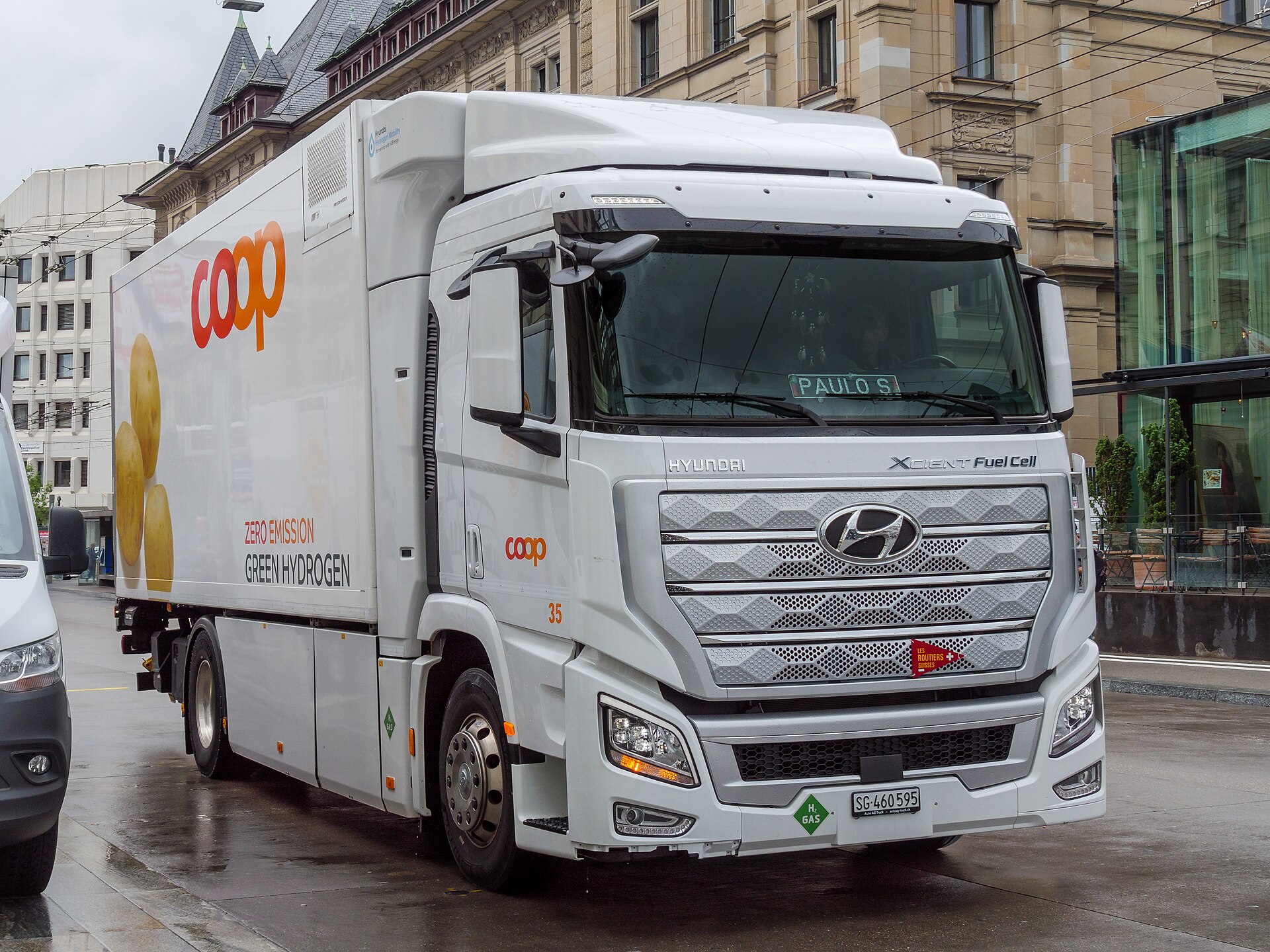
In July 2020, Hyundai Motor Company shipped the first 10 units of the Xcient Fuel Cell to Switzerland. The move made it the world's first mass-produced fuel-cell heavy-duty truck. The 36-tonne (GCW) rig pairs a 190 kW hydrogen fuel-cell system with a 350 kW electric motor, delivering roughly 400 kilometers of driving per fill. Hyundai planned to deliver 50 trucks to Swiss fleet operators by the end of 2020, a target it met.
The deployment was enabled by Hyundai Hydrogen Mobility (HHM), a joint venture with Swiss firm H2 Energy. Instead of selling the vehicles outright, HHM offers them on a pay-per-use basis. The Swiss Federal Roads Office (FEDRO) exempts fuel-cell trucks from the heavy vehicle charge (LSVA), which improves their total cost of ownership compared to diesel alternatives.
Hyundai announced a target to deliver 1,600 Xcient Fuel Cell trucks to Europe by 2025. The company later expanded operations to Germany and introduced design updates for other markets, including the United States, where the truck is sold as the Xcient Fuel Cell tractor.

A partnership built for hydrogen trucking
Hyundai's entry into the European hydrogen truck market relied on a carefully constructed partnership. The joint venture Hyundai Hydrogen Mobility (HHM) with H2 Energy was formed to manage deployment and commercial operation. H2 Energy brought local knowledge of the Swiss market and relationships with potential fleet operators.
The commercial model was a pay-per-use arrangement. Fleet operators did not buy the trucks. Instead, they paid for each kilometer driven, which covered the vehicle, maintenance, and hydrogen fuel. This structure lowered the upfront cost and reduced the financial risk of adopting a new technology.
The fuel supply was handled by Hydrospider AG, a joint venture of Alpiq, H2 Energy, and Linde. Hydrospider produced and supplied green hydrogen, ensuring the fuel came from renewable sources. The partnership created a closed loop: Hyundai provided the vehicles, H2 Energy managed the customer relationship, and Hydrospider supplied the fuel.
Technical specifications of the Xcient Fuel Cell
The Xcient Fuel Cell is a 36-tonne gross combination weight heavy-duty truck. Its fuel-cell system delivers 190 kW, and the electric motor produces 350 kW. The truck carries seven hydrogen tanks with a total capacity of around 32 kg of hydrogen.
Range and refueling
The driving range is approximately 400 kilometers per fill, which is sufficient for regional distribution routes common in Switzerland. Refueling takes between 8 and 20 minutes, depending on the station and ambient conditions. This is significantly faster than battery-electric truck charging, though the range is shorter than a diesel truck's.
Configuration
The first 10 units shipped in July 2020 were configured as 4x2 or 6x2 rigid trucks, though the exact configuration of the initial batch was not disclosed. The truck was designed for heavy-duty operations, including long-haul freight and distribution.
Switzerland's regulatory advantage for hydrogen trucks
Switzerland provided a favorable regulatory environment for hydrogen truck deployment. The Swiss Federal Roads Office (FEDRO) exempted fuel-cell trucks from the heavy vehicle charge (LSVA). The LSVA is a distance-based toll that applies to all trucks over 3.5 tonnes in Switzerland. The exemption reduced the operating cost of the Xcient Fuel Cell compared to diesel trucks, which pay the full charge.
The exemption was a key factor in making the total cost of ownership competitive. Without it, the higher purchase price and fuel cost would have made hydrogen trucks uneconomical for most operators. The regulatory framework also included support for hydrogen refueling infrastructure, which helped Hydrospider build the necessary stations.
Switzerland's mountainous terrain and strict emissions regulations also made hydrogen trucks an attractive alternative to diesel. The vehicles produce only water vapor as exhaust, which helped fleet operators meet corporate sustainability targets and comply with local air quality rules.
The initial deployment and fleet customers
Hyundai shipped the first 10 Xcient Fuel Cell trucks to Switzerland in July 2020. The trucks were delivered to Swiss fleet operators through Hyundai Hydrogen Mobility. The specific names of all initial customers were not publicly disclosed, but the operators were typically regional distribution and logistics companies.
The pay-per-use model meant that operators could test the technology without committing to a large capital expenditure. Hyundai Hydrogen Mobility handled maintenance and fuel supply, which reduced the operational burden on the fleets. By the end of 2020, Hyundai had delivered the planned 50 trucks to Swiss customers.
The early deployment was a proving ground for hydrogen trucking in Europe. Hyundai used the Swiss experience to refine the truck's design and the commercial model before expanding to other markets. The company later launched the Xcient Fuel Cell in Germany and introduced design updates for the US market.

Hyundai's long-term targets for hydrogen trucks in Europe
Hyundai announced a target to deliver 1,600 Xcient Fuel Cell trucks to Europe by 2025. This was a significant increase from the initial 50 trucks delivered to Switzerland in 2020. The target reflected Hyundai's belief that hydrogen fuel-cell technology would become a major part of the commercial vehicle market in Europe.
An integrated hydrogen ecosystem
The company's broader hydrogen strategy included plans for fuel-cell systems in buses, trucks, and other commercial vehicles. Hyundai also invested in hydrogen production and refueling infrastructure through partnerships like Hydrospider. The goal was to create an integrated hydrogen ecosystem that could support large-scale adoption.
Why Europe came first
The European market was a priority because of its regulatory support for zero-emission vehicles. The European Union's CO2 emission standards for heavy-duty trucks and national incentives like Switzerland's LSVA exemption made the region a natural starting point for hydrogen truck deployment.
Refueling infrastructure and the role of Hydrospider
The refueling infrastructure for the Xcient Fuel Cell trucks in Switzerland was built and operated by Hydrospider AG, a joint venture of Alpiq, H2 Energy, and Linde. Hydrospider produced green hydrogen using electrolysis powered by renewable electricity. The hydrogen was then compressed and dispensed at stations designed for heavy-duty trucks.
Speed and range
The refueling time for the Xcient Fuel Cell is between 8 and 20 minutes, depending on the station's capacity and the ambient temperature. This is comparable to diesel refueling times and much faster than battery-electric truck charging, which can take hours for a full charge. The range of approximately 400 kilometers per fill was sufficient for most regional routes in Switzerland.
Scaling the network
The infrastructure plan called for a network of hydrogen stations across Switzerland, with additional stations in neighboring countries as the fleet expanded. Hydrospider's role was critical because without a reliable supply of green hydrogen, the trucks would have been dependent on fossil-fuel-derived hydrogen, which would have reduced the environmental benefit.
Key facts about the Hyundai Xcient Fuel Cell deployment
- Model name: Hyundai Xcient Fuel Cell
- Vehicle type: 36-tonne (GCW) heavy-duty truck
- Fuel-cell system power: 190 kW
- Electric motor power: 350 kW
- Hydrogen storage: 7 tanks, approximately 32 kg total capacity
- Driving range: Approximately 400 km per refueling
- Refueling time: 8 to 20 minutes
- First shipment: 10 units to Switzerland in July 2020
- Planned 2020 deliveries: 50 trucks to Swiss fleet operators
- Long-term target: 1,600 trucks to Europe by 2025
- Joint venture: Hyundai Hydrogen Mobility (HHM) with H2 Energy
- Hydrogen supplier: Hydrospider AG (Alpiq, H2 Energy, Linde)
- Regulatory advantage: Swiss FEDRO exemption from heavy vehicle charge (LSVA)
- Commercial model: Pay-per-use through HHM
Xcient Fuel Cell vs typical diesel heavy-duty truck (Swiss context)
| Attribute | Xcient Fuel Cell | Diesel truck (typical) |
|---|---|---|
| Range per refuel | Approximately 400 km | 800 to 1,200 km |
| Refueling time | 8 to 20 minutes | 10 to 15 minutes |
| Emissions | Water vapor only (tailpipe) | CO2, NOx, particulates |
| LSVA charge | Exempt (FEDRO exemption) | Full charge applies |
| Fuel cost per km | Higher than diesel (subsidized) | Lower (market price) |
| Vehicle purchase cost | Higher (not publicly disclosed) | Lower (established market) |
Frequently asked questions
Is the Hyundai Xcient Fuel Cell the first mass-produced hydrogen truck?
Yes. Hyundai Motor Company shipped the first 10 units to Switzerland in July 2020, making it the world's first mass-produced fuel-cell heavy-duty truck.
How many Xcient Fuel Cell trucks did Hyundai deliver to Switzerland in 2020?
Hyundai delivered 50 trucks to Swiss fleet operators by the end of 2020, as planned.
What is the driving range of the Xcient Fuel Cell?
The truck has a driving range of approximately 400 kilometers per refueling.
How long does it take to refuel the Xcient Fuel Cell?
Refueling takes between 8 and 20 minutes, depending on the station and conditions.
What is the commercial model for the trucks in Switzerland?
The trucks are offered on a pay-per-use basis through Hyundai Hydrogen Mobility. Fleet operators pay per kilometer driven, covering the vehicle, maintenance, and fuel.
Who supplies the hydrogen for the trucks?
Hydrospider AG, a joint venture of Alpiq, H2 Energy, and Linde, produces and supplies green hydrogen for the trucks.
What regulatory support does Switzerland provide for hydrogen trucks?
The Swiss Federal Roads Office (FEDRO) exempts fuel-cell trucks from the heavy vehicle charge (LSVA), improving their total cost of ownership.
What are Hyundai's long-term plans for hydrogen trucks in Europe?
Hyundai announced a target to deliver 1,600 Xcient Fuel Cell trucks to Europe by 2025.