No single machine holds the undisputed title of the world's largest electric vehicle as of mid-2023. The claim is contested across categories, with the heaviest contenders in mining, the longest-range in ferries, and the most airborne in aircraft. The eDumper, a converted Komatsu HD 605-7 dump truck built by Kuhn Schweiz, was widely publicized in 2019 as the biggest EV. It weighs 45 tonnes empty and 65 tonnes loaded, with a 600 kWh pack. But by November 2022, both Fortescue Metals Group and Caterpillar had commissioned prototype battery-electric haul trucks in the 240-tonne payload class, dwarfing the eDumper in size and weight.
None of these machines is yet in full commercial production.
The title therefore depends on whether one measures by empty weight, loaded weight, payload capacity, or physical footprint. The eDumper operates at a quarry in Péry, Switzerland, hauling limestone and marl down a 13-percent grade. It generates more energy via regenerative braking on the descent than it consumes on the ascent. That makes it extraordinarily efficient for its application, but it is a conversion of a 45-tonne chassis, not a purpose-built giant. The newer prototypes from Fortescue and Caterpillar are designed from the ground up as battery-electric machines in the 200-tonne-plus payload class, and they are larger by every metric.

The eDumper: The First Widely Recognized Giant
The eDumper entered service in 2019 at a cement quarry in Péry, Switzerland. It is a converted Komatsu HD 605-7 dump truck, weighing 45 tonnes empty and 65 tonnes loaded. Its 600 kWh pack is among the largest ever installed in a production vehicle. The truck hauls limestone and marl down a steep 13-percent grade, and its regenerative braking system captures so much energy on the descent that the pack arrives at the bottom of the hill with more charge than it left with at the top. On the return ascent, the truck consumes that stored energy, meaning the net electricity draw from the grid is near zero for each cycle.
The eDumper replaced a diesel-powered equivalent. The electric drivetrain delivers comparable torque to the original diesel engine, but with lower operating costs and zero tailpipe emissions at the point of use. Kuhn Schweiz, the Swiss company behind the conversion, reported that the truck saves approximately 50,000 liters of diesel per year. The 600 kWh pack requires a high-capacity charging station at the quarry, but because the truck regenerates more energy than it uses, the charging infrastructure is primarily for backup and top-up rather than full recharging after every cycle.
The 240-Tonne Contenders: Fortescue and Caterpillar
Fortescue's Liebherr-Built Prototype
In November 2022, Fortescue Metals Group commissioned a prototype 240-tonne battery-electric haul truck at its Christmas Creek mine in Western Australia. The truck was developed with Liebherr, one of the three major mining equipment manufacturers actively building battery-electric haul trucks in the 200-tonne-plus payload class. Fortescue's prototype logged its first operational runs in April 2023, with the company targeting net-zero operational emissions by 2030. The truck's empty weight and pack capacity have not been publicly disclosed, but its payload of 240 tonnes makes it more than three times as heavy as the eDumper when loaded.
Caterpillar's 793 Electric
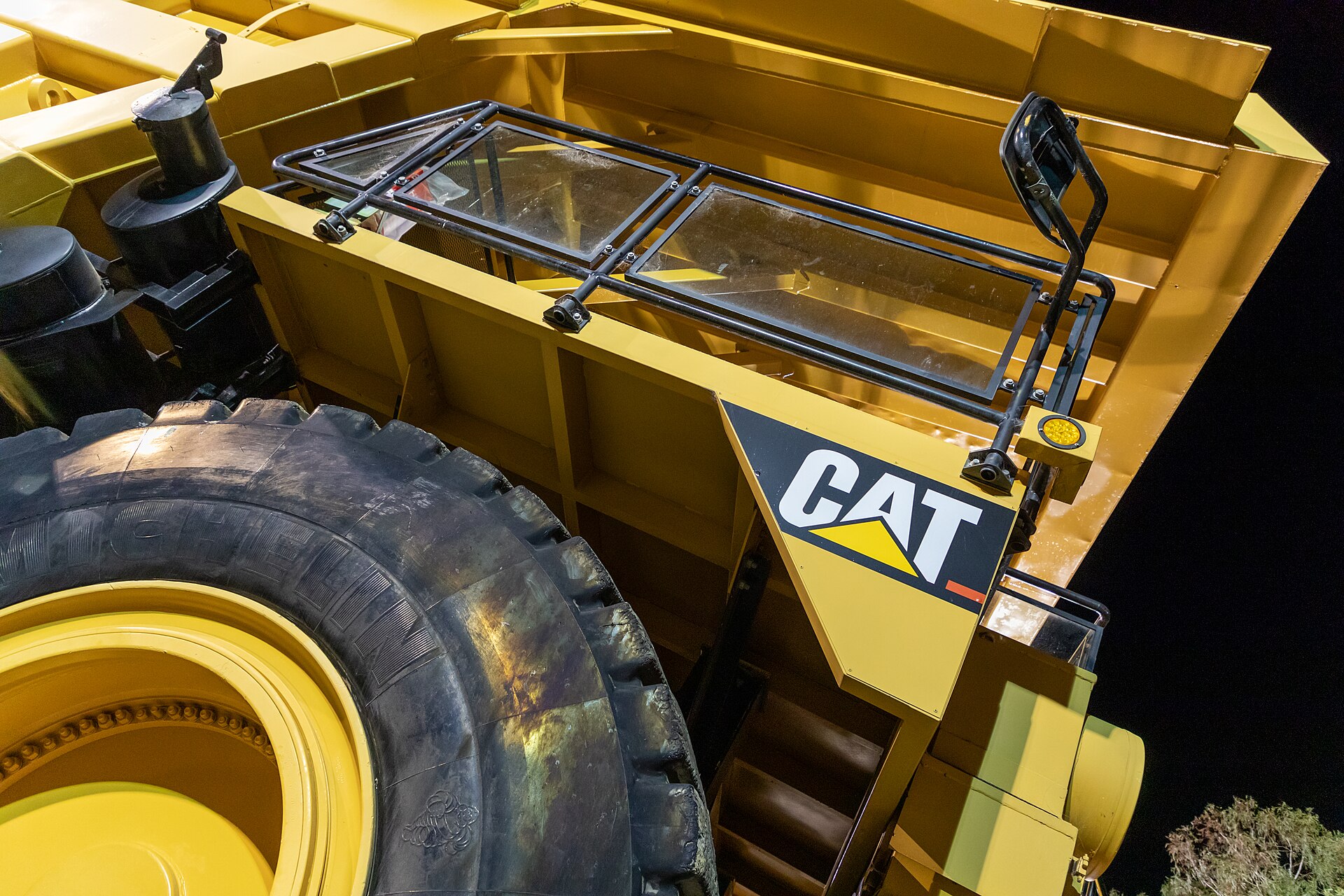
Also in November 2022, Caterpillar demonstrated a prototype battery-electric version of its 793 haul truck, called the Caterpillar 793 Electric, at its Tucson Proving Ground in Arizona. The 793 Electric is in the 240-short-ton (218-tonne) payload class. Caterpillar showed the truck to customers but has not released a commercial production date.
The Shared Engineering Challenge
Komatsu, the third major manufacturer, is also developing a battery-electric haul truck in this class. All three manufacturers face the same challenge: building a pack large enough to move 200-plus tonnes of rock up a mine ramp, then recharging it quickly enough to keep the mine productive.
Why Regenerative Braking Matters in Extreme-Duty EVs
The efficiency case for massive electric haul trucks rests almost entirely on regenerative braking. A typical mining haul truck carries a full load up a steep ramp out of a pit, then descends empty. That is the opposite of the eDumper's profile, which hauls material downhill and returns empty uphill. But in both cases, the ability to capture energy during braking or descent is critical. In a diesel truck, that energy is lost as heat. In an electric truck, the motor becomes a generator, feeding current back into the pack.
For the eDumper, the energy captured on the downhill run exceeds the energy needed for the uphill return. For a truck operating in a conventional pit mine, where the loaded trip is uphill, regenerative braking on the empty descent still recovers a substantial fraction of the energy spent on the climb. The net effect is that battery-electric haul trucks can achieve energy savings of 30 to 50 percent compared with diesel equivalents, depending on the mine layout. That translates directly into lower fuel costs and reduced carbon emissions, which is why Fortescue, Caterpillar, and Komatsu are investing heavily in the technology.
The Ellen: Largest Electric Ferry
Outside the mining sector, the title of largest electric vehicle shifts to different categories. The world's largest electric ferry, the Ellen, entered service in Denmark in August 2019. It has a 4.3 MWh pack, which is more than seven times the capacity of the eDumper's 600 kWh unit. The Ellen can carry 200 passengers and 30 cars, with a range of 22 nautical miles. It operates on a route between the islands of Ærø and Als in southern Denmark.
The Ellen's battery is charged at each port during the 10-minute turnaround. The charging infrastructure includes a shore-side connection rated at 4.4 MW, one of the highest-power charging systems deployed for any electric vehicle as of 2019. The ferry's electric drivetrain replaced a diesel-powered vessel, cutting CO2 emissions by an estimated 2,000 tonnes per year.
While the Ellen is far lighter than the mining trucks, its energy storage and physical size make it a contender for the biggest EV by battery capacity and passenger capacity.

Eviation Alice: Largest Electric Aircraft
The largest electric aircraft to fly as of 2023 is the Eviation Alice, a nine-passenger commuter plane that completed its maiden flight on September 27, 2022, at Moses Lake, Washington. The Alice is a twin-engine, all-electric aircraft designed for short-haul regional routes. It has a range of approximately 250 nautical miles and a maximum takeoff weight of around 7 tonnes. That is a fraction of the weight of the mining trucks or the Ellen ferry, but the Alice represents a different engineering challenge: lifting a battery into the air and keeping it there.
The Alice is not yet in commercial service. Eviation has orders from several regional airlines, but certification and production timelines remain uncertain. The aircraft's pack capacity has not been publicly specified, but it is substantially smaller than the Ellen's 4.3 MWh unit. The Alice matters because it demonstrates that battery-electric propulsion can work for aviation, a sector where weight is the overriding constraint. The aircraft's success or failure will influence whether larger electric planes, including regional jets and short-haul airliners, are developed in the 2020s and 2030s.
What the Contest for Biggest EV Means
The fact that no single vehicle has been definitively crowned the biggest EV as of mid-2023 is itself revealing. The title is contested across categories, and multiple prototypes in the 240-tonne class are still in testing, not yet in full commercial production. The eDumper was a proof of concept that regenerative braking could make a heavy electric vehicle energy-positive on certain routes. The Fortescue and Caterpillar prototypes show that the technology can scale to the largest machines in the mining industry. The Ellen proves that high-capacity marine electrification is commercially viable. The Alice shows that aviation, the hardest sector to electrify, is making progress.
The economic driver behind all of these machines is the same: replacing diesel fuel with electricity reduces operating costs and emissions. For mining companies, haul trucks account for a large share of diesel consumption and greenhouse gas emissions. For ferry operators, electric propulsion eliminates exhaust and noise in populated harbors. For airlines, even a small electric commuter plane opens the possibility of zero-emission short-haul routes. The contest for the biggest EV is not a publicity stunt. It is a signal that battery-electric technology has crossed a threshold where it can compete with diesel in the most demanding industrial applications. The next few years will determine which manufacturer builds the first truly production-ready giant.
Key Facts
- eDumper empty weight: 45 tonnes
- eDumper loaded weight: 65 tonnes
- eDumper battery capacity: 600 kWh
- eDumper entered service: 2019
- Fortescue prototype payload: 240 tonnes
- Fortescue prototype first runs: April 2023
- Caterpillar 793 Electric payload: 240 short tons (218 tonnes)
- Caterpillar demonstration date: November 2022
- Ellen ferry battery capacity: 4.3 MWh
- Ellen ferry entered service: August 2019
- Eviation Alice maiden flight: September 27, 2022
Contenders for the Biggest Electric Vehicle
| Vehicle | Category | Weight/Payload | Battery Capacity | Year Entered Service or Tested |
|---|---|---|---|---|
| eDumper (Kuhn Schweiz) | Mining haul truck | 45 t empty, 65 t loaded | 600 kWh | 2019 |
| Fortescue/Liebherr prototype | Mining haul truck | 240 t payload | Not disclosed | 2022 (prototype) |
| Caterpillar 793 Electric | Mining haul truck | 218 t payload | Not disclosed | 2022 (prototype) |
| Ellen ferry | Electric ferry | 200 passengers, 30 cars | 4.3 MWh | August 2019 |
| Eviation Alice | Electric aircraft | 7 t MTOW, 9 passengers | Not disclosed | September 2022 (first flight) |
Frequently Asked Questions
What is the world's largest electric vehicle by weight?
As of mid-2023, the title is contested. The heaviest contenders are the Fortescue/Liebherr 240-tonne prototype haul truck and the Caterpillar 793 Electric, both in the 200-tonne-plus payload class. The eDumper, at 45 tonnes empty and 65 tonnes loaded, was the first widely publicized giant but is smaller than these newer prototypes.
How does regenerative braking work in heavy electric vehicles?
When the vehicle descends a grade or brakes, the electric motor acts as a generator, converting kinetic energy into electrical energy and storing it in the battery. In the eDumper, which hauls material downhill, this captured energy exceeds the energy needed for the uphill return, making the truck energy-positive on each cycle.
What is the battery capacity of the largest electric ferry?
The Ellen, which entered service in Denmark in August 2019, has a 4.3 MWh battery pack, more than seven times the capacity of the eDumper's 600 kWh pack.
Has any electric aircraft flown with passengers?
The Eviation Alice, a nine-passenger commuter plane, completed its maiden flight on September 27, 2022, at Moses Lake, Washington. It is not yet in commercial service.
Why are mining companies building electric haul trucks?
Mining companies like Fortescue Metals Group are targeting net-zero operational emissions by 2030. Electric haul trucks reduce diesel consumption and greenhouse gas emissions, and regenerative braking can cut energy use by 30 to 50 percent compared with diesel equivalents.