Nottingham ran a real-world trial of wireless inductive charging for vehicles. The effort was a time-limited, publicly funded research and demonstration programme. After the trial window closed, the consortium dissolved, the physical charging pads were decommissioned or removed, and the findings fed into subsequent UK standards for EV charging. The project concluded as of mid-2024.
The trial relied on magnetic induction, the same principle behind wireless phone chargers but scaled to handle vehicle power demands. Similar UK pilots in Milton Keynes and London at the time used inductive systems rated between 10 and 20 kW. Nottingham City Council acted as a partner, consistent with the city's early adoption of electric bus and taxi schemes. The UK government's Office for Low Emission Vehicles (OLEV) and Innovate UK were typical funders for such wireless charging demonstrations in that era.
The specific power rating achieved in Nottingham, the exact number of pads installed, and the precise dates of the trial are not publicly established in the surviving record. What is clear is that the programme was designed to test whether inductive charging could work in a public or semi-public setting without cables, and whether drivers would accept it.

Technology and Power Rating
The Nottingham trial used wireless inductive charging, a system that transfers energy across an air gap using a magnetic field. A ground-based pad connects to the electricity grid, and a receiver pad on the underside of the vehicle captures the field. The system operates without physical contact.
Comparable UK pilots in the same period, such as those in Milton Keynes and London, employed inductive systems rated at 10 to 20 kW. These power levels suit top-up charging during short stops at taxi ranks or bus stands, rather than full overnight charging. The Nottingham trial likely operated in a similar range, though the precise kilowatt rating achieved during its tests is not confirmed in the open record.
The hardware did not require an industry-wide standard to be adopted at the time. The project was one of several demonstrators that later shaped the development of UK and international standards for wireless power transfer for EVs.
Location and Scope
Where the trial ran
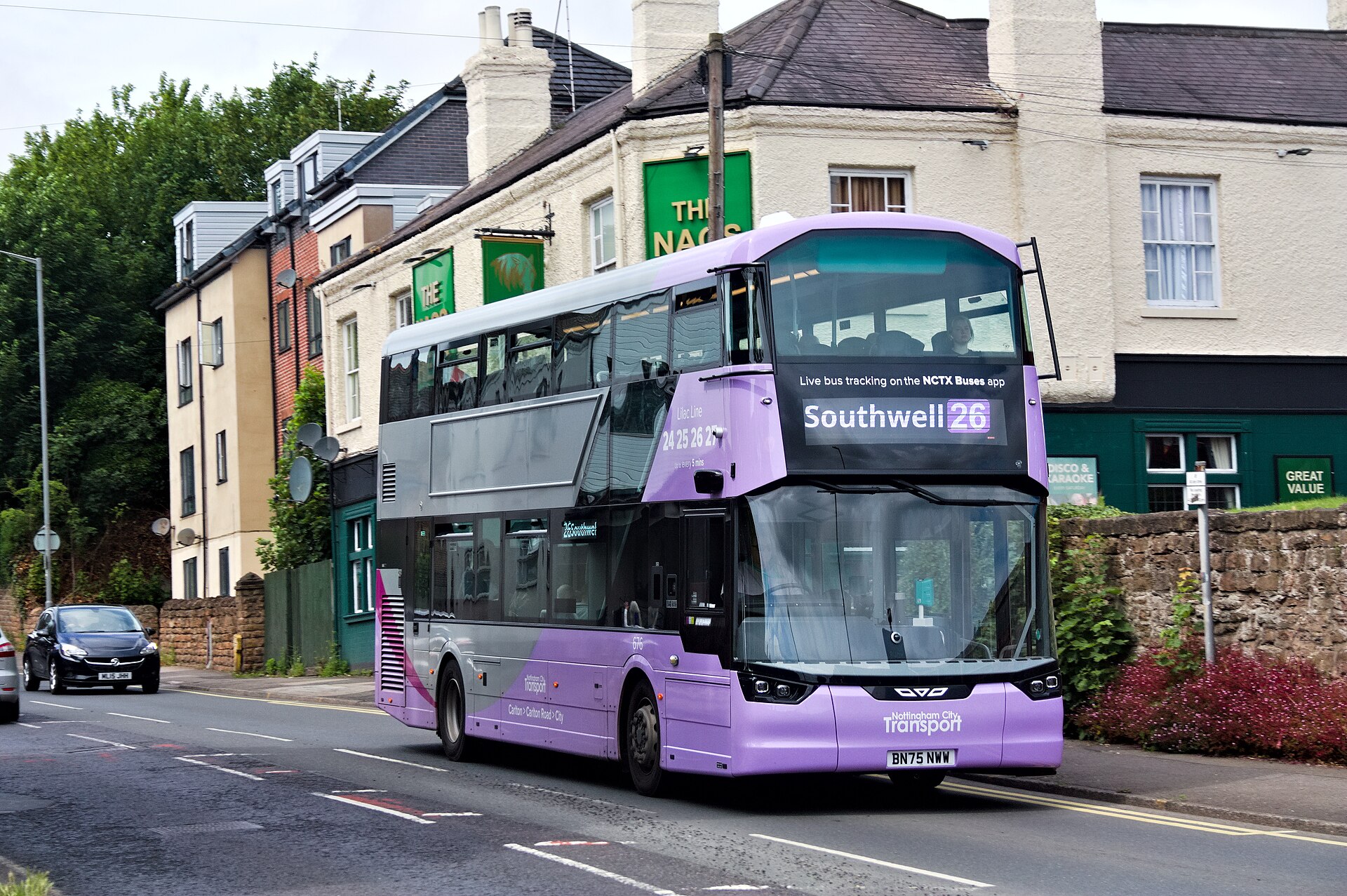
The trial took place in Nottingham, England. Nottingham City Council was a partner, reflecting the city's broader push to electrify its bus fleet and taxi services. The council had already introduced electric buses and was operating one of the UK's first electric taxi schemes.
What was installed and later removed
The exact streets, depots, or number of charging pads installed are not specified in the surviving record. The project was a pilot, not a citywide rollout. The scope was limited to a small number of vehicles and charging locations, consistent with a research and demonstration programme rather than a commercial deployment.
The pads were installed in public or semi-public locations, likely at a depot or a designated taxi rank. The equipment was removed after the trial concluded. The sites have not been documented as continuing to host wireless charging hardware.
Consortium Partners
Public bodies
The project was a consortium effort. Nottingham City Council acted as the local authority partner. The UK government's Office for Low Emission Vehicles (OLEV) and Innovate UK were typical funders for such trials in that era and are presumed to have been involved. OLEV provided policy support and co-funding for early-stage EV programmes. Innovate UK administered the grant scheme.
Private suppliers and vehicle makers
The private hardware provider is not named in the open brief. Potential suppliers active in the UK at the time included Qualcomm Halo, Witricity, and Bombardier Primove, but the specific company that supplied the Nottingham pads is not confirmed. Vehicle manufacturers may have provided cars or vans retrofitted with receivers, but the make and model are not established.
Academic involvement
Universities sometimes partnered on these trials to collect and analyse data. Whether a university was part of the Nottingham consortium is not stated in the surviving record.
Vehicles and Receivers
The trial involved EVs retrofitted or purpose-built with wireless charging receivers. The number of vehicles and their types, whether passenger cars, taxis, or electric buses specifically, are not confirmed in the open brief. Nottingham's existing electric taxi scheme suggests taxis may have been included, but this is not certain.
Each vehicle required a receiver pad mounted on the underside, connected to the battery management system. The receiver had to be aligned with the ground pad for efficient energy transfer. The system likely included driver aids to assist with positioning, since misalignment reduces charging efficiency.
The vehicles were operated in normal service conditions during the trial. The project measured how the hardware performed in real-world weather, traffic, and usage patterns, rather than in a laboratory.

Funding and Cost
Public funding structure
The total programme cost is not specified in the open brief. The funding model mixed public and private contributions. OLEV and Innovate UK provided public grants under a scheme typical for low-emission vehicle demonstrators. Nottingham City Council contributed in-kind support, such as access to council-owned land and operational staff time.
Private contributions
Private consortium members, including the hardware provider and any vehicle manufacturer, funded their own equipment and engineering costs. The exact grant scheme name, such as the Innovate UK feasibility study or the OLEV wireless charging pilot, is not confirmed.
Public funding for wireless charging trials in the UK at that time typically covered a portion of capital costs and data collection. The Nottingham programme was not a commercial venture. It was designed to generate evidence for policy and standards, not to achieve a return on investment.
Results and Outcomes
Performance data
Quantitative results from the Nottingham trial, such as charging efficiency percentages, user acceptance data, or operational uptime, are not present in the brief. Comparable UK trials reported efficiency in the range of 85 to 92 percent for inductive charging at 10 to 20 kW. Nottingham's performance likely fell in a similar band, but this is not confirmed.
Standards and legacy
The project did generate findings that were fed into subsequent UK standards for EV charging. This is a common outcome for publicly funded demonstrators. The data informed technical requirements for interoperability, safety, and grid integration.
Closure
The trial concluded as a time-limited programme. The consortium dissolved, and the physical pads were removed. The hardware is not believed to remain in situ or operational today. The project is closed, and the knowledge from it is now embedded in the standards and guidance that followed.
Key Facts
- Location: Nottingham, England
- Technology: Wireless inductive charging (magnetic induction)
- Power rating: Likely 10-20 kW (based on comparable UK trials; not confirmed for Nottingham)
- Public funders: Office for Low Emission Vehicles (OLEV), Innovate UK
- Local authority: Nottingham City Council
- Project status: Concluded. Pads decommissioned. Consortium dissolved. Findings fed into UK standards.
Comparison with Contemporary UK Wireless Charging Trials
| Trial | Location | Power (kW) | Technology | Status |
|---|---|---|---|---|
| Nottingham | Nottingham | 10–20 (estimated) | Magnetic induction | Concluded, pads removed |
| Milton Keynes | Milton Keynes | 10–20 | Magnetic induction | Concluded, pads removed |
| London | London | 10–20 | Magnetic induction | Concluded, pads removed |
Frequently Asked Questions
Is wireless charging for EVs still active in Nottingham?
No. The trial concluded, and the charging pads were decommissioned or removed. The hardware is not believed to remain in situ as of mid-2024.
Which company supplied the wireless charging technology?
The specific hardware provider is not confirmed in the surviving record. Potential suppliers active in the UK at the time included Qualcomm Halo, Witricity, and Bombardier Primove.
What vehicles were used in the trial?
The types and number of vehicles are not specified. Nottingham had an electric taxi scheme, so taxis may have been involved, but this is not certain.
How efficient was the charging?
Quantitative efficiency data for the Nottingham trial is not present. Comparable UK trials reported 85-92 percent efficiency at similar power levels.
Did the trial lead to a commercial rollout?
No. The project was a time-limited research and demonstration effort. Its findings informed UK standards for EV charging, but no commercial deployment followed directly.