Businessbusiness

Wimbledon 2019: 8 Sponsors, No Title Partner

Details on every major sponsor of The Championships 2019, from Slazenger and Rolex to HSBC and Jaguar Land Rover, plus the commercial strategy behind Wimbledon's no-title-sponsor model.
wimbledon-2019-sponsors

The 2019 Wimbledon Championships ran from 1 July to 14 July and ended with Novak Djokovic and Simona Halep claiming the singles titles. Beneath the tennis, a compact set of long-term sponsorship agreements operated with no single title backer and almost no in-play advertising. The All England Lawn Tennis Club (AELTC) stuck to its model of a small group of partners and suppliers, many of which had held their roles for decades.

Slazenger supplied the match balls for the 117th consecutive year. Rolex had been the timekeeper since 1978. Robinsons, the British squash brand, had provided the soft drink since 1935. IBM had served as the information technology supplier for more than 30 years. These were not annual deals. They were multi-decade relationships that a rival property could not replicate. The only numbers the AELTC disclosed publicly were prize money, which reached 38 million pounds for the 2019 event.

Because Wimbledon sells neither a title sponsorship nor perimeter advertising on Centre Court, the value of the deals lay in exclusivity and brand association rather than impressions from a logo rotation. What follows identifies every major 2019 backer, explains what each provided, and describes how the AELTC balanced tradition with commercial revenue.

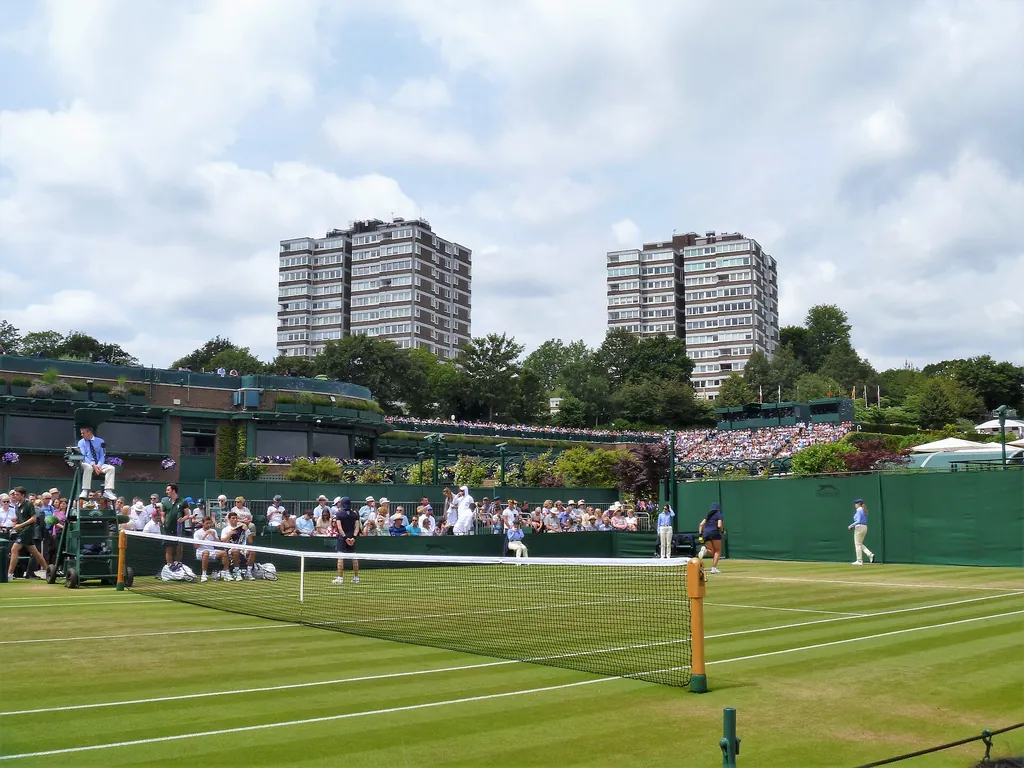
Wimbledon Centre Court 2019
Ethan.cane, Wikimedia Commons, CC BY-SA 4.0

Partners and Suppliers: Two Distinct Tiers

The top tier

The AELTC divides its commercial relationships into two tiers. The highest in 2019 comprised Slazenger, Rolex, IBM, Lanson, Evian, Lavazza, and Stella Artois. Each paid a fee and also provided product or services directly to the grounds. HSBC was the banking partner. Jaguar Land Rover served as the car provider, supplying a fleet of vehicles for player transport.

The lower tier

Suppliers provided goods or services but carried narrower branding rights. A partner's logo appeared on programmes, the tournament website, and some physical signage around the grounds. A supplier received less prominent placement. Neither tier, however, appeared on the court itself. The AELTC has enforced a policy since the 1990s that no advertising hoardings may be placed on Centre Court or No. 1 Court during play. Sponsors accepted that their branding would be visible only in concourses, catering areas, and digital channels. The trade-off was that Wimbledon's refusal to sell its playing surface as ad space made every logo that did appear feel deliberate rather than intrusive.

Slazenger and Rolex: The Two Pillars

Slazenger's century-plus run

Slazenger's relationship with Wimbledon is the longest-running sporting-goods partnership in history. The company became the ball supplier in 1902. For the 2019 event, Slazenger supplied tens of thousands of tennis balls, each stored in chilled conditions before use to maintain pressure. The contract was not rebid every few years. Both parties treated it as a permanent arrangement, and the AELTC had never invited other ball manufacturers to tender. The fee was not disclosed, but the value to Slazenger lay in the global broadcast exposure of the Wimbledon brand rather than a cash payment from the club.

Rolex on the clocks

Rolex has been the timekeeper since 1978. The Swiss watchmaker placed clocks on Centre Court, the scoreboards, and the clock tower above the main entrance. Unlike Slazenger, Rolex also ran an advertising campaign during the fortnight that promoted its association with Wimbledon separately. Rolex was one of the few backers that used its Wimbledon status in consumer marketing beyond the event itself. The company did not disclose its annual fee, and the AELTC released no total sponsorship revenue figure for 2019. Analysts have estimated that Rolex's partnerships across tennis, golf, and motorsport cost it tens of millions of dollars a year, but no figure specific to Wimbledon exists in public records.

The 2019 Lineup: Drinks, Cars, and Banking

Pouring and serving

Lanson supplied the champagne for the champions' presentation on Centre Court. Evian provided still and sparkling water for players and officials. Lavazza supplied coffee throughout the grounds, including the players' lounge and the media centre. Stella Artois was the beer, sold in the bars and hospitality areas but never shown on screen during play. These four brands were categorized in the top tier alongside Slazenger, Rolex, and IBM. None of them had on-court signage. Their logos appeared on cups, napkins, and the back of ticket stubs.

Money and movement

HSBC, the banking partner, operated a temporary branch on site and offered currency exchange services to international visitors. Jaguar Land Rover, the car provider, supplied a fleet that included plug-in hybrid models, a nod to the tournament's sustainability goals. The cars transported players between their hotels and the club. Both HSBC and Jaguar Land Rover had branded zones in the grounds, but those zones sat near the entrances rather than the show courts. The AELTC's reasoning was that spectators who wanted to see the backers could do so, but the tennis itself remained free of commercial interruption.

Rolex clock Wimbledon
Ypsilon from Finland, Wikimedia Commons, CC0

Where Branding Actually Appeared

Scoreboards and screens

Because the AELTC banned on-court advertising hoardings, backers had to find different ways to achieve visibility. The most prominent placement was the scoreboard. IBM supplied the digital infrastructure that powered the live scoring, the app, and the website. IBM's logo appeared on the digital scoreboards around the grounds and on the tournament's digital platforms. Rolex's clocks were visible on the same scoreboards and on the physical clock tower. Slazenger's logo appeared on the ball tubes and on the net tape.

Concourses and cups

Physical signage was limited to the outer concourses, the walkways between courts, and the hospitality areas. The AELTC kept logo sizes small and uniform to avoid a cluttered look. No banners hung from the stadium roofs or draped over the court-side seating. This approach meant that a television viewer watching the match broadcast saw almost no branding during a rally. The trade-off, from the backer's perspective, was that the few logos that did appear had higher recall. An Evian bottle on the umpire's chair or a Lanson bottle in the winner's hands carried more weight than a rotating digital hoarding.

The Economic Case for Fewer Backers

Scarcity as strategy

Most major sports events sell a single title backer and a ring of perimeter boards. Wimbledon does neither. The AELTC's commercial strategy is built on scarcity. By limiting the number of relationships and refusing to sell court-side space, it creates an environment where each association is more exclusive. A company that signs a five-year deal with Wimbledon knows that no competitor will appear in the same category for the duration of the contract. Category exclusivity was written into every 2019 agreement. Evian had the exclusive water rights. Lavazza had the coffee rights. Robinsons had the soft drink rights. Stella Artois had the beer rights.

Revenue without a title deal

The AELTC does not disclose its total commercial revenue, but the 2019 event generated total income from ticketing, broadcast rights, and partnerships that funded 38 million pounds in prize money. The club's financial reports, filed at Companies House, showed that commercial relationships accounted for a significant but undisclosed share of that income. The approach is defended by the AELTC's commercial director, who has said publicly that the club is more interested in the quality of the relationship than the quantity of logos on site. The absence of a title backer is not a gap in revenue. It is a deliberate choice to preserve the visual tone of the fortnight.

Audience Reach and the Post-2019 Outcome

Global eyeballs, minimal logos

The estimated global television audience for the 2019 Wimbledon fortnight was more than 1 billion viewers, counting cumulative reach across broadcast and digital platforms. That audience saw no logos during rallies, but they did see the Rolex clock between games, the IBM scoreboard, and the Slazenger stencil on the grass at each changeover. For the backers, the value proposition was association with an event perceived as traditional, prestigious, and commercially restrained. The AELTC marketed that restraint as a premium.

Carrying forward

The 2019 event concluded on 14 July. All agreements were fulfilled as contracted. Most major backers, including Rolex, Slazenger, and IBM, retained their roles in subsequent years. The 2020 Championships were canceled due to the COVID-19 pandemic, the first cancellation since World War II. That forced the AELTC to negotiate contract extensions and activation deferrals with its partners. The club maintained its relationship with the same core group through the disruption. No new major backer was announced for 2019. The lineup remained the same as in 2018, and it carried over largely unchanged into 2021.

About the author

, Editor

Kenneth Ma is the editor of LeadMonitor.ai, covering the companies, deals and policy decisions shaping business and technology markets.

View all 427 articles by Kenneth Ma  ·  Our editorial policy

Recent Stories

How to make money selling Canva templates

How to highlight text in Canva

How to print from Canva without quality loss

How to check if Canva is down right now

How to group and ungroup elements in Canva

How to stretch an image in Canva

How to make a QR code in Canva

Convert Canva to PowerPoint and Google Slides