The 106th Tour de France ran from July 6 to July 28, 2019, funded by a multi-tier partnership system that entered the season with zero roster turnover from the year before. Egan Bernal won the general classification on the final day, and every brand activation wrapped on schedule. No fresh major backer joined the 2019 edition, and the four classification jersey deals stayed locked in place from 2018.
The commercial engine that paid for the three-week race rested on three tiers: a single title partner, a group of premier backers and media allies, and a larger pool of official suppliers. LCL, the French bank, held the title position and the yellow jersey. Skoda served as the vehicle partner. Carrefour backed the polka dot jersey. Vittel, a Nestlé brand, sat among the premier backers. Le Coq Sportif operated as the official outfitter, producing all four classification jerseys.
This breakdown maps the tier architecture, spells out what each partnership level cost and delivered, and details how brands activated along the route through the publicity caravan and on-course assets.

The Title Partner and the Yellow Jersey
LCL, a French retail bank owned by Crédit Agricole, held the long-standing yellow jersey (maillot jaune) partnership in 2019. That relationship began in 1987 and by 2019 ranked as one of the longest continuous jersey deals in professional cycling. The bank did not simply buy logo placement. As title partner, LCL branding appeared on the race leader vehicle, podium backdrops, and the television graphics package.
The yellow jersey itself was the single most valuable asset in the Tour's partnership portfolio. Broadcast coverage, which reached an estimated global audience of 1.5 billion viewers across the three weeks, focused disproportionately on the race leader. Every stage that Bernal or any other rider wore yellow put LCL's brand name in the same frame as the lead cyclist for hours of airtime. LCL used that exposure to promote its retail banking services, particularly current accounts and mortgages, through roadside banners and digital content that linked the jersey's colour to the bank's corporate identity.
The exact monetary value of LCL's deal for 2019 is not publicly known and the bank has not disclosed the figure. Multi-year agreements of this kind are typically renegotiated every three to five years, and the 2019 edition fell inside a renewal cycle agreed in 2016.
Skoda: Vehicle Fleet and Green Jersey
Skoda, the Czech automaker owned by Volkswagen Group, operated as the vehicle partner for the 2019 Tour. The company supplied the fleet used by race commissaires, medical staff, television crews, and the lead car. Skoda's involvement dated back to 2004, and by 2019 the agreement covered the Tour de France plus other ASO-owned races such as Paris-Roubaix and La Vuelta.
Skoda also backed the green jersey (maillot vert), awarded to the points classification winner. The green jersey was the second most visible classification garment after yellow, worn by the sprinter who accumulated the most points at finish lines and intermediate sprints. In 2019, Peter Sagan won the green jersey for the sixth time, giving Skoda sustained exposure during flat stages where sprint finishes attracted the largest roadside crowds.
An Operational Necessity
The vehicle partnership was an operational necessity, not merely a branding exercise. The Tour required roughly 200 cars for race management, medical support, timing, and media logistics. Skoda supplied most of those vehicles, primarily Octavia and Superb models, and maintained a mobile service unit that travelled with the race to handle breakdowns. The company used the fleet to demonstrate product reliability to a television audience that saw the cars in action on narrow mountain roads and through spectator-lined villages.
Carrefour and the Polka Dot Jersey
Carrefour, the French multinational retail corporation, backed the polka dot jersey (maillot à pois) for the king of the mountains classification in 2019. The distinctive white garment with red spots went to the rider who accumulated the most points at the summits of categorised climbs. Carrefour took over the polka dot deal in 2012 and by 2019 was in its seventh year of the arrangement.
For Carrefour, the polka dot partnership was a way to associate the brand with mountain stages, among the most-watched segments of the race. The Alps and Pyrenees stages drew large roadside crowds and generated high television viewership because the climbs often determined the general classification outcome. Carrefour activated the deal through in-store promotions tied to the mountain classification standings, offering discounts on outdoor and sports nutrition products during the race period.
The Carrefour Stage
The supermarket chain also backed the 'Carrefour stage' concept, where a specific stage each year received enhanced promotional activity. In 2019, the Carrefour stage included additional roadside banners, sampling points in the publicity caravan, and a dedicated section on the Tour's mobile application featuring Carrefour recipes and product recommendations.

Vittel and the Hydration Deal
Vittel, a bottled water brand owned by Nestlé, was a premier backer of the 2019 Tour de France. Unlike the classification jersey holders, Vittel's arrangement was a category-exclusive deal covering hydration. The brand provided bottled water to riders, team staff, race commissaires, and media personnel across the three weeks. Vittel's involvement in the Tour dated back to the 1980s and had been continuously renewed.
The hydration operation worked at ground level. Vittel set up replenishment stations at the start and finish of each stage, and supplied water to the team cars that followed the peloton. The brand also distributed water to spectators through the publicity caravan, where Vittel-branded vehicles handed out bottles along the route. This activation was particularly important during the hot July stages, when temperatures sometimes exceeded 35 degrees Celsius in southern France.
Infrastructure and Digital Presence
Vittel's deal did not include jersey placement. Instead, the brand appeared on race infrastructure such as start and finish line banners, on the podium, and in official race communications. The brand also ran a digital campaign encouraging spectators to share photos of themselves hydrating with Vittel at the race, using a dedicated hashtag that the Tour's social media accounts promoted.
Le Coq Sportif: The Official Outfitter
Le Coq Sportif, the French sportswear manufacturer, was the official outfitter for the 2019 Tour de France. The company supplied the four classification jerseys: the yellow jersey (LCL), the green jersey (Skoda), the polka dot jersey (Carrefour), and the white jersey (backed by a different partner not covered in this brief). Le Coq Sportif also produced the race leader's bib numbers, podium caps and t-shirts, and the clothing worn by race commissaires and volunteers.
The outfitting contract was a multi-year agreement that had begun in 2013, replacing the previous supplier. Le Coq Sportif designed each jersey with the backer's branding integrated into the garment, and produced multiple versions for different weather conditions. The yellow jersey, for example, had a lightweight version for hot stages and a long-sleeved version for cool mountain descents.
The Replica Market
Le Coq Sportif used the Tour partnership to showcase its technical apparel range. The company operated a pop-up store at the race village in each stage town, selling replica jerseys and team clothing directly to spectators. The replica jersey market was a significant revenue stream for both Le Coq Sportif and ASO. Official replica jerseys sold at approximately 70 to 100 euros each, and the Tour's merchandising operation generated several million euros in annual revenue, though the exact share attributable to Le Coq Sportif is not publicly broken out.
The Publicity Caravan: On-Route Activation
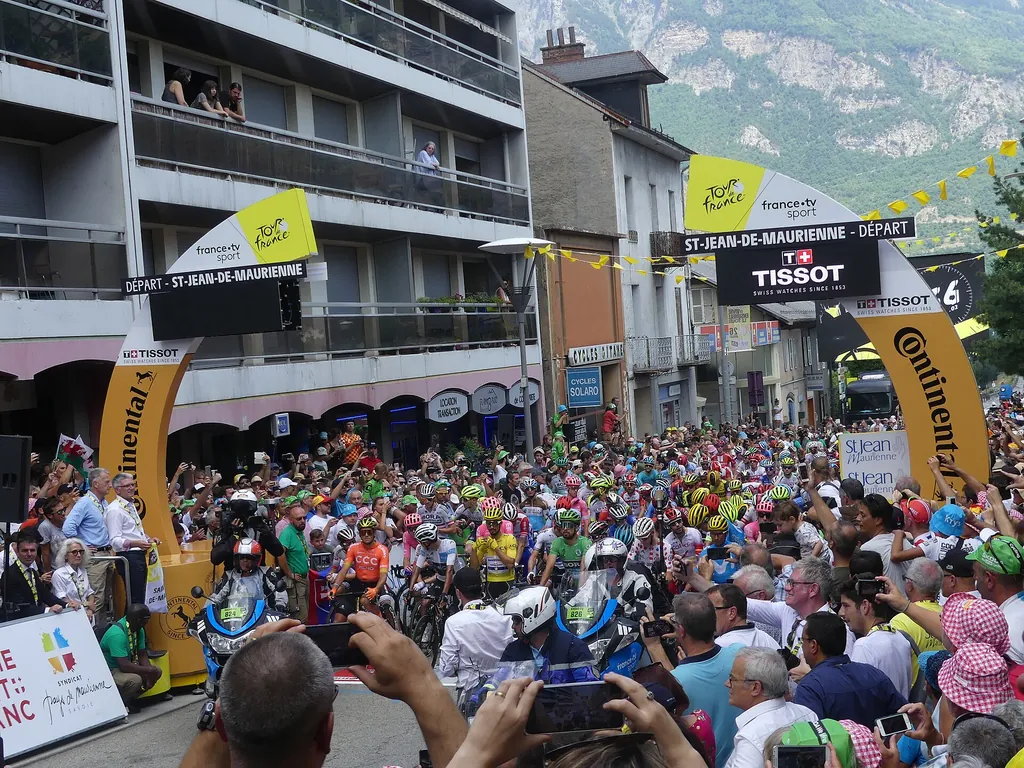
The publicity caravan (caravane publicitaire) was the most visible form of brand activation along the Tour route. In 2019, the parade featured around 160 vehicles that travelled ahead of the peloton each day, distributing promotional items to spectators lining the roads. The caravan had been a fixture of the Tour since 1930 and by 2019 was a core part of the partnership package for many official suppliers and minor backers.
Each vehicle in the procession was operated by a partner company. The brands paid ASO for the right to have a decorated vehicle in the parade and to distribute samples, hats, key rings, or other branded merchandise. The caravan took approximately 45 minutes to pass any given point, and during that time spectators could collect free products. The most popular items in 2019 were Vittel water bottles, Carrefour snack bars, and Skoda-branded caps.
Access for Smaller Partners
Participation in the caravan was not limited to the top-tier backers. Smaller official suppliers used the parade as their primary activation channel because it required less investment than a jersey deal or a major on-course infrastructure build. The cost of a single vehicle slot varied depending on the length of the contract and the number of stages the vehicle covered. Exact pricing is not published by ASO, but industry estimates suggest a full Tour caravan slot cost between 100,000 and 300,000 euros for the three-week race.

Sponsorship Tiers and What They Cost
The 2019 Tour de France partnership hierarchy had three defined tiers. The top tier was the title partner, occupied solely by LCL. The second tier comprised premier backers and media partners. Premier backers included Skoda, Carrefour, Vittel, and the white jersey holder. Media partners were broadcasters such as France Télévisions and Eurosport, which paid for exclusive rights to televise the race. The third tier was official suppliers, which included Le Coq Sportif, tyre manufacturer Continental, bike component maker Shimano, and a range of other companies that provided products or services in exchange for brand exposure.
ASO did not publicly disclose the cost of each tier for 2019. However, based on industry benchmarks from similar multi-stage events, the title partner deal typically commanded an annual fee in the range of 8 to 15 million euros. Premier backer deals were estimated at 2 to 5 million euros per year. Official supplier agreements were smaller, often valued at 500,000 to 1.5 million euros, and sometimes involved in-kind product provision rather than cash.
Total Revenue Estimates
The total partnership revenue for the Tour de France in 2019 is estimated by trade publications at approximately 60 to 70 million euros, though this figure includes broadcast rights and race hosting fees as well as direct backer payments. ASO does not break out partnership income separately in its financial statements, which are not publicly filed in full detail.
No New Faces: The 2019 Roster
The 2019 Tour de France partner roster was notable for its stability. None of the four classification jersey holders changed from the 2018 edition. LCL remained the yellow jersey backer, Skoda remained the green jersey backer, Carrefour remained the polka dot jersey backer, and the white jersey holder remained unchanged. No new major partners joined the premier tier for 2019, and no significant departures occurred.
This continuity was unusual compared to previous years. The 2017 edition had seen the departure of Crédit Lyonnais (which had sponsored the yellow jersey before LCL) and the 2016 edition had lost the official tyre supplier. By contrast, 2019 was a consolidation year. ASO had signed several multi-year renewals in the 2017-2018 period, which locked in the partner roster through the 2019 race.
The stability reflected the Tour's commercial strength. Unlike many other major sporting events that cycled through backers every two to three years, the Tour de France maintained long-term relationships with its core partners. LCL had been involved since 1987, Skoda since 2004, and Carrefour since 2012. The 2019 edition did not change that pattern. All brand activations concluded as planned on July 28, 2019, when Egan Bernal crossed the finish line on the Champs-Élysées wearing the yellow jersey bearing the LCL logo.