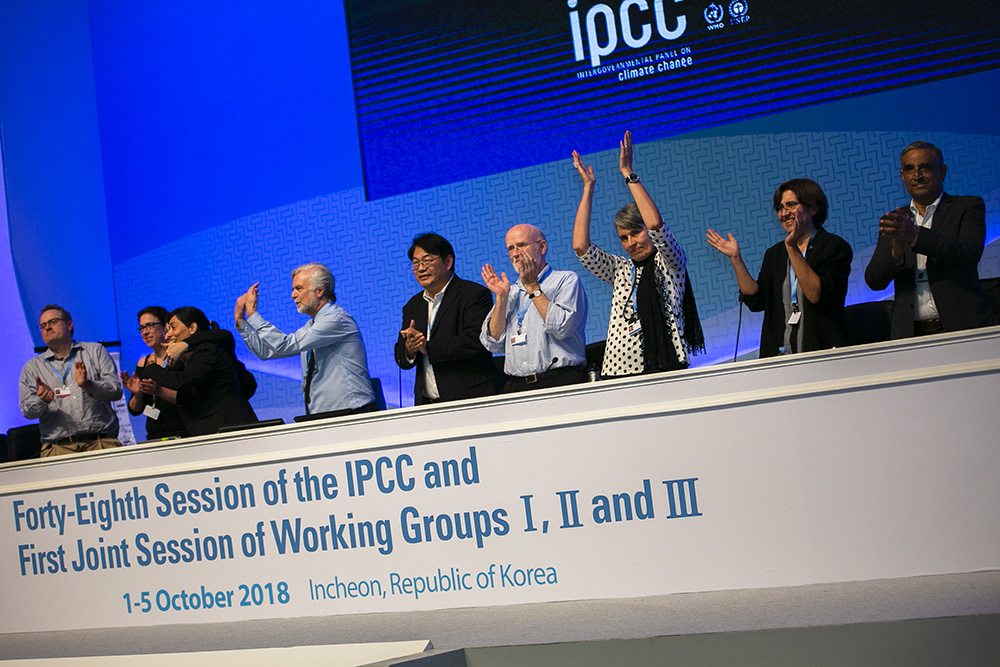
The Paris Agreement, adopted in December 2015, set a goal to hold global average temperature increase to well below 2°C above pre-industrial levels and to pursue efforts to limit it to 1.5°C. That 1.5°C figure was not pulled from a model. It came from a political process that weighed the sharply different risks between 1.5°C and 2°C of heating. The IPCC Special Report on Global Warming of 1.5°C, published in October 2018, made the case explicit: at 2°C, virtually all warm-water coral reefs vanish, crop yields in tropical regions drop further, and several hundred million more people face extreme heat than at 1.5°C.
The report also produced a hard number. As of the start of 2018, the remaining carbon budget for a 66% chance of staying below 1.5°C was roughly 420 gigatonnes of CO2. At the time, human activity released about 42 GtCO2 each year. That arithmetic gave the budget roughly a decade at current rates. By 2023, the World Meteorological Organization confirmed the global average near-surface temperature had already reached 1.45°C above pre-industrial levels. The budget has shrunk further since 2018, and annual pollution has not fallen fast enough to extend it.
The question of whether the 1.5°C target is still alive depends on what "alive" means. The planet has not yet permanently exceeded 1.5°C; a single warm year does not breach the long-term average. But the margin is thin, and the trajectory of greenhouse gases does not align with the pathway the IPCC described in 2018.
What the IPCC Report Said About the Energy Transition
The speed required
The IPCC Special Report concluded that limiting heating to 1.5°C requires global net human-caused CO2 to fall about 45% from 2010 levels by 2030 and reach net zero around 2050. That translates into rapid, economy-wide changes, with the energy sector at the center.
Power, transport, industry
Electricity generation must shift to near-zero carbon sources by mid-century. Transport, industry, and buildings need to electrify where possible and switch to low-carbon fuels elsewhere. In the power sector, the report modeled a tripling of solar and wind capacity by 2030 relative to 2015 levels, with coal-fired generation dropping roughly two-thirds over the same period. Gas-fired power without carbon capture would play a much smaller role. For transport, the shift means electric vehicles dominating new sales by the early 2030s in most pathways. Industry faces a harder problem: cement, steel, and chemicals require high-temperature heat or chemical reactions that resist electrification, so hydrogen and point-source CO2 collection become necessary.
Political reality check
The first global stocktake under the Paris Agreement, concluded at COP28 in Dubai in December 2023, formally called for transitioning away from fossil fuels and tripling renewable capacity by 2030. That language marked a political milestone. The stocktake also acknowledged that existing national pledges fall short of the 1.5°C pathway. The gap between what countries have committed in their Nationally Determined Contributions and what the IPCC says is required remains large, particularly for coal phase-down and methane reduction. Investment in fossil infrastructure continues, and some nations are expanding coal and gas capacity even as others retire it.
The Role of Carbon Removal in 1.5°C Pathways
The arithmetic of negative emissions
Nearly every IPCC model that limits heating to 1.5°C relies on some amount of atmospheric CO2 extraction, often called negative emissions. The reason is arithmetic: even with aggressive cuts, sectors like aviation, agriculture, and heavy industry are hard to decarbonize completely by 2050. Extracted CO2 offsets the residual releases. The report also noted that if cuts do not occur as fast as modeled, the required scale of extraction grows much larger, and the feasibility of deploying it at that scale becomes uncertain.
Methods and limitations
Technologies for drawing down carbon dioxide include afforestation, direct air capture with storage, bioenergy with carbon capture and storage, and enhanced weathering. None of these operate at the scale required in any 1.5°C scenario today. Direct air capture remains expensive. BECCS faces land-use competition with food production. The IPCC did not prescribe a specific mix but warned that banking on massive future removal is risky if the technologies do not scale or if storage proves less permanent than assumed.
Not a substitute
For policymakers, the implication is straightforward: removal complements deep cuts, it does not replace them. Every tonne that stays in the atmosphere today increases the extraction burden tomorrow. The remaining carbon budget is not a pool that can be refilled at will.
Sectors That Must Decarbonize Fastest
Electricity: move first, move fast
The IPCC report identified electricity generation as the sector that can and must decarbonize most quickly. It already has mature low-carbon alternatives: wind, solar, nuclear, and hydropower. Coal-fired power without CO2 controls is the single largest source of global carbon pollution, and retiring existing coal plants early is among the most effective actions available. The report modeled coal use falling roughly two-thirds by 2030 in 1.5°C pathways.
Transport: the slow-turnover problem
Transport is the second-largest source. It is the hardest to address in the short term because vehicle turnover is slow. Electric vehicles are now cost-competitive on a lifetime basis in many markets, but charging infrastructure and grid capacity lag. For heavy trucking, shipping, and aviation, electrification is not yet viable at scale. Alternative fuels such as hydrogen, ammonia, and sustainable biofuels become part of the picture. The 1.5°C pathways assume these sectors begin transitioning in the 2020s, not the 2040s.
Industry and buildings: the capex clock
Industry and buildings together account for a large share of final energy demand. In buildings, the priority is heat pumps, insulation, and efficient appliances. In industry, the challenge is process heat and chemical reactions. Steel can be made with hydrogen instead of coke; cement can be made with point-source capture. Both require long capital investment cycles, so decisions made in the next few years determine whether the 2050 target is reachable. Agriculture, too, remains a persistent source of methane and nitrous oxide that few national plans address with sufficient urgency.
Is the 1.5°C Target Still Achievable
The physical case
Geophysically, the target is not yet lost. The IPCC definition of exceeding 1.5°C refers to the global average temperature averaged over a multi-decade period, not a single year. Even though 2023 was the warmest year on record at 1.45°C above pre-industrial levels, one year does not constitute a breach. The planet could settle back below that level if emissions fall sharply and natural variability temporarily cools the climate. The remaining carbon budget is small but not zero.
The political gap
Politically and economically, the picture is more difficult. The distance between current national pledges and the 1.5°C pathway is large, and policy implementation has been slower than the models assume. The COP28 stocktake acknowledged the gap but imposed no binding obligations to close it. The next round of NDCs, due in 2025, will test whether countries are willing to accelerate.
Why the fraction still matters
For investors and operators, the relevant question is not if the target is technically alive but whether policy and market signals are strong enough to drive the required changes. The 1.5°C goal remains the reference point for most corporate net-zero commitments, for the EU's climate law, and for many national strategies. Even if the world temporarily overshoots 1.5°C, the effort to constrain heating still matters. Every fraction of a degree reduces physical risk. The alternative is not 1.6°C versus 1.5°C. It is 2°C or higher.
Key Facts
- Paris Agreement adoption: December 2015
- IPCC 1.5°C report published: October 2018
- Warming already observed by 2017: Approximately 1.0°C above pre-industrial levels
- Required CO2 reduction by 2030: About 45% below 2010 levels
- Net-zero CO2 target year: Around 2050
- Remaining carbon budget (start of 2018): Roughly 420 GtCO2 for 66% chance of 1.5°C
- 2023 global temperature anomaly: 1.45°C above pre-industrial levels (WMO)
- COP28 outcome: First global stocktake called for transition away from fossil fuels and tripling renewables by 2030